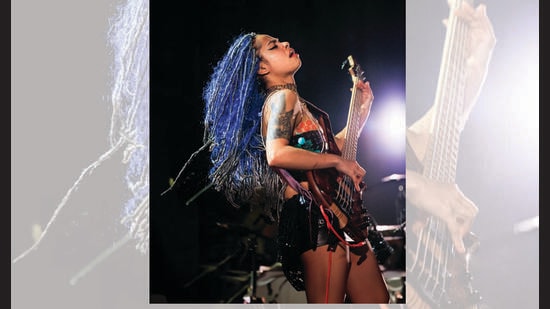
Most of us couldn’t name a bass player if our lives depended on it (Flea? Sting? Paul McCartney?). Narrow that down to Indian bass players and you’re really in niche-of-a-niche territory. And yet, when the Dhurandhar 1 and 2 soundtracks dropped in 2025 and 2026, music lovers just knew — that has to be Mohini Dey. The minute that dum-dum-dum-da-da-dum-dum kicks in on Ishq Jalakar, you’re locked in. It’s doing as much heavy lifting as Ranveer Singh on screen.

Bass, as musicians will tell you, is the low, deep, intimate part of a composition. It rumbles, never trills. And while the drums keep the beat, the bass (typically on guitar) forms the foundation of the sound. It’s the iconic boom-boom-boom in Queen’s Another One Bites the Dust, the dum-dum-drrumm-dum opening on The Beatles’ Come Together.
Dey’s bass is frenetic and it has popped up everywhere. At 30, she’s been AR Rahman’s bassist, part of Willow Smith’s crew, and has opened for Childish Gambino and Coldplay. Last year, she stunned the Berlin’s Sonic Pluriverse Festival when she broke into konnakol (a Carnatic form of vocal percussion) at a rock performance with her band MaMoGi.
Even without her instrument, she stands out. Dreadlocks, razor-sharp cat eyeliner, grunge and sequinned outfits offset with Indian jewellery. On her feeds, when she’s not playing, she’s cooking shrimp curry in a zebra-print dress, and making soap from scratch. How does she make it look this effortless and still never miss a beat?

Opening bars
Mumbai-born Dey says she didn’t choose bass. “My dad chose it for me. I three years old when he first put a bass guitar in my hands.” Her father Sujoy Dey, a bass player who worked with Sanjay Leela Bhansali and Nusrat Fateh Ali Khan, had noticed her tapping along in perfect sync to his basslines. So he built a small wooden guitar for her tiny hands. “I don’t even remember questioning it – it became a part of my world before I could fully understand what it meant. He was living his dream through me.”
Her mother Romia was a Hindustani Classical singer and dancer too, so “it was music 24×7 at home,” Dey says. “I don’t think I ever experienced music as something separate from life. It was just always there. I didn’t ‘fall in love’ with the bass later… I grew up inside it.”
By age seven, her father started giving her more challenging lessons, and he was surprised by how quickly she kept up. By age 11, little Dey was already accompanying virtuoso drummer Ranjit Barot on his tours. At 13, she was playing with maestro Zakir Hussain. By 16, she was performing with AR Rahman’s band on Coke Studio.
Of course, Dey knew she was not like the other kids. She was juggling school, practice, rehearsals, and performances. “Kids would make fun of me after watching me on TV,” she recalls. “They’d say ‘tinga-linga’s on the guitar’”. When Dey was allowed a half day at school because she was called in for a session, every kid in the classroom would throw her a look. “They’d whisper, ‘She thinks she is a rockstar. Yeah, a pimple-faced rockstar’.” Dey says she was too busy to be bothered. “I was a nerd who was very focused.”

Key change
Dey would wake up at 5am for school, then get home and practise until late into the evening. There were times when her father made her finish playing an exercise correctly to get to lunch or dinner. “I would be locked in the room until I got it right.”
By 13, she started to break. “I was pretty depressed. I didn’t think I was enough. My father and I had a deep relationship. It was extreme love, extreme everything, so even the fights were toxic. I remember Dad telling me that I wouldn’t be successful without him. I wanted to prove him wrong. I promised myself that one day, I will move out of my parents’ place and lead my life the way I want to.” At 17, she did. She wouldn’t speak to her father for the next three years.
Dey went on to perform all over the world, jamming with guitarist Steve Vai, German multi-instrumentalist Marco Minnemann, Dream Theater keyboardist Jordan Rudess and Japanese rock heavyweights B’z. She also released her solo album in 2023, Mohini Dey, which is how Willow Smith found her. Dey joined Smith’s touring alt-rock band. “I never saw that coming.”

Full volume
Dey has become something of a phenomenon her Carnatic takadimi beats and the ultra-fast slapping on the instrument. It’s possibly because she draws from more than bass music. “Growing up, I was deeply inspired by bass greats Jaco Pastorius, Victor Wooten and Victor Bailey — not just for their technique, but for how musical and expressive they were,” she says. “There’s an honesty in their playing that really shaped how I approach the instrument.” She also respects newer artists such as Thundercat and MonoNeon. “They have redefined what the bass can be in a modern context — visually, sonically, and culturally. I like when people are themselves and not trying to be anyone else.”

Scaling up
Dey’s second album releases soon. She is touring Japan, China, Europe and the US. “It feels good when your hard work is recognised, like hearing Chris Martin say, ‘Mohini, I could hear your bass through my walls in the green room and you sound so good’.”
Indian artists are only just making themselves heard globally. Dey says that even audiences are growing up and are “more curious, more accepting of different cultures and sounds.” For the talented and driven, there are more places to shine. Insta and YouTube make it easier to be discovered. But it also means that your competition is now global, she says, “You’re standing next to some of the best musicians in the world, every single day.”
So, India’s deep rhythmic and musical heritage is a huge advantage. “For me, it’s never been about trying to fit into a global sound. It’s about bringing my identity into the music, my upbringing, the way I hear rhythm, the way I phrase things. That’s what connects with a listener.”

A new verse
One thing about Dey is that she doesn’t gatekeep. She’s constantly sharing her rhythm, style and improvisation techniques with her 934K+ followers on Instagram (@Dey_Bass). There are unboxing videos of instruments, cool pedal accessories, and app reccos for keeping rhythm. As someone who almost buckled under pressure, Dey plays up her downtime too. She posts videos of herself cooking her own version of Maharani Chicken (she calls it “Jazzrani Chicken”) or drilling holes in her wall and hanging up shelves.
And she’s refining her on-stage look. High-heeled boots are fine. “I’m good at balancing on them while operating my pedalboard.” Saris, not so much. What if they unravel mid-set? “One wrong foot and it’s the wrong kind of show!” So, she sticks to snug tights or short metallic skirts so she can always see her feet and the pedalboard; and sleeveless tops so she doesn’t get too hot. With the bass often covering most of her torso, she leans into chokers and arm jewellery.
She also reconnected with her father before he passed away in 2023. “Some things were very painful for the both of us,” she says simply. “I was a rebellious kid and he had to learn to respect my choices and I had to respect his. But I am glad that my dad and I were able to have a beautiful relationship for a few years. Generation gap is a real thing, but we learnt to laugh together at our fights and lame jokes. Besides, I give him all the credit for who I am today. He gave me his all, including my gift. He was my creator.”
From HT Brunch, April 25, 2026
Follow us on www.instagram.com/htbrunch