By using this site, you agree to the Privacy Policy and Terms of Use.
Accept
Next India Magazine
  • Home
    • Home 2
    • Home 3Hot
    • Home 4
    • Home 5New
  • Home
  • Opinion

    That Provide Critical Analysis on Political Decision-Making

    krutikadalvibiz@gmail.com

    Analyzing Global Dynamics and Unraveling Key Policy Initiatives

    krutikadalvibiz@gmail.com

    Luxurious Stays Redefining Hospitality at Hotel Havens

    krutikadalvibiz@gmail.com

    Electric Cars Subsidies by German Taxpayers End Up on Foreign Roads

    krutikadalvibiz@gmail.com

    Challenge and Inspire Future of Political Thought

    krutikadalvibiz@gmail.com

    Assessing the Diplomatic Challenges and Global Security

    krutikadalvibiz@gmail.com
  • World
  • Politics
  • Market
  • Health
  • Insurance
  • Pages
    • Blog Index
    • Contact US
    • Search Page
    • 404 Page
    • Technology
    • World
  • Pages
    • Blog Index
    • Search Page
    • 404 Page
  • Technology
    TechnologyShow More
    Buying a Car Will Soon be Like Buying a Phone, Why Your Next Car Could be an EV
    Hands-On With the iPhone 13, Pro, Max, and Mini
    4 Min Read
    Explained: What are Smart Glasses and How Do It Work?
    4 Min Read
    Apple VS Samsung– Can a Good Smartwatch Save Your Life?
    4 Min Read
    Role of Technology in Modern Political Relations and Communication
    8 Min Read
  • Posts
    • Post Layouts
      • Standard 1
      • Standard 2
      • Standard 3
      • Standard 4
      • Standard 5
      • Standard 6
      • Standard 7
      • No Featured
    • Gallery Layouts
      • Layout 1
      • Layout 2
      • layout 3
    • Video Layouts
      • Layout 1
      • Layout 2
      • Layout 3
      • Layout 4
    • Audio Layouts
      • Layout 1
      • Layout 2
    • Post Sidebar
      • Right Sidebar
      • Left Sidebar
    • Review
      • Stars
      • Scores
      • User Rating
    • Content Features
      • Highlight Shares
      • Inline Mailchimp
      • Print Post
      • Inline Related
      • Source/Via Tag
      • Reading Indicator
      • Content Size Resizer
    • Table of Contents
      • Full Width
      • Left Side
    • Sponsored Post
  • Contact
  • Pages
    • Search Page
    • 404 Page
Reading: In rare colour photographs, Satyajit Ray emerges from behind the camera
SUBSCRIBE
Next India MagazineNext India Magazine
Font ResizerAa
  • My Saves
  • Economics
  • Technology
  • My Interests
  • World
  • My Feed
  • History
  • Business
  • Technology
  • Lifestyle
  • Fashion
  • Health
  • Technology
  • World
Search
  • Pages
    • Blog Index
    • Contact Us
    • Search Page
    • 404 Page
  • Home
    • Home 1
    • Home 2
    • Home 3
    • Home 4
    • Home 5
  • Home
  • Blog
  • Categories
    • Technology
    • Lifestyle
  • Personalized
    • My Feed
    • My Saves
    • My Interests
    • History
  • Demos
  • Categories
    • Technology
    • Business
    • Fashion
    • Economics
  • Bookmarks
  • Categories
    • Technology
    • Health
    • World
  • More Foxiz
    • Blog Index
    • Sitemap
  • Bookmarks
  • Contact
  • More Foxiz
    • Sitemap
Have an existing account? Sign In
Follow US
  • Home
  • World
  • Contact
  • Blog
© Foxiz News Network. Ruby Design Company. All Rights Reserved.
BusinessLifestyleStartup

In rare colour photographs, Satyajit Ray emerges from behind the camera

India Times Now
Last updated: May 7, 2026 9:55 pm
India Times Now
7 Min Read
Share
SHARE

In one frame, a crowd is gathered along the narrow lanes of Shahchara Mohalla in Lucknow as a royal palanquin passes by. On the sidelines, actor Farooq Sheikh, playing Aqil in ‘Shatranj Ke Khiladi‘ (1977), stands one hand firmly on his waist. And, leaning against a worn wall, one foot resting on a pipeline, director Satyajit Ray’s camera captures the scene unfolding around him. In another frame from the same shooting, Ray stands with members of his unit, carefully lining up a shot featuring Amjad Khan as Wajid Ali Shah in regal costume for the iconic historical satire on the British annexation of Awadh in 1856.

Spread across nearly 25 years, the 126 photographs chronicle actors, sets, locations and moments of filmmaking, while also documenting Ray in quieter, deeply human moments away from the camera.

In a third image, Ray is seen lining up a shot for The Stranger (Agantuk, 1991) with actor Utpal Dutt (Manomohan) and children on the Maidan in Kolkata. Taken on November 22, 1990, this was the first scene of the film to be shot, coincidentally on the day when his grandson Souradip was born. Another striking image shows the filmmaker standing amid mustard fields, consulting his “kherora khata” — the traditional Bengali red cloth-bound handmade ledger book that rarely left his side during shoots.

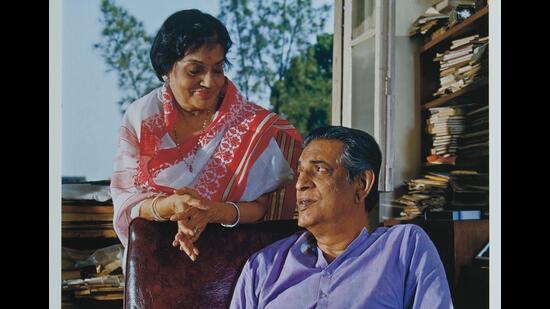
Audiences have long known Ray through his path-breaking cinema. Now, they have a chance to see the lens turned on the master filmmaker himself — and, that too, in colour. An exhibition at DAG titled “Faces and Facets: Satyajit Ray in Colour” brings together rare colour photographs of the legendary filmmaker taken by photographer Nemai Ghosh, his close friend and collaborator from 1968 until the director’s death in 1992. Opening on May 8 at at the art gallery on Janpath Road, the exhibition will remain on view until July 4.

The exhibition presents a deeply personal and expansive portrait of Ray, including behind-the-scenes images from films such as Agantuk, Ghare-Baire (1984) and Joi Baba Felunath (1979); photographs of him sketching costumes, composing music at home, or working quietly in his cavernous study; intimate family portraits; and contemplative moments on film sets where the filmmaker often withdrew into silence between takes. Ray once himself, remarking on the aloofness, said, “When I’m working I’m a complete democrat. It’s when I’m sitting at home alone and doing nothing that it seems aristocratic.”

The takes forward an earlier DAG exhibition, “Nemai Ghosh: Satyajit Ray and Beyond,” which foregrounded Ghosh’s iconic black-and-white photographs and situated Ray within a larger cinematic fraternity that included filmmakers such as Gautam Ghosh, Aparna Sen and Shyam Benegal.

“If black-and-white distilled the filmmaker into tonal contrasts and sculptural gravitas, colour restores atmosphere and immediacy bringing forth the warmth of interiors, the modulations of light across surfaces, and the subtle textures of the environments within which Ray conceived his films. exhibition attempts to bring to light Ray’s lesser known but equally extensive documentation of his cinema,” DAG said in a statement.

Spread across nearly 25 years, the 126 photographs chronicle actors, sets, locations and moments of filmmaking, while also documenting Ray in quieter, deeply human moments away from the camera. “Ray’s dedication to his craft led Ghosh to follow him like a shadow and conditioned him to the exacting demands of the maestro. Over the course of a twenty-five-year association that began on the sets of Goopy Gyne Bagha Byne (1969), Ghosh remained steadfast in upholding the values that defined Ray’s artistic vision. In Ray, Ghosh found not just a filmmaker but a mentor and friend; no other director’s set quite measured up,” said Ashish Anand, CEO and MD, DAG.

Anand added, “Nemai Ghosh’s lens extended beyond Satyajit Ray’s film sets into his intimate personal world. A frequent visitor to Ray’s home, Ghosh often captured Ray at the piano, at his drawing board, or in quiet conversation with friends and family. He photographed Ray in moments of profound introspection—whether at home, in his studio, or on location—likening him to a meditative yogi. From solitary walks through his house and lighter moments during shoots, or silent contemplation in open fields, Ghosh preserved a deeply human and nuanced portrait of the filmmaker. These candid glimpses became an integral part of Ghosh’s visual biography of a man he saw as both extraordinary and profoundly grounded.”

Accompanying the exhibition is a book, “Faces and Facets: Satyajit Ray in Colour”, which combines the photographs with quotations drawn from interviews conducted by biographer Andrew Robinson between 1982 and 1988 with Ray, his collaborators, actors and friends. Divided into two sections — “The Man” and “The Films”— the volume offers an intimate visual and textual journey into Ray’s creative universe; dialogue with him, his coworkers, friends and his actors.

In the preface, the late Ghosh reflects on decades spent documenting the filmmaker he affectionately called Manikda: “Manikda was always aware of my presence, although he never commented on it. ‘Nemai is like a bug on my windowsill.’ Keeping Manikda’s memory alive is a duty I gladly took upon myself. So when a few years ago i remembered that I had unpublished colour photographs of him, it was like chancing upon a forgotten treasure trove.”


Share This Article
Facebook Email Copy Link Print
Previous Article Leo Horoscope for Today May 08, 2026, Friday – Lead With Confidence But Stay Grounded
Next Article Virgo Horoscope for Today May 08, 2026, Friday – Virgo Horoscope For Today, May 08, 2026, Friday – Turn Small Tasks Into Satisfying Wins
Leave a Comment Leave a Comment

Leave a Reply Cancel reply

Your email address will not be published. Required fields are marked *

You Might Also Like

BusinessLifestyleStartup

Four killed, 14 injured as speeding dumper hits tractor-trolley in Moradabad

Four people were killed and 14 others were injured after…

2 Min Read
BusinessLifestyleStartup

RBI plans 1-hour delay on UPI transactions above ₹10,000, proposes ‘kill switch’ for scams| Technology News

Fast digital payments are one of the backbones of India’s…

5 Min Read
BusinessLifestyleStartup

Income Tax Department searches premises of TMC leaders days before Bengal polls| India News

The Income Tax Department on Friday morning searched the premises…

2 Min Read
BusinessLifestyleStartup

How much apartment space can ₹10 crore buy in top metros? Mumbai offers the least, costs the most

Mumbai remained India’s most expensive luxury residential market in 2025,…

6 Min Read
Next India MagazineNext India Magazine
Follow US
© 2026 Next India Magazine powered by India Times Now. All Rights Reserved.
Welcome Back!

Sign in to your account

Username or Email Address
Password

Lost your password?