



India
-Oneindia Staff

Aam Aadmi Party Rajya Sabha MP Sanjay Singh has accused the Bharatiya Janata Party of turning worship into a political test, after BJP leaders and supporters criticised AAP leaders for taking part in a Sundarkand recitation with Arvind Kejriwal.

AAP MP Sanjay Singh accused the BJP of making worship a political test after Party leaders criticized AAP’s Sundarkand recitation, questioning BJP’s authority over Hindu practices and linking the issue to alleged Ram temple donation irregularities.
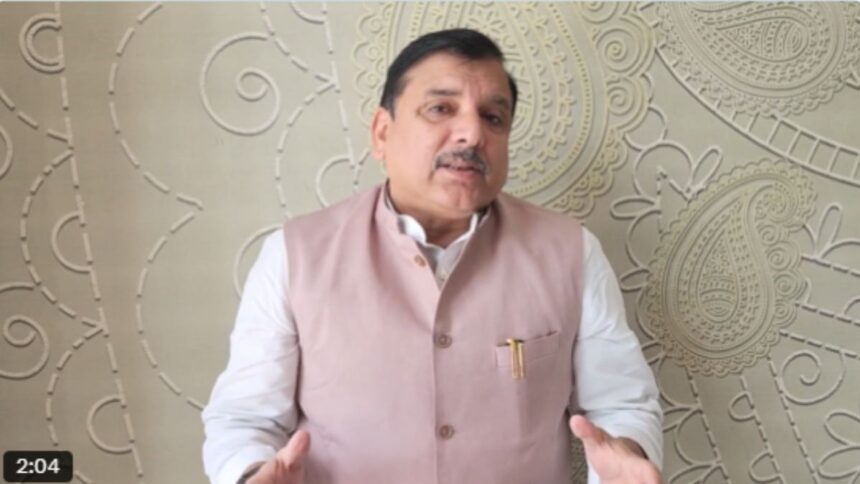
In a video statement shared on social media, Singh said the reaction from BJP leaders showed that the party wanted to decide who could perform religious rituals. He asked whether citizens would now need the BJP’s permission to read the Ramayana, recite Sundarkand or visit a temple.
The remarks have added another layer to the continuing political friction between AAP and the BJP. The exchange is not only about a religious event. It is also tied to AAP’s broader attack on the BJP over alleged misuse of faith for politics and accusations linked to donations collected in the name of the Ram temple.
Sanjay Singh questions BJP over Sundarkand row
Singh said AAP workers had performed Sundarkand along with Kejriwal, after which BJP leaders reacted sharply on social media. He claimed that BJP leaders had started abusing AAP members on platforms such as X and Facebook, questioning how they dared to hold the recitation.
“If this is the situation, then crores of Hindus in the country will have to take permission from the BJP even to worship,” Singh said in the video. He added that people may soon be asked whether they had approval before reading Sundarkand, the Ramayana or the Gita at home.
The AAP MP said the BJP had no authority to act as a gatekeeper of Hindu faith. “Where have they got the tender for Hinduism? How have they started considering themselves the contractors of Hindu religion?” he asked, accusing the party of treating religious practice as its exclusive domain.
Sundarkand, a section of the Ramcharitmanas, is widely recited by devotees of Lord Ram and Lord Hanuman. In public life, such recitations have also become politically visible, especially when parties organise them before elections, protests or campaigns. That has often led to charges of competitive religiosity among rival political groups.
AAP links recitation to Ram temple donation allegations
Singh also connected the Sundarkand recitation to allegations of irregularities in donations collected for the Ram temple. He alleged that there had been “crores” of wrongdoing and “chanda chori” in the name of the temple, and said BJP leaders were silent when such charges were raised.
According to Singh, the prayer was held to seek justice from Lord Ram and blessings from Lord Hanuman for action against those he described as involved in donation-related wrongdoing. The BJP has previously rejected opposition allegations around the temple donation issue and accused rivals of targeting Hindu sentiment for political reasons.
The Ram temple in Ayodhya has been one of the most powerful political and religious issues in India for decades. Since the temple’s consecration, political parties have frequently invoked it in speeches and campaigns. Opposition parties, including AAP, have tried to separate religious devotion from what they call the BJP’s political ownership of the issue.
Singh’s comments also referred to an ongoing signature campaign against Prime Minister Narendra Modi. He did not give fresh details in the video about the scale or timeline of the campaign, but presented the Sundarkand event as part of AAP’s wider protest against the ruling party.
Faith, politics and the battle for Hindu identity
The controversy reflects a familiar pattern in Indian politics. The BJP often projects itself as a party rooted in Hindu cultural assertion, while opposition parties accuse it of using religion for electoral gain. At the same time, several opposition leaders have increasingly participated in religious events to avoid being portrayed as distant from Hindu voters.
AAP has followed this route for years. Kejriwal has publicly attended religious programmes, spoken about temples and announced schemes linked to pilgrimages. The party’s position has been that welfare politics and religious devotion can coexist, while the BJP argues that AAP’s outreach is opportunistic.
Singh’s latest statement seeks to turn that criticism back on the BJP. His argument is that if the BJP attacks AAP for reciting Sundarkand, it is effectively claiming control over Hindu practice. That framing allows AAP to present itself as defending ordinary worshippers from political policing.
The BJP’s counter would likely be that AAP is using religious symbolism to distract from governance and political issues. Such arguments have become common between the two parties, especially in Delhi, where the BJP and AAP have fought bitterly over corruption allegations, civic governance, welfare schemes and control of administrative powers.
The tone of Singh’s video was combative. He told BJP leaders not to get agitated, saying the event was only a Sundarkand recitation. He added that they should imagine their condition if a “Lankakand” recitation was held, using a reference from the Ramayana to sharpen his political attack.
The immediate dispute may remain a social media-driven political exchange, but it points to a larger contest. AAP wants to challenge the BJP’s claim over religious nationalism without appearing anti-religious. The BJP, meanwhile, continues to question the sincerity of such gestures by its opponents. For voters, the issue may come down to whether public religion is seen as devotion, political signalling or both.