



India
oi-Swastika Sruti

The right to protest is dangerous in India as what we all came across this morning at Jantar Mantar white bedsheets suddenly covered Sonam Wangchuk and the next thing was he was in Safdarjung Hospital.

Climate activist Sonam Wangchuk’s indefinite hunger strike prompted the Delhi High Court to order daily medical monitoring but not force-feeding, highlighting a legal shift to balance protest rights with protecting life, unlike older IPC provisions.
An educator, an inventor, a climate activist – Sonam Wangchuk is on an indefinite hunger strike that enters 21 days with the growing concern on his health. The doctors have warned that prolonged fasting could lead to organ damage, that raised an important legal question: Can the government force-feed a person who is on a hunger strike?
The issue gained traction after the Delhi Police claimed that the Delhi High Court directed that Wangchuk should receive daily medical monitoring but did not say to force feed him or to end his fast against his will.
Why Is the Debate Around Force-Feeding Back?
As Wangchuk’s health deteriorates the High court mainly focused on protecting Wangchuk’s health rather than deciding the merits of his protest. The judges recorded the Centre’s assurance that doctors were already monitoring his condition daily. The court directed that medical supervision should continue and that doctors should provide treatment whenever required.
At the same time, the order did not authorise force-feeding, reflecting the cautious approach courts have adopted in recent years.
Supreme Court’s View on Hunger Strikes
No, this case has not reached the Supreme Court yet but during the Punjab farmer leader – Jagjit Singh Dallewal’s indefinite hunger strike in 2024, the apex court observed that the government’s duty also stands to protect a person’s life.
The court also made it clear that authorities should not interfere with a peaceful protest by forcing a competent adult to end a fast unless it becomes essential to save the person’s life.
The judgment highlighted the need to balance the right to protest with the state’s responsibility to prevent loss of life.
How Irom Sharmila’s Case Was Different
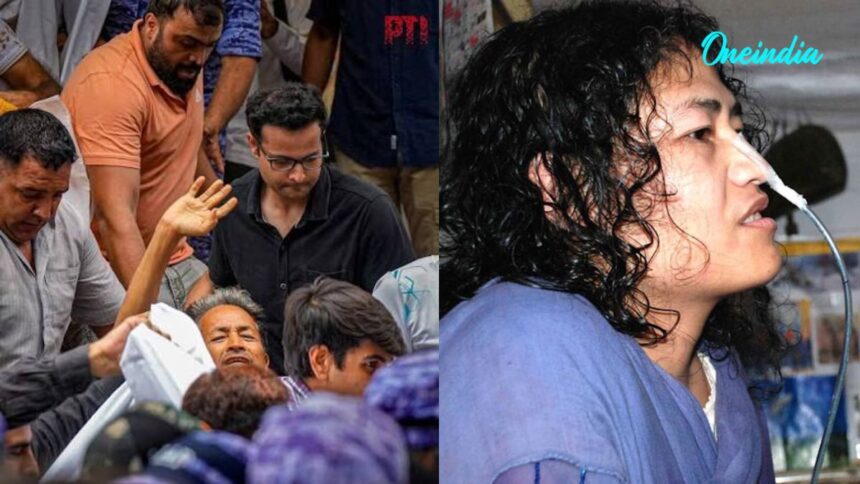
Iron lady of Manipur – Irom Sharmila was on a hunger strike for 16 years. Her protest was against the Armed Forces (Special Powers) Act. The authorities repeatedly arrested her and kept her alive by force feeding her through a tube inserted into her nose. As attempting suicide was then a criminal offence under Section 309 of the Indian Penal Code (IPC), allowing authorities to take such action.
Irom Chanu Sharmila (also known as the “Iron Lady of Manipur”) is widely recognized for undertaking one of the longest hunger strikes in modern history.
16 Years of Hunger for Justice 💪 The Iron Lady of Manipur who fasted against AFSPA for over 5,500 days. One of modern… pic.twitter.com/3G1t3ftczW
— Sanjay Deka (@SanjayDekaFLJ) July 15, 2026
Today, India’s legal framework has changed significantly.
What Changed Under the New Law?
With the replacement of IPC with Bhartiya Nyaya Sanhita (BNS), attempting suicide is no longer treated in the same manner. The court have increasingly recognised the importance of personal liberty and right to peaceful protest.
As a result, the government’s first responsibility is now seen as ensuring proper medical care and engaging in dialogue, rather than immediately resorting to force.
Supreme Court Earlier Favoured Dialogue
Earlier in 2011 – the Supreme Court expressed a similar view while hearing Baba Ramdev’s hunger strike. The court observed that the government should initially attempt discussions instead of directly treating the hunger strike as purely law and order issue. The court noted that the Union Government had engaged in dialogue with Ramdev through senior ministers and the Prime Minister before taking any further steps.
The idea of peaceful fasting has a long tradition in India;’s democracy inspired by
Mahatma Gandhi’s method of Satyagraha.
Can the Government Force-Feed Sonam Wangchuk?
There is no rule that allows the government to force feed him but there is also no straightforward answer to it. The courts have maintained that the state cannot remain silent if the person’s life is in danger.
This explains why the Delhi High Court’s order in Wangchuk’s case emphasised daily medical monitoring and treatment whenever necessary, but stopped short of directing force-feeding.