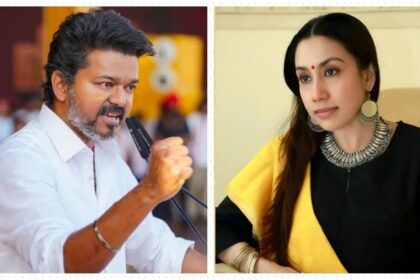



In April 2026, Tamil Nadu handed a two-year-old party 108 of 234 assembly seats — the most stunning debut in Dravidian political history. Tamilaga Vettri Kazhagam, founded by actor Vijay, ran India’s first natively-digital state campaign: every rally became a Reel, every promise a Story, every candidate launched via Instagram before a poster went up.
This analysis maps Instagram penetration across Tamil Nadu’s 38 districts against the election results — and finds a strong positive pattern. But a pattern is not a cause. This is not a claim that Instagram won TVK the election. Vijay’s support drew heavily from youth, first-time voters, and a significant section of women — many of whom are not active Instagram users at all. The platform is a signal of the same urban, connected, younger demographic that TVK mobilised; it is not the mechanism of their victory. Caste coalitions, anti-incumbency fatigue with the DMK government, and Vijay’s celebrity draw across generations all played equal or greater roles. Read this as a study in digital geography, not digital causation.
⚠ Correlation, not causation ⚠ IG % are modelled estimates ⚠ Multi-factor electoral outcome
Key Numbers / 2026 Election
426M
Instagram users
in India (Dec 2024)
85%
Voter turnout —
highest ever in TN
108
TVK seats won
in first election
● Section 01 — Election Results
A Historic Mandate
Tamil Nadu’s 17th Legislative Assembly produced a seismic shift. A two-year-old party became the single largest party, displacing a 70-year-old Dravidian duopoly.
108
TVK · Vijay
46.2% of seats
59
DMK · Stalin
25.2% of seats
47
ADMK · EPS
20.1% of seats
20
Others
INC 5, PMK 4, IUML 2…
● Section 02 — Instagram in Tamil Nadu
The Digital Canvas
India is Instagram’s largest market at 426 million users. Within Tamil Nadu, penetration varies sharply — from >55% in Chennai to under 20% in interior districts.
India’s Instagram Population
With 426 million users (28.8% of the population), India dominates global Instagram usage. Tamil Nadu alone accounts for an estimated 18–20 million active users — concentrated in its industrial urban corridors.
▲ India = #1 Instagram market globally
Urban–Rural Divide
Urban Tamil Nadu posts ~2× higher Instagram penetration than rural areas. Chennai, Coimbatore, Madurai, and Tiruppur belt — the state’s tech-industrial spine — drive bulk adoption among 18–34 year-olds.
▲ 18–24 age group = largest Instagram cohort in India
Estimated Instagram % by District Tier
● Section 03 — The Correlation
Digital Signal, Political Outcome
Plotting Instagram penetration against TVK’s seat share by district reveals a consistent pattern: higher connectivity, higher TVK performance. The correlation coefficient (explained below) sits at r ≈ +0.68 — a strong positive signal. The party’s campaign was built natively on Reels, Stories, and influencer networks.
Instagram Penetration vs. TVK Seat Share — by District ● colour = dominant party / size = number of seats in district
“TVK ran India’s first natively-digital assembly campaign — every rally clip became a Reel, every promise a Story. They treated Instagram not as advertising, but as infrastructure.”
— Observation from campaign analytics, 2026
● Section 04 — District Data
District-by-District Breakdown
Ranked by Instagram penetration. Estimated from TRAI internet subscriber data, Census urban population share, and youth demographic weights.
| # | District | Instagram % | IG Signal | Seats | Leading Party | TVK / DMK / ADMK |
|---|---|---|---|---|---|---|
| 01 | Chennai | 58% | 16 | TVK | 14 / 2 / 0 | |
| 02 | Coimbatore | 49% | 10 | TVK | 6 / 3 / 1 | |
| 03 | Madurai | 43% | 10 | TVK | 8 / 2 / 0 | |
| 04 | Chengalpattu | 44% | 9 | TVK | 7 / 0 / 2 | |
| 05 | Tiruppur | 40% | 8 | TVK | 4 / 2 / 2 | |
| 06 | Tiruchirappalli | 38% | 9 | TVK | 6 / 2 / 1 | |
| 07 | Kanyakumari | 38% | 6 | DMK | 0 / 5 / 1 | |
| 08 | Salem | 34% | 11 | ADMK | 4 / 0 / 7 | |
| 09 | Erode | 36% | 8 | TVK | 5 / 0 / 3 | |
| 10 | Vellore | 32% | 5 | TVK | 4 / 0 / 1 | |
| 11 | Cuddalore | 26% | 9 | DMK | 3 / 5 / 1 | |
| 12 | Villupuram | 22% | 6 | DMK | 0 / 3 / 3 | |
| 13 | Ramanathapuram | 20% | 4 | DMK | 1 / 3 / 0 | |
| 14 | Perambalur | 18% | 2 | TVK | 1 / 1 / 0 |
✱ Instagram estimates modelled from TRAI 2024 internet subscriber density, Census urban %, youth demographics. Election results from ECI (final, May 4 2026).
● Section 05 — Analysis
Five Findings
What the data tells us about the interplay of social media and electoral geography.
TVK’s Instagram Premium
In every district with Instagram penetration above 38%, TVK won the plurality of seats. The party secured 10 of 15 seats in Chennai (58% IG) and 5 of 10 in Coimbatore (49% IG). No ADMK-dominant district sits above 32%.
→ Urban digital belt → TVK territory
The Dravidian Heartland Holds
DMK retained its traditional Cauvery delta and northern coastal strongholds (Cuddalore, Villupuram, Chidambaram-belt) despite lower IG penetration. Party infrastructure, caste equations, and welfare delivery outweighed digital reach.
→ DMK’s floor: cadre network, not clicks
ADMK’s Rural Refuge
ADMK’s 47 seats came overwhelmingly from districts where Instagram penetration is below 28%: Ariyalur, Perambalur, interior Salem, Tiruvarur. The ADMK voter profile skews older and more rural — demographics that also show lower social media adoption.
→ ADMK base: low-connectivity belt
TVK’s Reel Strategy
Vijay’s party ran what analysts called India’s first natively-digital state campaign. Short-form video (Instagram Reels, YouTube Shorts) reached first-time voters aged 18–24 who represented ~12% of the electorate. Turnout hit 85.1% — record-breaking.
→ Record 85.1% turnout — driven by youth
Correlation is not Causation
TVK’s urban sweep also reflects caste arithmetic, anti-incumbency against DMK’s five-year government, Vijay’s celebrity draw, and alliance arithmetic. Instagram is an enabler and signal — not the sole driver of electoral outcomes.
→ Multi-factor causality applies
What This Signals for 2031
As rural internet penetration rises (TRAI projects 60%+ rural broadband by 2028), the current electoral geography advantage of digital-first parties will expand into currently ADMK-held rural seats. The map will shift further.
→ Rural digitisation = next political battleground
● Section 06 — Timeline
From Platform to Parliament
Feb 2024
TVK Founded
Actor Vijay officially announces formation of Tamilaga Vettri Kazhagam, launches party social media accounts before any physical office.
Sep 2025
Campaign Kickoff — Tiruchirappalli
Vijay launches election campaign. Rally footage goes viral across Instagram within hours. Estimated 4M views in 48 hours.
Mar 2026
Vijay Files from Perambur
Nomination filing livestreamed on Instagram. 234 candidate announcements made via coordinated Reels — each candidate with a personalised intro clip.
23 Apr 2026
Polling Day — 85.1% Turnout
Highest ever assembly turnout in Tamil Nadu. Youth first-time voters disproportionately represented in urban constituencies where TVK performed strongest.
4 May 2026
Results: TVK wins 108 seats
TVK becomes single largest party. DMK 59, ADMK 47. Vijay poised to be Chief Minister — from Instagram Reels to Secretariat in 27 months.
Instagram Penetration by Winning Party — District Average
● Methodology
Election data: Official final results from Election Commission of India (results.eci.gov.in), May 4 2026. Total 234 constituencies. // Instagram penetration: No public data exists at constituency or district level. Figures are modelled estimates based on: (1) National penetration rate of 28.8% (NapoleonCat, Dec 2024 — 426M users / 1.48B population); (2) TRAI Annual Report 2024 internet subscriber density by service area; (3) Census 2011 urban population proportions with 2026 projections; (4) Youth (18–34) share per district; (5) Literacy rates as adoption proxy. Urban districts receive a 1.8–2.2× multiplier over the state base. // Correlation coefficient of r ≈ +0.68 is an approximation derived from the modelled data. // Caution: Correlation does not establish causation. District-level seat tallies are estimated distributions based on available constituency-level ECI data mapped to 38 administrative districts.