


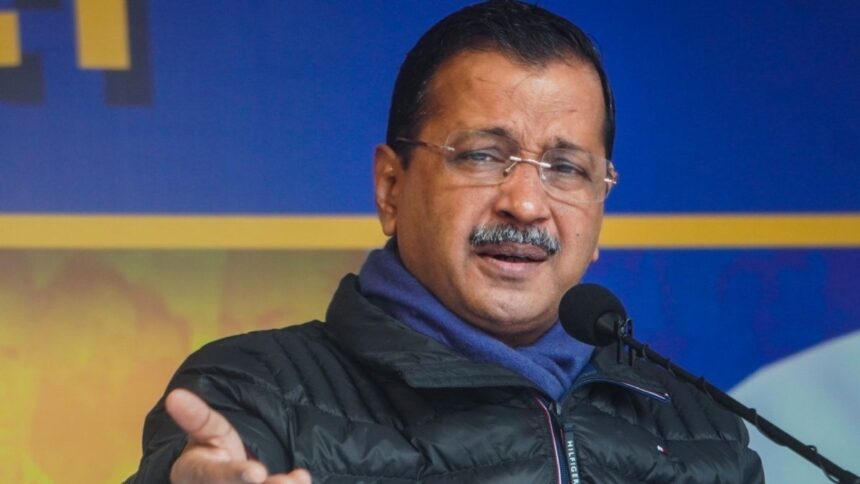
Arvind Kejriwal announces a personal and legal boycott of the excise policy case proceedings before Justice Swarana Kanta Sharma, following a denial of recusal by the Delhi high court. The decision is framed as civil resistance and a protest guided by Gandhi, while the court emphasises the need for judicial independence and consistency in recusals.
India
-Oneindia Staff

Aam Aadmi Party chief Arvind Kejriwal has told Justice Swarana Kanta Sharma that there will be no appearance by Arvind Kejriwal in the excise policy case, either personally or through any lawyer. The communication, disclosed by the party on Monday, follows the Delhi high court’s refusal to remove Justice Sharma from the matter.

Delhi CM Arvind Kejriwal announced he will not appear in the High Court’s excise policy case before Justice Swarana Kanta Sharma due to loss of faith, calling it Satyagraha. The court previously dismissed his plea to recuse the judge, citing potential bias.
In the letter, Arvind Kejriwal expressed loss of faith in the judge. Arvind Kejriwal wrote, “My hope of getting justice from Justice Swarana Kanta has been broken.” Arvind Kejriwal added that this prompted a protest decision guided by Mahatma Gandhi, stating, “Therefore, I have decided to follow Mahatma Gandhi’s path of Satyagraha.” Arvind Kejriwal described the move as a symbolic stand.
Arvind Kejriwal and excise policy case before Justice Swarana Kanta Sharma in Delhi high court
Arvind Kejriwal stressed that the decision to boycott the excise policy case proceedings before Justice Swarana Kanta Sharma in the Delhi high court is an individual choice. Arvind Kejriwal wrote, “I have made the decision by listening to the voice of my conscience.” According to the party, Arvind Kejriwal intends this as a form of civil resistance.
जस्टिस स्वर्णकान्ता शर्मा जी से न्याय मिलने की मेरी उम्मीद टूट चुकी है।
अपनी अंतरात्मा की आवाज़ सुनते हुए, गांधी जी के सिद्धांतो को मानते हुए और सत्याग्रह की भावना के साथ, मैंने फ़ैसला किया है कि मैं इस केस में उनके सामने पेश नहीं हूंगा और कोई दलील भी नहीं रखूँगा। pic.twitter.com/vhTSEZabqa
— Arvind Kejriwal (@ArvindKejriwal) April 27, 2026“>
The letter came soon after the Delhi high court dismissed Arvind Kejriwal’s plea seeking the recusal of Justice Swarana Kanta Sharma from the excise policy case. Arvind Kejriwal’s petition had argued that there was a perceived conflict of interest because Justice Sharma’s children are empanelled as Central government counsel. Arvind Kejriwal claimed this raised a reasonable fear of bias.
Delhi high court, Arvind Kejriwal and excise policy case orders by Justice Swarana Kanta Sharma
Justice Swarana Kanta Sharma, hearing the excise policy case in the Delhi high court, rejected Arvind Kejriwal’s recusal request with a detailed order. Justice Sharma held that a litigant’s subjective suspicion cannot by itself require a judge to step aside. Justice Sharma observed that the “mere apprehension” of not securing relief is insufficient for recusal.
Justice Swarana Kanta Sharma warned that accepting such recusal pleas in the excise policy case involving Arvind Kejriwal would send an unhealthy message about the Delhi high court. Justice Sharma stated, “If this court was to recuse, it would be an act of surrender and a signal that institution including judge and the court can be bent, shaken and changed. Applications seeking recusal are rejected.” Justice Sharma added, “Judges are bound by the discipline of their office… Today it is this court; tomorrow it will be another court.”
Addressing Arvind Kejriwal’s allegations, Justice Swarana Kanta Sharma remarked that the recusal file in the excise policy case before the Delhi high court “did not arrive with evidence but it arrived on my table with aspersions, insinuations and doubts cast on my integrity.” Arvind Kejriwal had also cited Justice Sharma’s attendance at Akhil Bharatiya Adhivakta Parishad events, arguing that the body is linked with an ideology hostile to the Aam Aadmi Party.
The dispute is tied to alleged irregularities in Delhi’s excise policy, in which Arvind Kejriwal and others are accused. On 27 February, a trial court discharged Arvind Kejriwal and 22 co-accused, holding that Central Bureau of Investigation material did not justify a trial. The CBI challenged that decision in the Delhi high court, where Justice Swarana Kanta Sharma stayed, on 9 March, the trial court’s directions for departmental action against a CBI officer and described some of the earlier observations as “prima facie misconceived.” The case and Arvind Kejriwal’s boycott decision now continue under close judicial and political attention.