


India
oi-Prakash KL

The trading floors of Asia hummed with a cautious, almost hesitant energy as dawn broke on Tuesday, 14 April. For seven gruelling weeks, global energy markets had been caught in the crossfire of a volatile conflict involving the US, Israel, and Iran. The physical flow of the global economy was choking, but today, a fragile whisper of diplomacy sent a sudden ripple through the numbers.
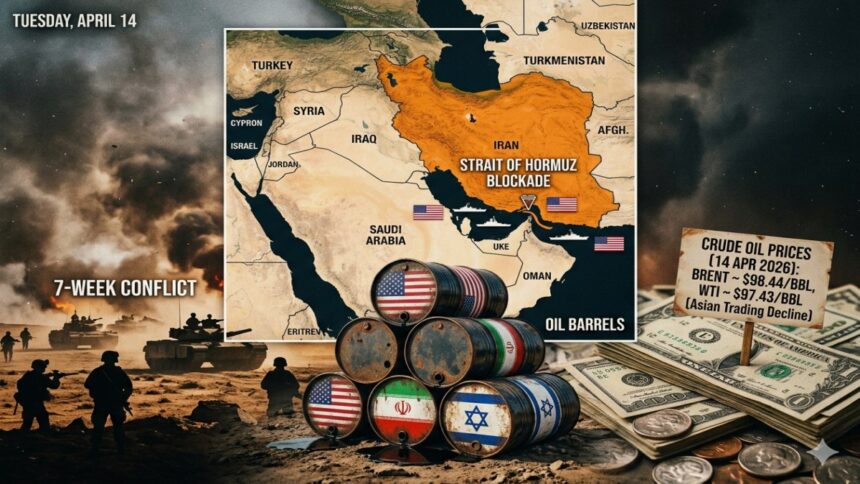
Crude oil prices began to drift downwards. Brent crude, the international benchmark, slipped towards $98.44 per barrel, whilst West Texas Intermediate (WTI) edged closer to $97.43. This cooling of the market was unexpected, given the physical realities playing out in the Middle East.
On April 14th, crude oil prices, including Brent nearing $98.44 and WTI $97.43, fell below $100 amid reports of US-Iran diplomatic talks, despite a US blockade of the Strait of Hormuz causing high consumer fuel costs and regional grades surging due to physical tightness.

The United States had commenced a strict blockade of the Strait of Hormuz, explicitly targeting vessels linked to Iran’s Gulf ports. Ordinarily, such a drastic manoeuvre would send prices skyrocketing, exacerbating the supply fears that had already pushed global fuel costs to eye-watering heights.
The impact on ordinary consumers had been severe. In Europe, the price of jet fuel and diesel had rocketed to near-record levels, breaching the $200-a-barrel mark, whilst American drivers faced the highest petrol and diesel costs seen since 2022. The vital shipping artery of the Strait of Hormuz saw only a trickle of traffic. Following a brief surge in transits on Sunday, activity plummeted again on Monday, with only a very limited number of tankers managing to complete the tense journey.
Yet, beneath the sabre-rattling, a delicate diplomatic waltz was commencing. The primary catalyst for the market’s downward trajectory was the emergence of reports suggesting that back-channel chatter between Washington and Tehran was underway. With a previously announced two-week pause in hostilities set to expire on 21 April, both sides appeared to be searching for a longer-term ceasefire.On Tuesday, 14 April, benchmark futures like Brent and WTI saw declines of nearly 2%, falling below the triple-digit threshold as traders priced in the possibility of a longer-term ceasefire.
However, the “split” in the market is evident when looking at the broader list of indexes. While major benchmarks dipped on peace hopes, regional grades like Murban Crude and DME Oman surged by more than 4% and 5% respectively, reflecting the immediate physical tightness in the Middle East. With the Strait of Hormuz currently seeing only a trickle of its normal tanker traffic, the energy sector remains on a knife-edge; any breakdown in these delicate negotiations could see prices rapidly reverse course and climb back toward the record levels seen earlier this month.
| Futures & Indexes | Last | Change | |
|---|---|---|---|
| WTI Crude | 97.55 | -1.53 | |
| Brent Crude | 98.62 | -0.74 | |
| Murban Crude | 103.33 | +5.17 | |
| Natural Gas | 2.616 | -0.011 | |
| Gasoline | 3.097 | -0.019 | |
| Heating Oil | 3.808 | -0.026 | |
| WTI Midland | 102.28 | +1.40 | |
| Mars | 127.16 | +3.42 | |
| Opec Basket | 107.29 | +0.29 | |
| DME Oman | 103.19 | +4.18 | |
| Mexican Basket | 90.68 | -1.04 | |
| Indian Basket | 116.26 | -4.02 | |
| Urals | 114.66 | -7.12 | |
| Western Canadian Select | 84.22 | +0.00 | |
| AECO C natural gas | 0.850 | -0.070 | |
| Dubai | 100.75 | -1.95 | |
| Brent Weighted Average | 101.17 | +3.87 | |
| Louisiana Light | 103.26 | -1.61 | |
| Domestic Swt. @ Cushing | 95.56 | +1.21 | |
| Giddings | 89.31 | +1.21 | |
| ANS West Coast | 108.05 | -1.31 | |
| Gulf Coast HSFO | 80.25 | +0.14 | |
| Ethanol | 1.938 | +0.003 | |
| Dutch TTF Natural Gas | 15.03 | -0.81 | |
| LNG Japan/Korea Marker | 19.42 | -0.07 |
US President Donald Trump buoyed the markets when he addressed reporters, claiming Iran had initiated contact. “We’ve been called this morning by the right people, the appropriate people, and they want to work a deal,” he proclaimed. Across the geopolitical divide, Iranian President Masoud Pezeshkian signalled a pragmatic willingness to engage, provided any continuing discussions remained strictly within the framework of international law.
The strategic calculus behind the naval blockade was becoming clear. US Vice President JD Vance acknowledged the painful domestic reality of higher fuel prices but argued that the blockade had significantly bolstered American negotiating leverage. “We can start to wind this thing down,” he told Fox News. However, as Dr Deep Pal, Director of Geopolitics and Policy at the Koan Advisory Group, noted, it is a perilous tightrope: while the blockade squeezes Iran economically, it risks a much broader, punishing surge in global energy costs.