



India
oi-Prakash KL

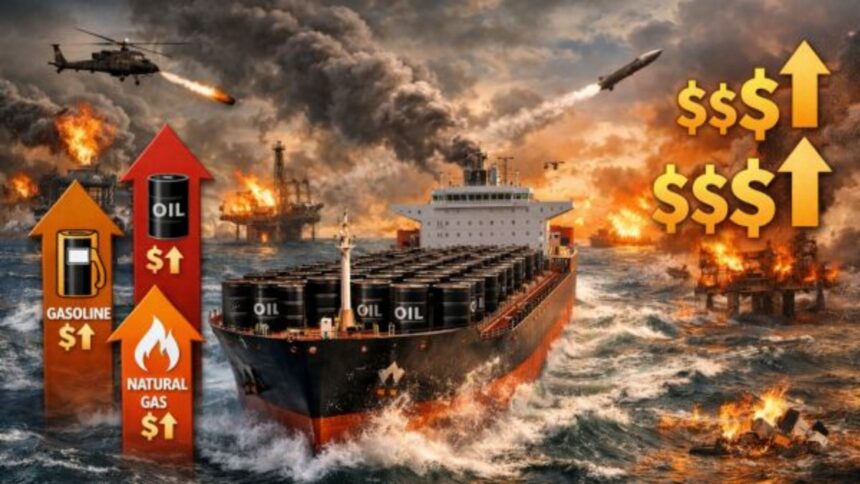
Crude Oil Rates Today: Global crude oil markets have entered a volatile phase, with benchmark prices climbing above the psychologically significant $100-per-barrel mark amid tightening supply signals and escalating geopolitical tensions.
The rally has been led by Brent Crude, which rose to $103.38 per barrel, gaining 1.44% in the latest session. Its US counterpart, WTI Crude, also advanced to $94.46, up 1.67%. This marks the fourth consecutive session of gains, underlining the sustained bullish momentum in global oil markets.
Global crude oil prices surpassed $100 per barrel, with Brent Crude reaching $103.38 and WTI Crude $94.46, driven by strong US demand and escalating Middle East geopolitical tensions, indicating anticipated continued market volatility.

Demand Signals Drive Prices Higher
A key driver behind the recent surge is strong demand, particularly in the United States. Larger-than-expected drawdowns in gasoline and distillate inventories have signalled robust consumption, easing concerns about a slowdown in energy demand. Refined products such as gasoline rose to $3.386 (+0.83%), while heating oil climbed to $3.958 (+0.5%), reflecting continued resilience in downstream markets.
Natural gas, however, remained relatively stable, with prices at $2.717, showing a marginal dip of 0.18%. In contrast, European gas benchmark Dutch TTF Natural Gas surged 7.59%, highlighting regional supply tightness.
| Futures & Indexes | Last | Change | |
|---|---|---|---|
| WTI Crude | 94.55 | +1.59 | |
| Brent Crude | 103.40 | +1.49 | |
| Murban Crude | 103.12 | +6.83 | |
| Natural Gas | 2.717 | -0.005 | |
| Gasoline | 3.386 | +0.028 | |
| Heating Oil | 3.958 | +0.020 | |
| WTI Midland | 100.51 | +3.94 | |
| Mars | 111.55 | -3.07 | |
| Opec Basket | 97.74 | -1.86 | |
| DME Oman | 93.45 | -4.40 | |
| Mexican Basket | 90.45 | +2.06 | |
| Indian Basket | 103.05 | +2.64 | |
| Urals | 98.84 | +0.79 | |
| Western Canadian Select | 77.32 | +2.25 | |
| AECO C natural gas | 0.950 | +0.030 | |
| Dubai | 102.88 | +1.22 | |
| Brent Weighted Average | 97.14 | +2.05 | |
| Louisiana Light | 92.76 | +5.15 | |
| Domestic Swt. @ Cushing | 88.61 | +2.52 | |
| Giddings | 82.36 | +2.52 | |
| ANS West Coast | 101.54 | -6.89 | |
| Gulf Coast HSFO | 81.53 | +2.13 | |
| Ethanol | 1.920 | +0.020 | |
| Dutch TTF Natural Gas | 14.46 | +1.02 | |
| LNG Japan/Korea Marker | 15.81 | -3.39 |
Middle East Tensions Add Risk Premium
While demand fundamentals remain strong, geopolitical developments have significantly amplified market uncertainty. Rising tensions in the Middle East-particularly around the strategically vital Strait of Hormuz-have added a substantial risk premium to oil prices.
Iran’s reported capture of two container ships attempting to exit the Gulf has heightened fears of potential supply disruptions. The Strait of Hormuz, through which nearly a fifth of the world’s oil supply passes, remains a critical chokepoint, and any disruption could have far-reaching implications for global energy markets.
Although there have been indications of a possible second round of talks between Iran and the United States, progress has been limited so far. The absence of a clear diplomatic breakthrough continues to keep traders on edge.
Mixed Trends Across Global Benchmarks
Beyond Brent and WTI, price movements across global crude benchmarks have been mixed but largely positive. Murban Crude surged sharply by 7.09% to $103.12, reflecting strong Asian demand. The Indian Basket also climbed 2.63% to $103.05, indicating higher import costs for India.
Other notable movers include:
WTI Midland crossing $100 at $100.51 (+4.08%)
Louisiana Light jumping 5.88% to $92.76
Western Canadian Select rising 3% to $77.32
However, not all grades followed the upward trend. Mars crude declined 2.68% to $111.55, while Oman crude dropped 4.50% to $93.45, reflecting regional supply-demand imbalances.
Outlook: Volatility Likely to Persist
With oil prices now firmly above $100, markets are likely to remain volatile in the near term. The interplay between strong demand fundamentals and geopolitical uncertainty will be critical in determining the next direction.
Any escalation in tensions around key supply routes or failure of diplomatic efforts could push prices even higher. Conversely, a breakthrough in negotiations or easing of supply concerns may bring some relief.
For now, the global oil market appears to be navigating a delicate balance-caught between solid demand growth and an increasingly fragile geopolitical environment.