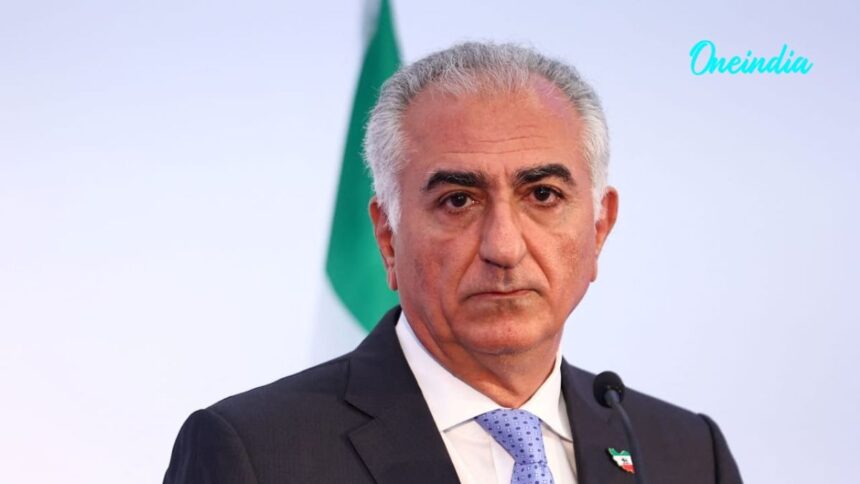
Reza Pahlavi, exiled Iranian opposition figure, criticised the US Iran ceasefire during a Berlin briefing, warning against optimistic assumptions about Tehran’s leadership and calling for stronger European support for Iranian democracy amid ongoing regional tensions.
International
-Swastika Sruti

Iran’s exiled crown prince Reza Pahlavi was splashed with a red liquid outside Germany’s federal press conference venue in Berlin on April 23, 2026, moments after criticising the US–Iran ceasefire deal. Security moved Reza Pahlavi into a waiting car, while supporters nearby watched the disturbance unfold outside the Bundespressekonferenz building.

On April 23, 2026, Iranian exiled crown prince Reza Pahlavi was splashed with a red liquid in Berlin after criticizing the US-Iran ceasefire deal and alleging recent executions in Iran; the suspect was detained, and the liquid was tomato juice.
Reza Pahlavi had just completed a media briefing where the ceasefire between the United States and Iran dominated questioning. Witnesses saw an individual step forward and hurl the substance as Reza Pahlavi left the building. Police detained the suspect immediately, and officials later said the liquid appeared to be tomato juice rather than anything dangerous.
Reza Pahlavi criticism of US–Iran ceasefire in Germany
During the press conference in Germany, Reza Pahlavi argued that the ceasefire agreement relied on unrealistic expectations about Tehran’s leadership. Reza Pahlavi said the deal assumes Iran’s rulers will suddenly change course and “become pragmatists.” Reza Pahlavi added, “I don’t see that happening,” stressing doubts about any lasting shift in Iran’s political approach.
Reza Pahlavi told reporters that diplomatic efforts had already been stretched. Reza Pahlavi said, “I’m not saying that diplomacy should not be given a chance, but I think diplomacy has been given enough chance.” The comments placed Reza Pahlavi at odds with those who hope the ceasefire might eventually lead to wider talks.
Reza Pahlavi political ambitions and stance on US-Israeli intervention
Reza Pahlavi has spent most of life in exile but is increasingly presented as an opposition figure. Reza Pahlavi has positioned himself as a possible alternative if Iran’s Shiite theocracy collapses. Reza Pahlavi has openly supported US-Israeli military intervention in the Middle East, aligning with those who see pressure as key to shifting Iran’s behaviour.
Anti-government protests in Tehran and several Iranian cities last year helped boost Reza Pahlavi’s visibility. Still, Iran’s opposition remains divided, and unity has proved elusive. Western governments have been cautious about Reza Pahlavi, unsure how much backing Reza Pahlavi actually holds inside Iran, nearly fifty years after the fall of Reza Pahlavi’s father’s rule.
Reza Pahlavi visit to Germany, US–Iran war context and executions claim
Reza Pahlavi travelled to Berlin at a time when efforts to end the US–Iran war seem stuck. The conflict began on February 28 when the United States and Israel launched airstrikes that killed Iran’s Supreme Leader, Ali Khamenei. European countries, including Germany, have refused to join that military campaign alongside Washington and Tel Aviv.
Both Iran and the United States maintain blockades at the Strait of Hormuz, which carries about one fifth of global oil supplies. Against this backdrop, Reza Pahlavi urged European governments in Germany to give stronger backing to Iranians seeking democracy, arguing that external pressure could influence Tehran’s domestic repression and regional actions.
Reza Pahlavi also criticised Chancellor Friedrich Merz’s administration for not arranging talks during the Berlin trip. Reza Pahlavi described the missed meeting as a shame, especially while European capitals debate their response to Iran. Reza Pahlavi’s comments reflected frustration that many governments still hesitate to engage directly with opposition figures in exile.
At the same Berlin appearance, Reza Pahlavi highlighted what Reza Pahlavi described as a surge in executions. Reza Pahlavi claimed that Iranian authorities executed 19 political prisoners over the past two weeks and sentenced another 20 people to death. Reza Pahlavi asked, “Will the free world do something, or watch the slaughter in silence?”
Key figures mentioned by Reza Pahlavi in Germany can be summarised as follows:
| Issue | Figure | Context |
|---|---|---|
| Political prisoners executed | 19 | Alleged executions in Iran over the past two weeks |
| Prisoners sentenced to death | 20 | New death sentences reported by Reza Pahlavi |
| Share of world oil via Strait of Hormuz | Roughly one fifth | Strategic importance during US–Iran conflict |
Despite the symbolic impact of the red liquid incident in Germany, Reza Pahlavi appeared uninjured and continued waving to supporters before leaving. The liquid stained Reza Pahlavi’s blazer and neck, but police reported no serious harm. The episode underlined both the tensions around the US–Iran ceasefire and the polarised reactions to Reza Pahlavi’s role in exile politics.