



India
oi-Prakash KL

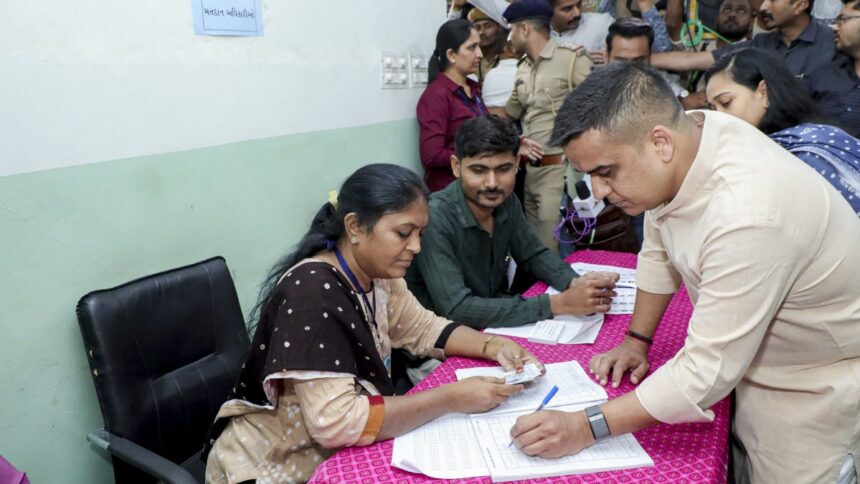
Gujarat Election Results: The counting of votes is currently underway for the Gujarat local body elections, a massive democratic exercise widely viewed as a barometer for the public mood ahead of next year’s crucial State Assembly elections.
With over 9,200 seats contested across municipal corporations, municipalities, and panchayats, the results will provide a definitive look at the political landscape of the state.
Vote counting is underway for Gujarat’s local body elections involving over 9,200 seats, considered a barometer for state assembly elections, featuring contests between BJP, Congress, and AAP amid revised OBC reservations and first-time polls for nine new municipal corporations.

Turnout Trends: Rural Zeal vs Urban Reserve
The State Election Commission reported a notable disparity between urban and rural engagement. While the overall turnout for the 15 municipal corporations reached 55.1%, rural and semi-urban areas showed significantly higher enthusiasm:
Taluka Panchayats: 67.26%
District Panchayats: 66.64%
Municipalities: 65.53%
In the urban centres, Vapi in Valsad district led the charge with a robust 72.29% turnout. Conversely, the newly established Gandhidham Municipal Corporation recorded the lowest urban engagement at 46.03%. The state’s commercial hub, Ahmedabad, saw a moderate turnout of 51.81%.
The rural narrative was dominated by the tribal-populated Narmada district, which posted a staggering 84.49% turnout, contrasting sharply with Porbandar, which recorded the lowest rural participation at 50.80%.
A Shifting Political Landscape
The elections were conducted under newly revised norms for Other Backward Classes (OBC) reservations, a move that necessitated extensive delimitation and the restructuring of wards across several districts. This election also marked a milestone for nine newly-formed municipal corporations-including Morbi, Mehsana, and Navsari-which went to the polls for the first time.
While the proceedings were largely peaceful, officials confirmed that a technical glitch with an Electronic Voting Machine (EVM) necessitated a repoll on Monday in one village within the Surendranagar district.
The Key Contenders
The electoral battleground features a high-stakes struggle between established giants and emerging forces:
BJP & Congress: The traditional titans of Gujarati politics remain the primary focus. The BJP is looking to replicate its 2021 dominance, where it secured a landslide victory, winning 6,236 of the 8,470 contested seats.
Aam Aadmi Party (AAP): In an ambitious expansion, the Arvind Kejriwal-led party fielded candidates for approximately 5,000 seats, marking its most significant push into Gujarat’s local governance to date.
Minor Parties & Independents: The AIMIM and NCP also fielded candidates in several key pockets, potentially acting as spoilers for the larger parties.
Notable individuals in the fray include former IPS officer M.L. Ninama, former radio personality Abha Desai, and former MLA Bhupendra Bhayani, adding a layer of celebrity and administrative experience to the local contests.
The 2021 Benchmark: In the previous local elections, the BJP swept all six municipal corporations and the vast majority of panchayats, leaving the Congress trailing significantly. All eyes are now on whether the opposition can bridge that gap or if the ruling party will maintain its formidable grip on the state.
As the results trickle in, the outcome will likely dictate the strategic shifts both the ruling and opposition parties will make as they pivot toward the upcoming Assembly campaign.