


International
oi-Pankaj Mishra

As Pakistan celebrates Gwadar’s recent traffic gains, a pointed signal is emerging behind the scenes. Hangeng Trade Company, a Chinese meat-processing firm operating in Gwadar’s North Free Zone, has shut its factory, sacking all employees and citing an “unworkable business environment” and what it called non-market barriers that left its export shipments stuck and undelivered.
In a stark warning to potential investors, the company urged anyone considering Gwadar-based ventures to carefully evaluate the uncertainties and risks before committing capital. It is worth noting that Hangeng is not a port stakeholder – the port itself is operated by China Overseas Port Holding Company (COPHC) – but the symbolism of a Chinese commercial operator walking out precisely when Pakistan is trying to attract more of them is difficult to ignore.
Chinese firm Hangeng Trade Company’s closure in Gwadar signals investor concerns, compounded by the BLA’s April 2026 maritime attacks, posing significant risks to the port’s commercial viability despite recent traffic gains.

For years, analysts tracking the Baloch Liberation Army focused almost entirely on its roadside bombs, targeted assassinations, and attacks on security convoys in Balochistan’s interior. In April 2026, that calculus changed abruptly.
On April 13, the BLA announced the formation of its “Hammal Maritime Defence Force” and claimed its first maritime operation in the Jiwani area near Gwadar, where fighters using a speedboat targeted a Pakistan Coast Guard patrol vessel and claimed three personnel were killed. The group stated that “following operations on land, this action in maritime boundaries marks a new and critical development in the BLA’s military strategy,” and warned that its scope was “no longer limited only to the mountains and cities.”
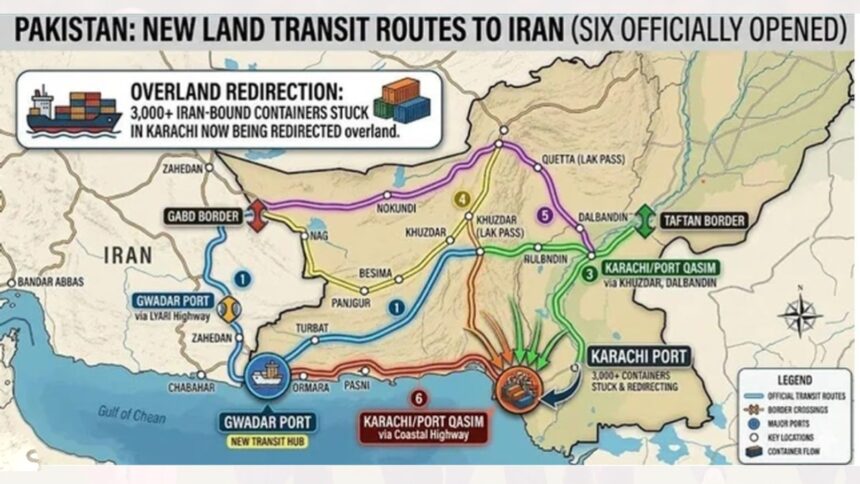
Pakistan is celebrating a surge in container traffic driven by the newly activated Pakistan-Iran road corridor and a crisis-driven diversion of shipping away from the Strait of Hormuz.
Shortly after US and Israeli airstrikes on Iran began, Iran’s Revolutionary Guard Corps declared the Strait “closed,” and traffic through the waterway reportedly fell by about 95 percent from its pre-war average of 178 daily transits. But the BLA’s strategic logic in this context is not difficult to read. If Gwadar’s land approaches have proven difficult to fully secure despite years of military presence, the littoral waters offer a new theatre where the group can impose costs on the port’s commercial ambitions at relatively low operational investment.
A single credible maritime threat, broadcast to global shipping companies and their insurers, is worth more to the insurgency than a dozen land attacks that can be reported and forgotten.
The insurance market has already registered this shift in the broader region. War-risk premiums for Gulf vessels rose from approximately 0.2 percent of a vessel’s value to as high as 1 percent within 48 hours of the conflict’s outbreak.
Insurers eventually returned to offering seven-day renewable coverage for Hormuz transits at around 1 percent of hull value – four times the pre-war rate of 0.25 percent. No publicly available data documents a specific Gwadar-rate separate from these regional figures, but the addition of a domestic maritime insurgency in Gwadar’s own coastal waters can only move that calculus in one direction.
Shipping insurance is a reliable indicator of how the maritime industry perceives risk – premiums rise when risk rises, routes are reconsidered when premiums rise significantly, and ports that become expensive to reach lose traffic to alternatives. Dubai’s Jebel Ali and even Karachi, for all their own limitations, do not yet face a declared armed group operating in their immediate approaches.
Pakistani security officials have publicly played down the April attack, describing it as an isolated incident. But the BLA’s formation of a dedicated maritime wing with its own name, spokesperson statement, and released video footage suggests systematic intent rather than opportunism. The group has consistently demonstrated the capacity to adapt – from urban bombings to complex ambushes, and now apparently to sea-based operations. Dismissing the maritime shift as insignificant risks repeating the analytical failures that allowed the BLA to expand substantially through the 2010s.
The deeper problem for Gwadar is that maritime security and commercial viability are inseparable. The port’s current traffic surge is already a product of exceptional circumstances. Gwadar is currently functioning not as a trade hub but as a temporary logistical buffer – cargo is offloaded, stored for short durations under the port’s free-storage offer, and then reloaded for onward shipment. That traffic will not automatically persist once the Hormuz situation stabilises. If maritime insecurity is layered on top of the port’s existing structural constraints – an operational channel depth of only 12.5 metres that bars standard container vessels, which require 13 to 14 metres of draft, chronic siltation costs, and stalled plans to expand berth capacity – the commercial case for routing long-term trade through Gwadar becomes very difficult to make.
Chinese commercial operators, who are ultimately the most consequential audience for Gwadar’s development pitch, are not sentimental about political narratives. They operate on risk-adjusted returns. A port with rising regional insurance costs, an active insurgent group now operating in its own coastal waters, and unresolved infrastructure limitations presents a risk profile that most serious logistics operators would struggle to justify.
The revenue-sharing structure compounds the problem for Pakistan: COPHC currently collects ninety-one cents of every dollar a transshipment container generates at Gwadar, leaving Pakistan with nine. A boom that mostly accrues to the foreign operator while Pakistan absorbs the security costs and geopolitical exposure is not the foundation of a sustainable port strategy.
Pakistan has invested enormous political capital in Gwadar as the CPEC anchor port. The BLA’s maritime shift suggests that those celebrating the recent surge as a breakthrough may be doing so too soon. What looks like a game-changer from Islamabad looks, from the perspective of any long-term commercial planner, like a port entering its most difficult chapter yet.