



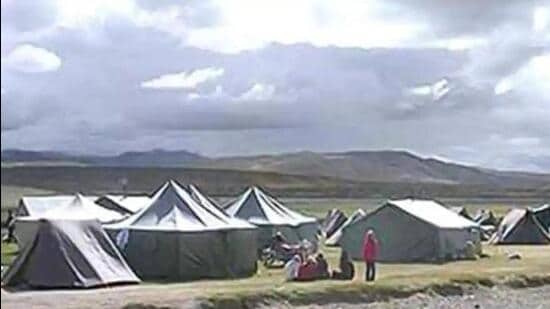
The number of Indian pilgrims eligible for the Kailash Manasarovar Yatra organised by the external affairs ministry and China this year is 1,000, an increase of 250 over the figure for 2025.

The pilgrimage is set to take place from June to August, the external affairs ministry said in a statement on Thursday. Ten batches, each consisting of 50 pilgrims, are scheduled to travel through Lipulekh Pass in Uttarakhand state, while another 10 batches, also consisting of 50 pilgrims, will travel through Nathu La in Sikkim state, the statement said.
Last year, 750 Indian pilgrims were chosen through a computerised draw for the Kailash Manasarovar Yatra, which was organised after a gap of five years as India and China began normalising their relations after the end of the military standoff on the Line of Actual Control (LAC) in 2024.
The website kmy.gov.in has been opened for accepting applications for this year’s pilgrimage. “The Yatris will be selected from among applicants through a fair, computer-generated, random and gender-balanced selection process,” the statement said.
The entire process for the pilgrimage, from the online application till selection of the pilgrims, is fully computerised. Applicants can login by registering on the site and submit their applications online. They do not need to send letters or faxes to seek information.
Applicants can either select both routes, indicating their priority, or select only one route. The last date for registration is May 19.
The resumption of the pilgrimage to Mount Kailash and Mansarovar Lake in China’s Tibet Autonomous Region, which was not been held between 2020 and 2024, was among confidence-building measures between the two sides after they reached an understanding in October 2024 on disengagement of troops at the friction points of Demchok and Depsang.
After the understanding on disengagement of forces, Prime Minister Narendra Modi and President Xi Jinping met in the Russian city of Kazan and decided to revive several mechanisms to address the border dispute and to normalise ties. One of these mechanisms – the Special Representatives on the border issue – focused on the resumption of the Kailash Mansarovar pilgrimage and several other crucial aspects of bilateral ties.
The pilgrimage was put off in 2020 because of the Covid-19 pandemic and it was subsequently affected by the face-off on the LAC, which took relations to their lowest point in six decades.
The site in Tibet is of religious significance to Hindus, Jains and Buddhists, and pilgrims have to trek at altitudes of up to 19,500 feet in extreme weather and rugged terrain.