



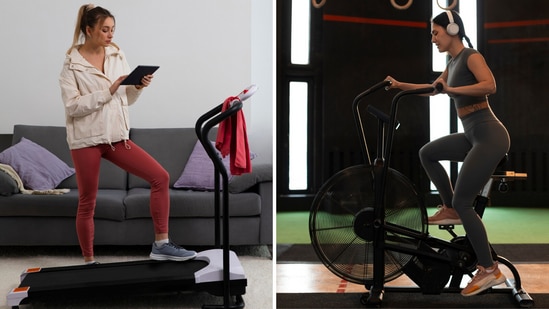
Choosing between a treadmill and a cross trainer largely depends on your fitness and health goals. From weight loss and endurance training to low-impact cardio workouts, both machines are popular choices for home and gym fitness routines. While treadmills are often preferred for intense cardio sessions, cross trainers may offer a smoother and more joint-friendly workout experience. Understanding the differences between these machines in terms of calorie burn, muscle engagement, joint impact, and workout style can help you make a smarter fitness choice.


“Treadmills are ideal for higher calorie burn and endurance training, while cross trainers offer a low-impact, full-body workout that is gentler on the joints. The right choice depends on your fitness goals, joint health, and comfort.” – Dr Ranjan Modi, Senior Consultant, Interventional Cardiology, at Medanta Hospital.
What is a treadmill?
Treadmills are popular indoor exercise machines that provide a moving surface on which to walk, jog, or run. They improve blood circulation, increase stamina, and help control the major cardiovascular risk factors of obesity, high blood pressure, diabetes, and high cholesterol. Treadmills can be used to walk quickly, jog, train for endurance, and burn calories. They are also very useful for people who enjoy walking or running but do not have access to safe outdoor areas.
What is a cross trainer?
The cross trainer, also known as the elliptical, is a low-impact cardio fitness machine that allows both arms and legs to move in a smooth elliptical motion simultaneously. A cross trainer allows users to do cardio exercise while putting less strain on their joints than traditional forms of cardio exercise, such as running/jogging or other high-impact exercises. Cross trainers are especially effective at increasing aerobic fitness while putting little strain on the user’s joints, making them a safe option for older adults, overweight people, people just starting to exercise, and people with knee or back problems to improve their aerobic fitness level. The cross-trainer is an excellent choice for people looking for a total-body workout with a low risk of joint strain or injury from exercise.
Key difference between a treadmill and cross trainer
When using a treadmill instead of an elliptical machine, the amount of muscle used and the amount of impact differ. To run or walk on a treadmill, you primarily use your legs, joints, knees, and ankles, and running has the greatest impact on these areas of the body. Elliptical machines provide a blended, smooth, low-impact activity for the entire body by working both the Upper and lower body muscles together. While you may burn more calories running at high intensity on a treadmill than on an elliptical, ellipticals are generally easier on the joints and allow for longer workout sessions.
Which is better for weight loss?
When combined with a healthy diet and regular physical activity, both types of machines can help you lose weight. A treadmill, on the other hand, will slightly increase total calories burnt compared to a crosstrainer because the body must exert more force against the ground than it would on a crosstrainer. Furthermore, high-intensity treadmill workouts significantly improve cardiovascular fitness and metabolic health. Both types of machines will also help with fat loss because they allow you to exercise for longer periods of time without fatigue and have less impact on your joints.
Which is better for joint health?
Cross-trainers provide low-impact exercise that is less taxing on your joints than other types of exercise. The smooth, gliding motion reduces pressure on the knees, hips, ankles, and lower back, making them a better option for the elderly, heavier people, those with arthritis, and anyone recovering from an orthopaedic injury. In contrast, a treadmill can cause knee and/or back pain, especially if you run for an extended period of time at a high level of resistance.
Which is better for a full-body workout?
According to an expert, an elliptical machine engages the user’s arms, shoulders, chest, core, and legs, providing a more complete full-body workout than a treadmill. In contrast, a treadmill focuses on the lower body and cardiovascular system. If you want to improve your overall body conditioning while also receiving cardiovascular benefits, you may prefer to use an elliptical machine rather than a treadmill.
Which is better for cardio?
Treadmills and cross-trainer machines can both help you achieve cardiovascular fitness. Treadmills are frequently used to improve a person’s ability to tolerate exercise, endurance, and maximum aerobic capacity. Treadmills are also widely used by younger, more athletic people to improve overall performance. Cross trainers offer a great cardiovascular workout while lowering the risk of injury. For those who have a history of exercising injuries, cross-trainers are often a better long-term solution than treadmills. A cross-trainer may be the safest and most comfortable form of exercise for older adults or people with heart disease.
Things to look for before getting these
Before purchasing a treadmill or cross trainer, consider your age, fitness goals, weight, joint health, available space, and safety features, such as heart rate monitoring, cushioning, stability, and emergency stop. Treadmills are ideal for those who want to run while also burning calories, whereas cross trainers are ideal for those who have joint problems or are new to exercise. Finally, consistent moderate exercise is the most important factor in maintaining a healthy heart and overall fitness.
Disclaimer: This article is for informational purposes only and not a substitute for professional medical advice. Always seek your doctor’s advice for any questions about a medical condition. At Hindustan Times, we help you stay up-to-date with the latest trends and products. Hindustan Times has an affiliate partnership, so we may get a part of the revenue when you make a purchase. We shall not be liable for any claim under applicable laws, including but not limited to the Consumer Protection Act, 2019, concerning the products. The products listed in this article are in no particular order of priority.