


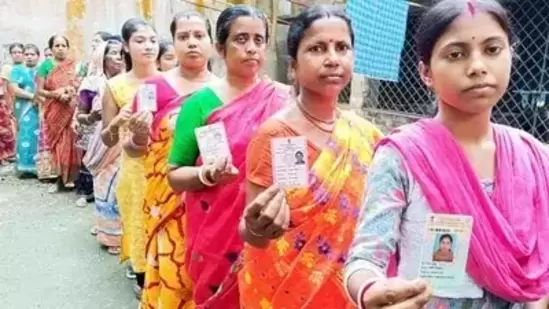
The clue lies in the queues. Women are everywhere. In Tamil Nadu, a record 84.69% turnout with female participation at 85.76%, overtaking male turnout at 83.57%.

In West Bengal, where only the first phase of polling is over, turnout is even higher at 91.78%. Once again, women lead, 92.69% to 90.92% for men.
The queues result in many things. Stirring words on nari shakti at election speeches. Cash in hand via unconditional cash transfers (UCTs) in three of the four states—Kerala is the exception—and one union territory, Puducherry where assembly elections are underway.
In Assam, among the first states to introduce UCTs, women heads of households receive ₹1,250. In West Bengal, where Lakshmi Bhandar was introduced in 2021, the transfer now ranges between ₹1,500 and ₹1,700. In Tamil Nadu, it is ₹1,000. And in Puducherry, women heads of families below the poverty line used to get ₹1,000, which has been bumped up to ₹2,500 this election cycle.
As an added layer to the UCTs, are a slew of women-centric schemes. Tamil Nadu, West Bengal and Assam support girls’ higher education through cash assistance. West Bengal offers marriage assistance grants. Assam supports grassroots women entrepreneurs through self-help groups.
West Bengal offers free bicycles to girls, Tamil Nadu free bus rides, and Assam free scooters to women in self-help groups. Tamil Nadu even has an official state policy for women. Introduced in 2024, it aims to improve access to health and employment.
Kerala is the only state of the four that does not offer large-scale UCTs. What it offers instead is a robust livelihood programme, Kudumbashree. “Instead of relying on cash transfers, it has invested in institution-building and collective economic empowerment,” writes Sunaina Kumar, director and senior fellow at the Centre for New Economic Diplomacy at the Observer Research Foundation.

The largesse to women comes not from political parties or state governments. It is prompted and promoted by the women themselves. Women, as this election cycle also confirms, are voting in larger numbers than men, and there is evidence that they are exercising their voting independently of family diktats for candidates who they prefer.
There are several reasons for their higher voter turnout that include mobilisation by the Election Commission, higher educational attainment, and an aspirational desire to participate in a fundamental democratic exercise.
In the first elections in independent India in 1951, 2.8 million women had to be disqualified because they had been identified only as “A’s mother” or “B’s wife”, points out Kumar. The shift from then to now “marks a profound transformation,” she writes.
In the ongoing West Bengal elections, mass deletions by the Election Commission ostensibly to update electoral rolls have reportedly disproportionately impacted minorities and women. It has also led to a fear of getting struck off the electoral list for subsequent elections. That fear has led to the mass return of migrant workers, including women, from other parts of India to West Bengal.
Now that they matter electorally, the women will not be disenfranchised.

The generosity of political parties of all stripes and ideology towards woman can only be welcome. There is, however, one crucial area where we continue to see a historical miserliness: Giving women a seat at the table.
Women’s representation in Parliament hovers at 14% and in the state assemblies at an average of 10%.

The statistics have remained stubbornly, and depressingly, low.

It was clear even 27 years ago that nothing would change unless seats were reserved for women. The first women’s reservation bill was introduced in 1996. It lapsed in the face of open misogyny and hostility.
Nearly three decades later, how much had changed when Parliament finally passed the Nari Shakti Vandan Adhiniyam, or women’s reservation bill, with near unanimity in September 2023.
But, there was a catch. Reservation would only kick in only after the completion of the census, delayed since 2012 first because of Covid and then for reasons that are unclear.
Then after 1.3 billion people had been enumerated, a delimitation commission would be set up. This commission would redraw the constituencies, based on their populations.
This set off alarm bells. States like Tamil Nadu and Andhra Pradesh feared they would lose parliamentary seats as a penalty for successfully implementing population-control programmes. Hindi-belt states like Bihar and Uttar Pradesh stood to gain representation.
Nobody knew when the census-delimitation exercise would be complete, which meant that women’s reservation, a reality in law and on paper, was on indefinite hold.
Does reservation have to wait for an expanded parliament sometime in the indeterminate future? Why not set aside 33% of seats in the existing 543 seat parliament? Perhaps the answer lies in the fact that accommodating women in an expanded house of 851 seats would mean none of the “men’s seats” would be taken away.
The entitlement of patriarchal power structures behind a law meant to empower women is evident.
A promise deferred

For three years no party spoke about nari shakti. Then suddenly the government sprung a surprise in the last session: A special three-day extension solely to discuss the implementation of the Nari Shakti Vandan Adhiniyam or the women’s reservation act. The government had a plan: Increase Lok Sabha seats for all seats by a flat 50%. This would take the number of seats in parliament to 850. The additional seats would then be earmarked for women. And the old Census 2011 would be used for delimitation.
A united opposition saw the proposal as an attempt to redraw the electoral map. It was also evident, that if passed, it would give the BJP and its allies the credit for the historic enhancement of increasing women’s representation not just for this election cycle but for crucial state elections next year as well.
The constitutional amendment bill failed to get the two-thirds majority to pass.
The BJP is making a virtue of defeat. At an election rally in Coimbatore, prime minister Narendra Modi said: “I only want our sisters to come to parliament in greater numbers. But these noble efforts were delayed. The DMK, Congress and their allies made this bill a target of hatred. If this bill had been passed earlier many Tamil women from ordinary families would have become MPs and MLAs.”
But if the BJP has reportedly planned a 15-day outreach on the women’s quota issue, the opposition too is not about to miss an opportunity. It has challenged the ruling party to implement reservation now with 543 seats and an equitable distribution through sub-quotas for OBCs. Failure to do so is political showmanship and a fake concern for women’s empowerment, it says.
While women must wait, yet again, for their rightful share in power, nothing stops political parties from proving their bona fides by fielding more women candidates. They can also boost women’s leadership within their own internal party structures by appointing women as general secretaries, party treasurers and one the national executive committee.