


India
oi-Madhuri Adnal

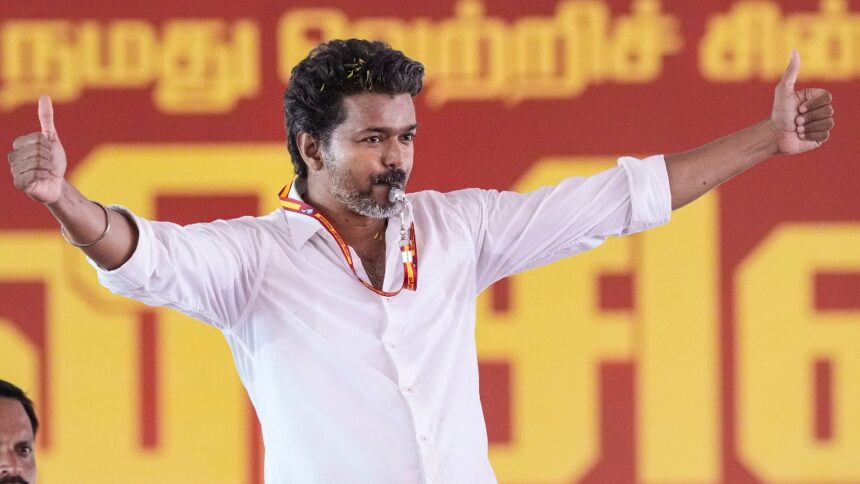
It’s a “Whistle Podu” moment for Vijay as Tamilaga Vettri Kazhagam (TVK) surges across Tamil Nadu – and this time, the whistle is not just a symbol, but a statement.
Officially allotted by the Election Commission of India for the 2026 Assembly elections, the whistle was a personal choice by Vijay. But as early trends show TVK leading in 105 of 234 seats, the symbol has quickly evolved into a rallying cry for a shifting political mood – one that is beginning to challenge the entrenched dominance of the Dravida Munnetra Kazhagam (DMK) and the All India Anna Dravida Munnetra Kazhagam (AIADMK).
Tamilaga Vettri Kazhagam (TVK), led by Vijay and allotted the whistle symbol for the 2026 Assembly elections, shows strong early leads, challenging established parties with a welfare-focused manifesto promising financial aid, jobs, and governance reforms.

At the heart of this surge lies not just star power, but a carefully structured, welfare-driven manifesto that appears to be striking a chord across voter groups.
Philosophy meets populism
During the manifesto launch, Vijay anchored TVK’s political vision in the teachings of Thiruvalluvar’s Thirukkural. The framework of aram (virtue), porul (wealth) and inbam (joy) was presented not as abstract philosophy, but as a governance blueprint.
#WATCH | Tamil Nadu Elections 2026 | Family of TVK chief and actor Vijay blow whistles and celebrate at their residence, as the party continues its lead in the state. It is currently leading on 110 of the total 234 seats in the state. pic.twitter.com/EnVN6HouAQ
— ANI (@ANI) May 4, 2026“>
This blend of cultural grounding and modern policy has allowed TVK to position itself as both rooted and reformist – a balance that seems to be resonating in a state where political narratives are often deeply tied to identity and legacy.
Welfare at the centre of the pitch
TVK’s 95-page manifesto places welfare at the core, combining direct cash support with structural reforms. Vijay has repeatedly stressed “honest administration” as the party’s ideology, contrasting it with what he describes as promise-heavy but delivery-light governance under incumbent Chief Minister M. K. Stalin.
Women form the backbone of this strategy. The promise of ₹2,500 per month for women heads of families, six free LPG cylinders annually, and dedicated safety mechanisms signals a clear attempt to consolidate household-level support. Added benefits tied to marriage and childbirth – including gold assistance – further expand the welfare net.
Youth, jobs and aspiration
Beyond welfare, TVK’s manifesto taps into aspiration, particularly among young voters. Collateral-free education loans of up to ₹20 lakh, unemployment allowances, and skill training stipends aim to address both immediate financial stress and long-term employability.
The proposed recruitment transparency in government jobs and the ambitious “CM People Service Associate” programme – which promises 500,000 village-level roles – underline a broader strategy: linking governance reform with employment generation.
This dual messaging of support and opportunity appears to be a key factor behind TVK’s traction among first-time voters.
Farmers and grassroots economy
Farmers are another major focus area. Loan waivers, legally backed minimum support prices, and a proposed cultivator rights card aim to bring both relief and recognition to agricultural workers, including tenant farmers often left out of formal systems.
At the same time, TVK is attempting to reshape the local economy by incentivising companies to hire locally, offering tax and power subsidies tied to workforce composition. This move aligns economic growth with regional employment – a theme that runs consistently through the manifesto.
Governance reforms and accountability
TVK’s pitch goes beyond welfare and jobs into systemic reform. Proposals like a Citizen Privilege Card and a Right to Service Act aim to simplify access to schemes and ensure time-bound delivery of government services.
The idea of allowing citizens to directly petition the legislative assembly – with mandatory responses for high-support submissions – introduces a participatory governance element rarely emphasised in state-level politics.
The scale of TVK’s rise suggests more than just electoral momentum. It reflects a broader shift – one where voters appear willing to look beyond traditional party lines in search of new leadership and governance models.
For now, the whistle is blowing loud across Tamil Nadu. Whether it marks a lasting political transformation or a moment of disruption will depend on how this surge translates into governance. But one thing is clear: Vijay’s manifesto is not just a document – it has become the engine driving TVK’s “Whistle Podu” moment.