


Football
-Prakash KL

Cape Verde’s World Cup debut ended in heartbreak, but not before the Atlantic island nation became one of the defining stories of the 2026 tournament. The Blue Sharks, representing one of the smallest countries ever to play at a World Cup, pushed reigning champions Argentina to extra time in Miami before losing 3-2 in the last 32.
For many viewers, the team’s run has raised a simple question: where exactly is Cape Verde, and how has a country of roughly 530,000 people managed to trouble football’s biggest names? The answer lies in a nation shaped by migration, scarcity, resilience and a football culture strengthened by a vast diaspora.
Cape Verde, an Atlantic archipelago nation of 530,000 people, debuted in the 2026 World Cup, reaching the last 32 and pushing Argentina to extra time, showcasing resilience shaped by its migration history and diaspora.

Where is Cape Verde?
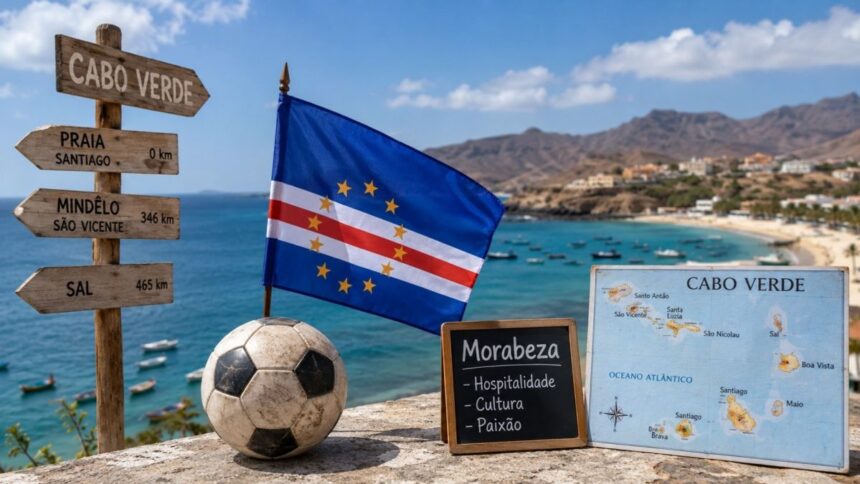
Cape Verde, officially Cabo Verde, is an archipelago of ten volcanic islands in the central Atlantic Ocean. The islands lie about 600 to 850 kilometres west of Senegal, off the coast of West Africa. They form part of Macaronesia, a region that also includes the Azores, Madeira and the Canary Islands.
The country’s islands are usually grouped into two chains: Barlavento, or windward, and Sotavento, or leeward. Santiago is the largest island and home to Praia, the capital. Other well-known islands include São Vicente, Santo Antão, Sal, Boa Vista and Fogo, which has an active volcano that last erupted in 2014.
Cape Verde is small in land area and population, but its global presence is much larger. Generations of emigration have created sizeable Cape Verdean communities in Portugal, the United States, the Netherlands, France and other parts of Europe. In football, that diaspora has become a major sporting resource.
A country built by the sea, migration and survival
The islands were uninhabited until Portuguese navigators arrived in the 15th century. The first permanent settlement was founded at Ribeira Grande, now Cidade Velha, on Santiago island in 1462. Its location made the archipelago a strategic stop between Europe, Africa and the Americas.
That geography also tied Cape Verde to one of history’s most brutal systems. Ribeira Grande became an important staging post in the transatlantic slave trade, growing wealthy within the Portuguese empire. The legacy of slavery, forced movement and later migration remains central to Cape Verdean identity.
After the decline of the slave trade in the 19th century, the economy weakened. Repeated droughts and famines forced many Cape Verdeans to leave in search of work and survival. This history of departure helped create a society where family networks often stretch across continents.
Cape Verde became independent from Portugal on July 5, 1975. Unlike some other Portuguese colonies in Africa, it achieved independence without an armed conflict on its own soil. Since introducing multiparty democracy in 1991, the country has been widely regarded as one of Africa’s more stable democratic states.
Why Cape Verde’s World Cup run matters
On the pitch, Cape Verde’s 2026 campaign has been far more than a feel-good underdog story. The team earned its first World Cup point against Spain, with goalkeeper Vozinha producing a performance that became one of the early talking points of the tournament.
Against Uruguay, Cape Verde scored its first World Cup goals, turning a historic appearance into a genuine footballing statement. Then came the knockout tie against Argentina, where Sidny Lopes Cabral’s spectacular goal helped take the defending champions deep into extra time.
The defeat in Miami was painful because Cape Verde came so close to one of the biggest shocks in World Cup history. Yet the reaction to the final whistle showed how far the team had travelled. Players sank to the turf, but their campaign had already changed how many fans viewed the Blue Sharks.
The achievement feels even sharper because Cape Verde does not have the sporting infrastructure of larger football nations. Its domestic league operates in difficult economic conditions, and many of its leading players develop abroad. The national team depends on connecting talent from the islands with players of Cape Verdean heritage overseas.
Culture, language and a global Cape Verdean identity
Portuguese is the official language, but everyday life is largely carried in Kriolu, a Portuguese-based creole with variations across the islands. That mix reflects the country’s layered history: African roots, Portuguese colonial influence, Atlantic movement and a strong sense of island identity.
Music is one of Cape Verde’s most recognised cultural exports. Morna, often associated with themes of longing, exile and return, was taken to global audiences by singer Cesária Évora. UNESCO added morna to its list of Intangible Cultural Heritage in 2019, recognising its importance to Cape Verdean culture.
That sense of “sodade”, or longing, has often been linked to Cape Verde’s history of separation and emigration. It also helps explain why the national football team carries emotional meaning beyond the islands. For many in the diaspora, the Blue Sharks are a visible link to home.
The country’s modern development story is also unusual. Cape Verde graduated from the United Nations’ Least Developed Country category in 2007, supported by education, tourism, remittances and services rather than large natural resources. Its economy remains vulnerable, especially to climate pressures and tourism shocks, but its progress has been notable.
Only a limited share of Cape Verde’s land is arable, and drought has long shaped life on the islands. Agriculture is concentrated mainly on islands such as Santiago, Santo Antão, São Nicolau, Fogo and Brava. These constraints make the country’s international rise, in football and beyond, even more striking.
Cape Verde might have ;eft the 2026 World Cup without another match to play, but its impact will outlast the scoreline against Argentina. The tournament introduced millions to a small Atlantic nation with a difficult past, a far-reaching diaspora and a team that refused to behave like outsiders.