India
oi-Madhuri Adnal

Even as the Centre continues to defend its E20 petrol rollout, a new India Today-CVoter survey suggests the policy is struggling to win over even the government’s own support base. The survey found that more than half of National Democratic Alliance (NDA) supporters would rather not use E20 petrol as concerns over fuel efficiency and vehicle damage continue to persist.
The survey found that 52.5 per cent of NDA supporters said they would not opt for E20 petrol, while only 18.1 per cent said they would. Another 29.5 per cent remained undecided.
An India Today-CVoter survey revealed over half of respondents, including NDA supporters, prefer not to use E20 petrol due to concerns about fuel efficiency and vehicle damage, with most favoring consumer choice. The poll was conducted July 8-9 among 1,641 adults.

The scepticism extended beyond the ruling alliance’s voter base. Among Opposition supporters, 57.9 per cent said they would not choose E20 petrol, while 55 per cent of respondents aligned with other political parties also rejected it. Overall, 55.1 per cent of those surveyed said they would not prefer using E20 petrol, compared with 17.1 per cent who supported it.
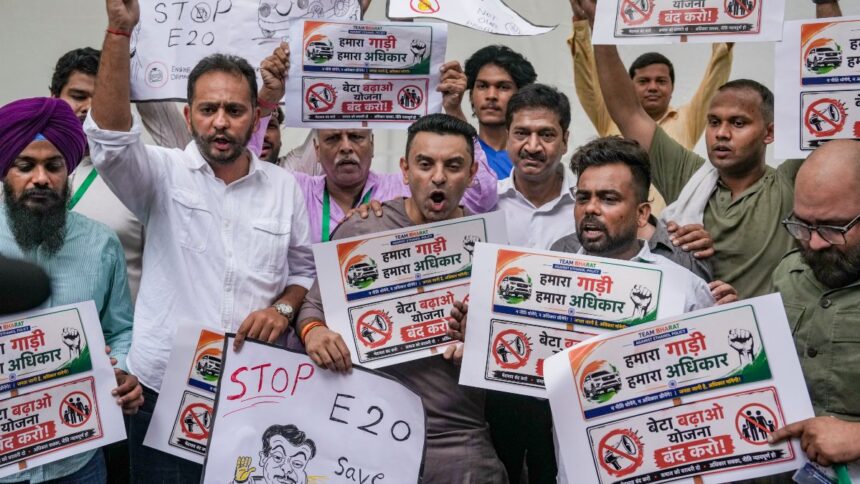
The findings come amid an intensifying debate over the Centre’s ethanol blending programme. Days ago, Union Road Transport and Highways Minister Nitin Gadkari challenged critics to identify even one person whose vehicle had been adversely affected by E20 petrol. Protesters responded by saying they could present six such vehicle owners and asked the minister to meet them before they spoke publicly.
Beyond fuel preference, the survey also found limited support for the ethanol blending policy itself. Across all respondents, 52 per cent said they did not support blending ethanol with petrol, while 22 per cent backed the policy. Among NDA supporters, 48.2 per cent opposed the policy, 24.4 per cent supported it and 27.4 per cent remained undecided.
Concerns over mileage emerged as one of the biggest reasons behind the resistance. According to the survey, 52.8 per cent of respondents believed E20 petrol reduces fuel efficiency. The figure stood at 51.2 per cent among NDA supporters and 55.4 per cent among Opposition voters.
Vehicle compatibility also remained a major concern. More than half of respondents (54.2 per cent) believed ethanol-blended petrol could damage most vehicles. The share was 49.9 per cent among NDA supporters and 60.2 per cent among Opposition supporters. Another 14.3 per cent believed the fuel affects only certain vehicles, while 10.9 per cent said it does not damage vehicles.
The survey also found that 56.3 per cent of respondents considered the mandatory rollout of E20 petrol unfair to owners of older vehicles. Among NDA supporters, 49.2 per cent shared that view, compared with 65.8 per cent of Opposition supporters.
While respondents remained sceptical about E20, they strongly backed giving consumers a choice. Nearly 76 per cent said both ethanol-blended petrol and regular petrol should continue to be sold. Support for retaining both fuel options stood at 72.4 per cent among NDA supporters.
A similar majority favoured differential pricing. Overall, 74.5 per cent said E20 petrol should be cheaper than regular petrol, including 75.6 per cent of NDA supporters. Even so, price alone did not appear enough to change consumer behaviour. While 40.8 per cent said they would switch if E20 were sold at a lower price, 40.4 per cent said they still would not.
The survey also explored public opinion on the government’s argument that ethanol blending will reduce India’s dependence on crude oil imports. Overall, 37.2 per cent strongly agreed with the claim and another 19.5 per cent somewhat agreed. In contrast, 17.1 per cent strongly disagreed and 14.1 per cent somewhat disagreed.
Asked what they believed was the primary reason behind the government’s push for E20 petrol, 27.5 per cent cited reducing crude oil imports, 21.3 per cent pointed to supporting sugarcane farmers and 11 per cent said reducing pollution.
The findings are based on an India Today-CVoter Snap Poll conducted through Computer Assisted Telephone Interviewing (CATI) between July 8 and July 9 among 1,641 adults across the country. According to CVoter, the results were weighted using Census and Election Commission data and carry a margin of error of ±3 per cent at the macro level and ±5 per cent at the micro level, with a 95 per cent confidence interval.