


Bengaluru
oi-Madhuri Adnal

If you are one of the thousands of Bengalureans who spend hours crawling through the Outer Ring Road every day, the Karnataka government says change is finally on the way.
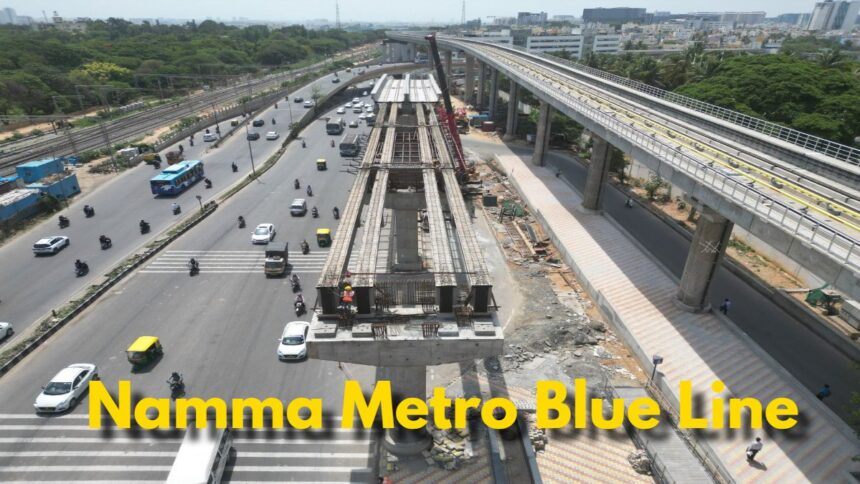
The state has now put a timeline on the much-delayed Namma Metro Blue Line and unveiled plans to redevelop a 17-km stretch of the Outer Ring Road (ORR), promising better roads, wider footpaths and improved pedestrian infrastructure.
The Karnataka government will redevelop a 17-km stretch of Bengaluru’s Outer Ring Road (ORR) for Rs 450 crore, improving roads and pedestrian infrastructure, while Namma Metro Blue Line trial runs begin in October with commercial operations expected in 2027.

Greater Bengaluru Development Minister Krishna Byre Gowda on Saturday said he has directed the Bangalore Metro Rail Corporation Limited (BMRCL) to begin trial runs of the Blue Line in October. Commercial operations are expected to begin in 2027.
The 58.19-km Metro corridor, which was originally scheduled to be completed in 2024, will connect KR Puram, Central Silk Board, Hennur, Hebbal and Kempegowda International Airport in different phases.
The announcement was made during a stakeholder meeting on the redevelopment of the ORR stretch, where the government also revealed plans to spend Rs 450 crore on upgrading one of Bengaluru’s busiest and most congested road corridors.
For the government, the Metro project and the ORR makeover go hand in hand. According to Gowda, Bengaluru cannot solve its traffic problems without strengthening public transport infrastructure.
The minister said the sheer volume of traffic on the ORR, coupled with complex junctions and directional movements, makes Metro connectivity a top priority for the corridor.
The government is seeking public suggestions for the redevelopment project even though consultants have already submitted the design plan.
“We will share a design draft with you, and we will also take your suggestion, and if it fits, we will integrate and take it ahead,” Gowda said.
But the proposed makeover is not just about easing traffic. The government believes Bengaluru’s ORR has become difficult to navigate not only for motorists but also for pedestrians.
According to Gowda, inadequate and discontinuous footpaths have pushed people towards motorised transport even for short distances. He said residents who would otherwise choose to walk for about two kilometres are often left with little choice because of poor pedestrian infrastructure.
“If the issue is fixed, the situation can be improved,” he said.
The redevelopment blueprint includes at least 10-foot-wide granite footpaths across the stretch. High-rise pedestrian crossings and foot overbridges will be connected to cycle tracks and bus bays, while existing junctions and skywalks are also set to be upgraded.
The government is also proposing long-lasting road infrastructure for the corridor. Major carriageways are expected to be developed using asphalt or white topping, with white-topped roads projected to last for nearly 25 years.
Interestingly, the state plans to change how road maintenance contracts are awarded. Instead of simply constructing the roads and handing them over, contractors will be responsible for maintaining them for the next 10 to 12 years under an annuity payment model.
Payments will be released in instalments only after annual quality checks of road surfaces, footpaths and street lighting, ensuring that contractors remain accountable for the condition of the infrastructure long after construction is completed.
Apart from roads and footpaths, the redevelopment project also aims to streamline civic infrastructure work. Stormwater drains, drinking water supply, sewage lines, electricity and gas pipelines are expected to be developed through inter-departmental coordination. Public toilets, parking facilities, bus stands and pedestrian amenities are also part of the plan.
Gowda attributed many of Bengaluru’s infrastructure woes to decades of unplanned urbanisation. He said unauthorised layouts, multi-storey buildings constructed on 20-foot roads and layouts developed without leaving space for civic amenities and playgrounds have only worsened mobility challenges over the last 30 years.
He added that suggestions such as grade separators are expensive and complicated by land acquisition issues. Rationalising traffic movement at major intersections continues to remain a challenge because of the ORR’s complex junction design.
For now, the government believes the solution lies in redeveloping the corridor rather than introducing temporary fixes.
“This stretch requires a new approach and redevelopment,” Gowda said.