


After zamindars, the most significant patrons of terracotta temples were merchants. The surge in textile exports and the monetization of the economy under the Mughals in the 17th and 18th centuries enabled merchants to become wealthy and to replicate the temple sponsorship of the landholding classes.
Inscriptions record temple-building as acts of devotion, but in practice, they also signalled the patron’s wealth and prospects, attracting cultivators and artisans to the merchant’s village. The temple compound was where the Vaishnav community gathered for daily kirtan and annual festivals, practices that bound them to one another and to the patron-sponsor.
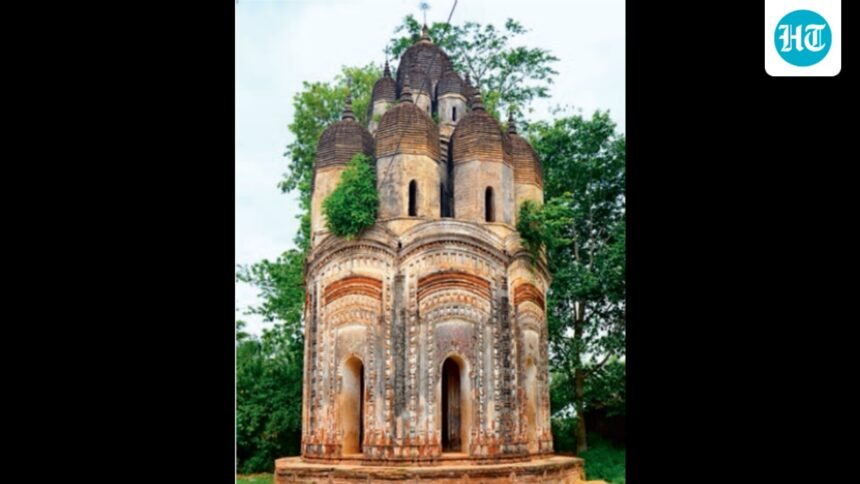
Hitesranjan Sanyal has shown that the number of merchant-sponsored temples rose sharply in the 18th-century. These merchant-patrons were usually from the upwardly mobile Navasakha, Ajalchal, and Antyaja castes, who had previously been cultivators and artisans. To distinguish their temples from those of the landed elite, they favoured new structures such as the naba-ratna and eclectic imagery—Shaivite, Shakta, and Vaishnav, alongside scenes from the Mangal-Kavyas, especially the Chandimangal.
Merchant-sponsored temples are found in every district of Bengal. In Birbhum, commercial activity increased after the East India Company gained direct control of the region in the 18th-century.
Ilambazar became a major manufacturing centre—specializing in tussar, indigo, and shellac—and several merchants sponsored temples. Several sites in Central Birbhum specialized in traditional ironsmelting, including Ganpur where several merchants built richly decorated temples faced with a local pink laterite called phulpathor. In the market town of Siuri, once renowned for furniture and palanquins, the merchant Ghanashyam Das built the majestic Radha Damodar Temple. In Surul, in eastern Birbhum, the Sarkar merchants sponsored three terracotta temples near their 19th-century mansion. The ancient town of Supur became a French textile trading outpost in the 18th-century when its merchants built two ornate brick temples. Further south, in Itanda, textile merchants sponsored several temples, including a jor-bangla Kali temple.
Many villages in eastern Bardhaman district were centres of silk-cocoon rearing, silk spinning, and tussar weaving. Amadpur has several at-chala temples sponsored by Choudhury, Nandi and Banerjee merchants. Nearby, Hat-Gobindapur and Krishnapur also have merchant-built mansions and temples.
The village of Bahadurpur, once famed for textiles, has richly decorated temples built by the Nayeks and Banerjees. In Sribati near Katwa, the Chandra silk merchants built three ornate temples near their 19thcentury mansion. In Jagadanandapur, Krishnadulal Ghosh Choudhury built a sprawling sandstone Radha-Gobinda Temple. Bonpas, once known for its brass and bell-metal industry, has several merchant-built temples.
In Bankura district, many villages around Bishnupur became silk weaving centres. Rajagram near Bankura town was renowned for cotton textiles, tussar and shellac. It still has many old merchant mansions and several weavers continue to work with spinning wheels and handlooms. The Dutta and Kundu families built ornate pancha-ratna temples here. In Bishnupur town, the Basu silk merchants sponsored the naba-ratna Sridhar Temple. East of Bishnupur, Joypur also became a silkweaving centre, where the Dey and Datta merchants built naba-ratna Vishnu temples. In Rajogram, a market for tussar cocoons, the Laha merchants family built a Rasmancha, a double-storey Dalan, and a Giri Govardhan Temple near their mansion. Further east, Kotulpur produced coarse cotton cloth used in tents and bandages. Wealthy from this trade, several branches of the Bhadra family built temples, pavilions, and mansions. In northern Bankura, Sonamukhi was an ancient textile centre that prospered in the 19th-century when the magnificent 25-ratna Sridhar Temple was built by Rudradas Tantubai. Nearby stands a Shiva temple built by the Chandra merchants, who traded in perfumes and spices.
Villages in the fertile Hugli district were strategically located to supply goods for Bengal’s export market, being less than a day’s journey from the 15th century Sultanate port of Satgaon.
In the 18th-century even more villages became textile-producing centres serving the European trading posts along the river. In villages like Haripal and Dwarhatta, the French, Dutch, and English even set up their own manufacturing centres or aurungs to control production and ensure supply for their ships. In eastern Hugli, Rajbalhat emerged as a major textile centre, where the Sil and Ghatak families built several richly decorated temples. Other villages with merchant-sponsored temples include Kotalpur (Bakuli family), Jaynagar (Chatterjee family), Baligori (Dey family), and Aknapur (Kundu and Mallick families). In western Hugli, silk-weaving villages around Arambagh and Goghat are rich in merchant-sponsored temples. Notable examples include Hatbasantapur (China family), Bhalia (Sarkar family), Badanganj (Barat family), and Shyambazar (Datta and Das families). The large village of Bali-Dewanganj, famous for silk weaving and metalware, boasts ornate merchant mansions and temples in neighbourhoods such as Routpara, Ghoshpara, and Dalalpara.
Several villages in northern and eastern Medinipur district became centres for silk-cocoon rearing, spinning, and weaving. Remnants of aurungs established here by the Dutch, French, and English still survive around Daspur. Villages in this region with merchant-sponsored temples include Khirpai (Datta family), Suratpur (Hazra family), Khorda-Bishnupur (Roy family), Purba Gopalpur (Adhikari family), and Ajuria (Charan family). In central Medinipur, on the Kangsabati River is the village of Pathra where several temples were sponsored by the indigo-trading Majumdar and Banerjee families. Lowada, once famous for sugar and palm candy, has the Poddar family’s Radha-Gobinda Deul. Further south, the Maity textile-merchants constructed the superb Janaki Ballabh Temple in Tilantapara.
(Excerpted with permission from Tapestries in brick:A Guide to the Architecture of Bengal by Amit Guha, published by HarperCollins; 2026)