



Partner Content
-Staff

Most succession plans begin with an assumption that rarely gets questioned: Today’s high-performing individual contributor will become tomorrow’s manager.
For decades, that assumption held up. Career progression followed a familiar path. Employees built expertise, proved themselves, took on more responsibility, and eventually moved into people management. Organizations invested in identifying future leaders because there was a reasonable expectation that those leaders wanted the role.
The traditional management career path is losing its appeal. Discover why professionals are rethinking leadership roles, embracing ‘conscious unbossing,’ and what this shift means for organizations. Learn how to adapt succession planning and redefine career growth to attract and retain top talent in a changing workforce.

That expectation is becoming less reliable.
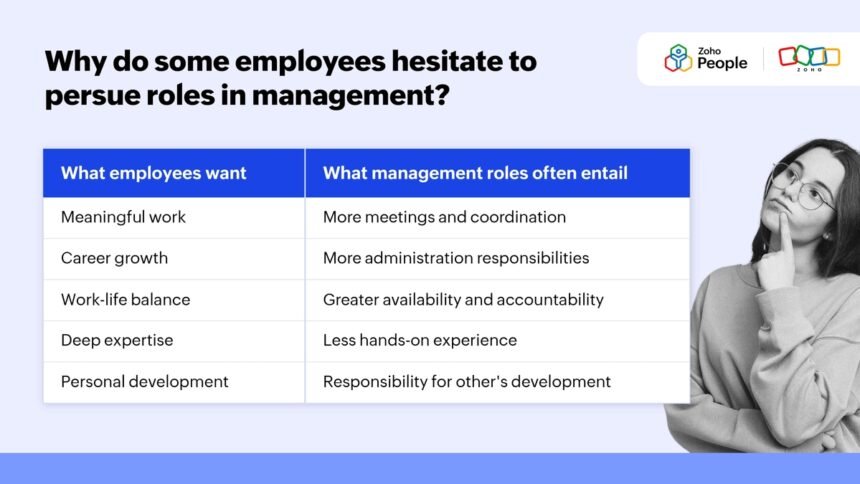
A growing number of younger professionals are choosing not to pursue management, even when they’re well-positioned to do so. Research on what’s now being called “conscious unbossing” suggests many Gen Z employees see middle management as a role with high responsibility, limited autonomy, and little room for work-life balance. At the same time, other studies show that relatively few see leadership positions as their primary career goal.
And while some may see this as a generation lacking ambition, it’s more about a generation redefining what ambition looks like.
Many still want greater influence, more meaningful work, and opportunities to shape business outcomes. What they’re questioning is whether managing people is the only way to achieve those goals.
That distinction impacts succession planning, which has traditionally assumed the two were inseparable.
The succession pipeline is changing
Organizations often describe leadership pipelines as though they’re just built around capability. In reality, they’re also built around willingness.
Capability is relatively easy to assess. Performance reviews, stretch assignments, and leadership potential frameworks all attempt to answer the same question: Can this person lead?
Willingness is less visible. It’s often assumed rather than discussed.
When that assumption no longer holds, the pipeline begins to narrow in ways that aren’t immediately obvious. Roles don’t suddenly become impossible to fill. Instead, fewer employees volunteer for leadership development opportunities, fewer express interest in management positions, and internal succession slates become noticeably thinner over time.
By the time a key manager leaves, the problem has already been building for years.
This is where HR faces a different kind of challenge. The issue goes from simply replacing managers to ensuring there’s a sustainable pool of people who actually want to become them.
Why the role has become less attractive
The hesitation isn’t difficult to understand.
Managers today are expected to coach employees, deliver results, navigate change, handle performance conversations, support wellbeing, manage hybrid teams, and translate strategic priorities into day-to-day execution. Alongside those responsibilities sits an increasing amount of administrative work, approvals, compliance requirements, and coordination across functions.
Many employees have spent the early years of their careers watching managers juggle competing priorities with little time left for the parts of leadership that attracted them in the first place.
Research consistently points to high levels of stress and burnout among middle managers. It’s hardly surprising that employees paying attention ask themselves whether the promotion is worth it.
Viewed through that lens, conscious unbossing looks more like a practical career decision.
The cost extends beyond one vacant role
When fewer employees aspire to management, the impact reaches beyond succession planning.
Organizations rely more heavily on external hiring for leadership positions, often at a higher cost and with longer ramp-up periods. Existing managers inherit larger teams while vacancies remain open, which increases workload across the organization. Meanwhile, employees lose opportunities to learn from leaders who understand the business because fewer internal candidates are ready to step into those roles.
There’s another consequence that’s easier to miss.
Some of the strongest individual contributors choose to remain exactly where they are. They continue producing excellent work, but the organization misses the chance to benefit from their broader influence. Expertise stays within a team instead of shaping strategy across the business.
Rethinking career growth
This shift presents an opportunity to rethink how organizations define leadership.
For years, people management has been treated as the default marker of career progression. Yet influence doesn’t always come from having direct reports. Technical specialists lead complex projects, product experts shape business decisions, and individual contributors mentor colleagues, solve critical problems, and influence outcomes across teams without formally managing anyone.
Career frameworks should reflect that reality.
Building meaningful specialist career paths, creating opportunities to lead through expertise, and recognizing impact beyond headcount can help organizations retain talented employees without forcing them into management roles.
At the same time, management itself deserves a closer look.
If organizations want more employees to see leadership as an attractive career choice, the role needs to be designed accordingly. That means reducing unnecessary administrative work, providing stronger support systems, investing in manager development, and ensuring expectations remain realistic. Encouraging more people to become managers is difficult if existing managers are already stretched too thin.
Final thoughts
Younger employees are asking harder questions about what leadership should look like and whether traditional management roles still offer the value they once did.
Organizations that continue planning succession around yesterday’s career expectations may find their leadership pipeline gradually narrowing without realizing why.
Those that adapt have an opportunity to build something more resilient: career paths that recognize different forms of leadership, succession plans grounded in employee aspirations rather than assumptions, and management roles that people choose because they see them as meaningful, not simply because they’re the next step on the ladder.