



International
oi-Swastika Sruti

Certain photographs make it into history books as documentation of an important historical occurrence. Certain other photographs are remembered for their documentation of a personal occurrence within an historical event.

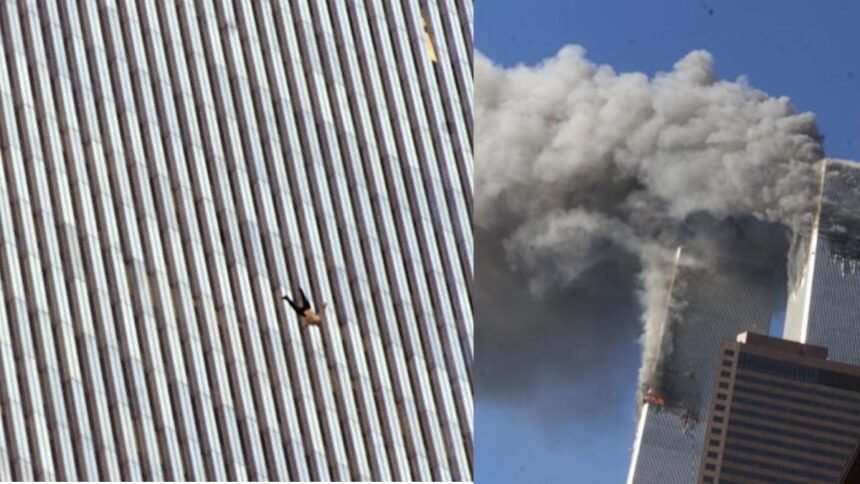
Richard Drew’s photograph “The Falling Man” captures an individual falling from the North Tower of the World Trade Center on September 11, 2001, becoming a controversial symbol of individual lives lost during the tragedy.
Richard Drew’s photograph titled “The Falling Man” is one of such photos. The photograph depicts one person who falls from the burning North Tower of the World Trade Center in New York City on September 11, 2001.
It will forever remain one of the most controversial and painful photographs from the events of 9/11. It is also a symbol of the fact that the deaths of thousands of people were actually lives of many individuals.
Richard Drew was covering a completely different assignment
In the morning of September 11th, Drew found himself in Manhattan because he was attending a maternity fashion show in Bryant Park. That day he learned that there had been a crash of a plane into the World Trade Center building.
He had to change his assignment instantly, as his editor told him to leave the fashion show and go to the place where the incident happened.
Drew got downtown and arrived in the area of Chambers Street. At that moment, the second plane hit the South Tower, and the towers were on fire.
The city was full of emergency services personnel and frightened citizens.
Drew started taking pictures of the events.
He did not know he had captured ‘The Falling Man’
From his position, Drew could see people falling from the towers.
He used a 200mm zoom lens and began following one person through his camera as the figure descended. He took several photographs in rapid succession.
A first responder eventually pulled Drew towards a safer location.
At that moment, Drew did not know that one of the frames he had captured would become one of the defining photographs of the attacks.
It was only later, when he returned to the Associated Press office and reviewed his photographs, that he noticed the unusual frame.
The person appeared almost perfectly vertical, with one knee bent and his arms close to his body. Behind him stood the enormous facade of the burning tower.
The chaos of 9/11 was suddenly represented by one silent figure.
Why the photograph shocked so many people
The photograph was published by newspapers, including The New York Times, but it quickly became controversial. For many readers, seeing a person falling to their death was too painful. Some newspapers stopped displaying the image after receiving complaints.
The debate was not simply about whether the photograph was disturbing. It raised a larger question about how the media should document a tragedy of this scale.
Should audiences see the most painful moments of a disaster? Or should some images remain private out of respect for victims and their families?
“The Falling Man” became part of that debate.
The identity of the man remains uncertain
Perhaps the most troubling mystery surrounding the photograph is that the man’s identity has never been conclusively confirmed.
Several people were suggested as possible identities over the years. Among them were Jonathan Briley, an audio engineer who worked at Windows on the World, and Norberto Hernandez, who was also associated with the restaurant.
However, neither identification was definitively established.
That uncertainty has made the photograph even more haunting. The person in the image has no confirmed name, yet his photograph has been seen around the world.
The photograph is about more than the towers
The Twin Towers became the visual centre of the September 11 attacks. Images of smoke pouring from the buildings, aircraft striking the towers and the eventual collapse were broadcast repeatedly across the world.
“The Falling Man” showed something different.
It did not focus on the destruction of the buildings. It focused on one person caught in an impossible situation.
That is what gives the photograph its uncomfortable power.
Instead of thinking only about the scale of the disaster, the viewer is forced to think about an individual human being.
A picture that continues to raise questions
Drew has spoken about the photograph many times over the years and has defended its importance as a piece of photojournalism. For him, the image documented the final moments of someone’s life during one of the most significant events in modern history.
The photograph also reminds us of something that can become easy to lose when discussing 9/11 through statistics: nearly 3,000 people were killed, but the tragedy was experienced one person at a time.