



Bengaluru
oi-Madhuri Adnal

It rained heavily across Bengaluru on Tuesday, and within hours, several parts of the city were struggling with waterlogging and traffic disruption.
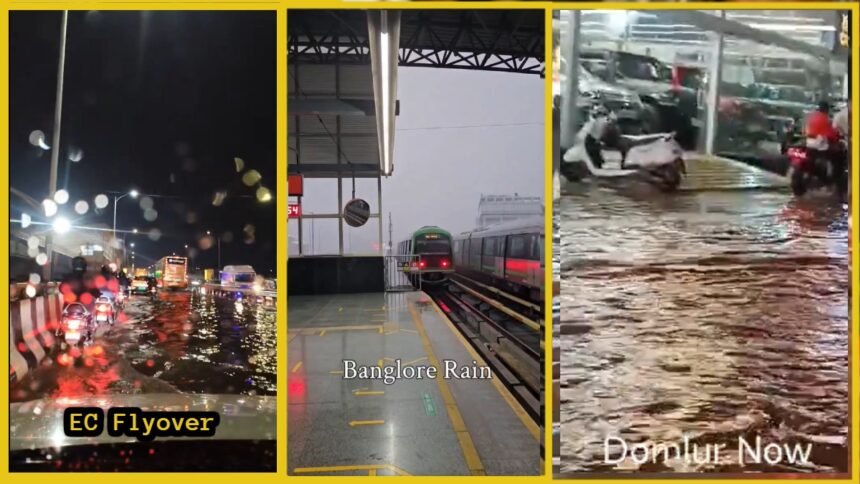
Electronic City flyover, Richmond Circle, Domlur and the under construction Ejipura flyover were among the areas affected. Waterlogging was also reported around MG Road and the Chinnaswamy Stadium, making it difficult for commuters to move through the city.
Heavy rains caused widespread waterlogging and traffic disruption across Bengaluru on Tuesday, affecting key areas and railway services. Despite identifying 210 flood-prone locations, recurring issues like blocked drains and urbanization persist, raising questions about the city’s preparedness.

Rain was reported from several other parts of Bengaluru, including Ramohalli, Yelahanka, Rajajinagar, JP Nagar Phase 8, HAL Airport, Malleshwaram, Whitefield and KR Puram. Yelahanka also reported rain towards KIA and Devanahalli.
Raining cats and dog near Chinnaswamy Stadium #BengaluruRains #weather pic.twitter.com/Fqr1fvMzvh
— Madhuri Adnal (@madhuriadnal) September 15, 2026
Domlur is heavily waterlogged right now after intense downpours. Roads are turning into rivers #BengaluruRains #DomlurFloods #BangaloreTraffic pic.twitter.com/Mu3ux8pevo
— 𝕯𝖍𝖆𝖓𝖊𝖘𝖍 (@dhanesh313) September 15, 2026
It’s raining ☔️ 🌧️ in #Bengaluru.
A welcome change today, rain is widespread across the city after several days of isolated showers. Hope this rainy spell continues for few more days🌧️#BengaluruRains #KarnatakaRains
🎥Karthik YP pic.twitter.com/Zk6fOMsAP9
— Naveen Reddy (@navin_ankampali) September 15, 2026
The impact was not restricted to roads. The Shivamogga to Bengaluru railway route was also disrupted after a tree fell on the railway track and overhead electrical wires near Arasalu. The Talaguppa Bengaluru Intercity was reportedly delayed for more than three hours as railway authorities cleared the obstruction.
After long time witnessing heavy rain in
Bengaluru.. Videos are from the Ejipura under-construction flyover. Captured with Mappls app camera. #bengalururains #bengaluru https://t.co/SFZwuKrsu1 pic.twitter.com/VMJLHXkg5X— Kalaivanan Sundaram (@kalaivananst) September 15, 2026
Electronic City flyover current status, #Bengalururains,#Bengaluru pic.twitter.com/0TXaRBFGWE
— Naveen Venkatesh (@iamnaveen_333) September 15, 2026
Bengaluru already knows its flood spots
This is where the bigger question begins.
BBMP’s flood data has already identified waterlogging and flood prone locations across Bengaluru. The city has around 633 drainage catchments and roughly 840 to 860 km of primary and secondary stormwater drains.
Yet waterlogging continues at several known problem areas.

Drain encroachments, blocked drains, waste, inadequate maintenance and rapid urbanisation have all been identified as reasons behind Bengaluru’s recurring flooding.
The city has also previously identified 210 flood prone locations, with mitigation work carried out at several hotspots. Some locations have reportedly improved after drainage and pumping interventions.
So the question is not whether Bengaluru knows where it floods.
It does.
The question is what happens after those locations are identified.
What is GBA doing?
The Greater Bengaluru Authority (GBA) officials had instructed officials to improve coordination between Bengaluru’s civic agencies as part of its flood mitigation and monsoon preparedness measures.
The directions included cleaning and desilting stormwater drains, conducting drone surveys of major drains before and after desilting, inspecting flood prone areas on the ground and ensuring side drains and shoulder drains were cleared to prevent waterlogging.
GBA had also directed civic agencies to activate control rooms, appoint nodal officers and coordinate with the BWSSB, BESCOM, Metro, Railways and fire services during the rainy season.
Specific instructions were also issued to ensure quick action on fallen trees and respond promptly to public complaints during heavy rain.
With several of these measures already instructed, the question now is whether they have made a difference on the ground.
Bengaluru is still seeing waterlogged roads, stalled traffic and stranded commuters whenever heavy rain hits.
So, who is responsible for ensuring they do not bring Bengaluru to a standstill every time it rains?