

By using this site, you agree to the Privacy Policy and Terms of Use.
Accept
Next India Magazine
  • Home
    • Home 2
    • Home 3Hot
    • Home 4
    • Home 5New
  • Home
  • Opinion

    That Provide Critical Analysis on Political Decision-Making

    krutikadalvibiz@gmail.com

    Analyzing Global Dynamics and Unraveling Key Policy Initiatives

    krutikadalvibiz@gmail.com

    Luxurious Stays Redefining Hospitality at Hotel Havens

    krutikadalvibiz@gmail.com

    Electric Cars Subsidies by German Taxpayers End Up on Foreign Roads

    krutikadalvibiz@gmail.com

    Challenge and Inspire Future of Political Thought

    krutikadalvibiz@gmail.com

    Assessing the Diplomatic Challenges and Global Security

    krutikadalvibiz@gmail.com
  • World
  • Politics
  • Market
  • Health
  • Insurance
  • Pages
    • Blog Index
    • Contact US
    • Search Page
    • 404 Page
    • Technology
    • World
  • Pages
    • Blog Index
    • Search Page
    • 404 Page
  • Technology
    TechnologyShow More
    Ramya Sudha Vinukonda: A Biology Teacher Turning Government School Classrooms into Spaces of Possibility
    6 Min Read
    Dr. Nishant Sawant: The Mind Behind Secure Digital Progress
    4 Min Read
    NASA’s Artemis II Mission Rekindles Humanity’s Dream of Deep Space Exploration
    5 Min Read
    Buying a Car Will Soon be Like Buying a Phone, Why Your Next Car Could be an EV
    Hands-On With the iPhone 13, Pro, Max, and Mini
    4 Min Read
  • Posts
    • Post Layouts
      • Standard 1
      • Standard 2
      • Standard 3
      • Standard 4
      • Standard 5
      • Standard 6
      • Standard 7
      • No Featured
    • Gallery Layouts
      • Layout 1
      • Layout 2
      • layout 3
    • Video Layouts
      • Layout 1
      • Layout 2
      • Layout 3
      • Layout 4
    • Audio Layouts
      • Layout 1
      • Layout 2
    • Post Sidebar
      • Right Sidebar
      • Left Sidebar
    • Review
      • Stars
      • Scores
      • User Rating
    • Content Features
      • Highlight Shares
      • Inline Mailchimp
      • Print Post
      • Inline Related
      • Source/Via Tag
      • Reading Indicator
      • Content Size Resizer
    • Table of Contents
      • Full Width
      • Left Side
    • Sponsored Post
  • Contact
  • Pages
    • Search Page
    • 404 Page
Reading: From ₹150 grant in 1947 to Delhi University’s key student body: A look at DUSU’s evolution
SUBSCRIBE
Next India MagazineNext India Magazine
Font ResizerAa
  • My Saves
  • Economics
  • Technology
  • My Interests
  • World
  • My Feed
  • History
  • Business
  • Technology
  • Lifestyle
  • Fashion
  • Health
  • Technology
  • World
Search
  • Pages
    • Blog Index
    • Contact Us
    • Search Page
    • 404 Page
  • Home
    • Home 1
    • Home 2
    • Home 3
    • Home 4
    • Home 5
  • Home
  • Blog
  • Categories
    • Technology
    • Lifestyle
  • Personalized
    • My Feed
    • My Saves
    • My Interests
    • History
  • Demos
  • Categories
    • Technology
    • Business
    • Fashion
    • Economics
  • Bookmarks
  • Categories
    • Technology
    • Health
    • World
  • More Foxiz
    • Blog Index
    • Sitemap
  • Bookmarks
  • Contact
  • More Foxiz
    • Sitemap
Have an existing account? Sign In
Follow US
  • Home
  • World
  • Contact
  • Blog
© Foxiz News Network. Ruby Design Company. All Rights Reserved.
BusinessLifestyleStartup

From ₹150 grant in 1947 to Delhi University’s key student body: A look at DUSU’s evolution

India Times Now
Last updated: September 19, 2026 9:12 am
India Times Now
7 Min Read
Share
SHARE

As vote counting for the DUSU polls is underway on Saturday, the story of how the Delhi University Students’ Union came into being offers a glimpse into the humble beginnings of one of the country’s most prominent student bodies.

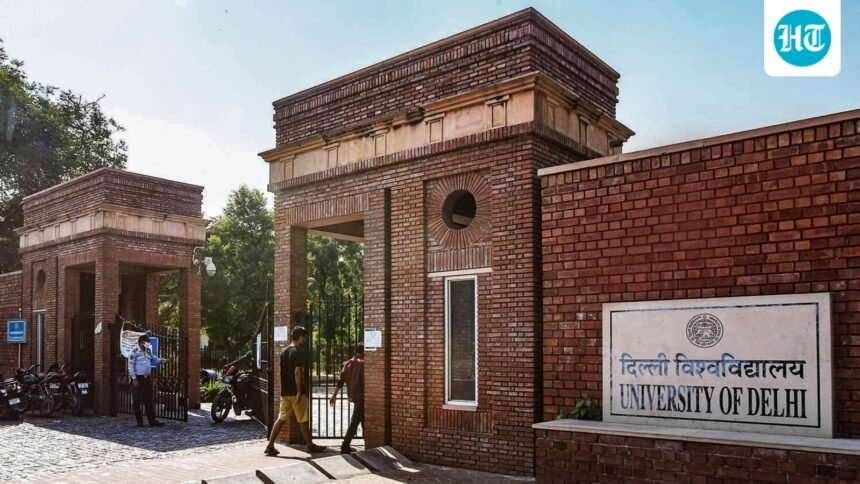
Voting for the 2026 DUSU elections was held on September 18, with counting beginning at 8 am on Saturday at North Campus. (File Photo)

DUSU traces its origins to August 6, 1947, just days before India’s Independence, when the university’s vice-chancellor informed the Executive Council that a representative body of students desired to establish a university students’ union.

The Council agreed in principle, noting that a committee would draft the necessary constitution and procedure, and proposed a small grant of ₹150 for the union’s preliminary expenses once it was formally constituted. That proposal, made just before midnight on August 15, 1947, marked the start of an institutional journey that would eventually turn DUSU into the representative body for students from most Delhi University colleges and faculties, and a key arena of campus politics that draws national attention.

Also read: DUSU 2026 election results LIVE: NSUI’s Meena edges past Yash Dabas by 1 vote; ABVP leads secretary race

In the early years, the union’s functioning and finances remained uncertain.

On March 27, 1953, the university’s Executive Committee considered an application from the University Students’ Union for a grant-in-aid, observing that the body should strive to become self-sufficient after already receiving ₹500 that year.

By March 14, 1954, the financial strain was more apparent: The union had incurred expenditure of ₹1,995 against an income of only ₹815. In the same meeting, the vice-chancellor noted that a constitution had been given to DUSU and that elections had been held for the first time.

He proposed a caretaker committee to run the union until the next academic year, with a cap on new expenditure until August 1954 and a grant of up to ₹1,100 to meet already incurred costs, subject to approval of bills by the union’s treasurer.

Also read: ‘Fear, terror, hegemony’: HC slams DUSU poll candidates

These early records show efforts to give the student body an institutional footing, from financial accountability to administrative oversight. The constitutional structure of DUSU came under renewed consideration nearly two decades later.

On August 2, 1973, the Executive Council considered the “abrogation of the existing constitution and promulgation of an interim constitution” for the union. The interim constitution imposed financial controls; initially, expenditures above ₹100 required authorisation by the union’s Executive Committee.

It also established a detailed administrative structure: The vice-chancellor was designated patron of DUSU, responsible for ensuring the union functioned in accordance with the constitution. The union’s structure also included a staff adviser, appointed by the patron from among the teaching faculty, and a treasurer whom the patron also appointed.

The constitution provided for four elected office-bearers — president, vice-president, secretary, and assistant secretary — to be directly elected by DUSU members by simple majority. The president was the chief executive, while the vice-president performed the president’s functions in his or her absence.

Also read: DUSU elections over the years: From a 50-day strike to court battles over violence

The secretary was to act in consultation with the president and function in all matters relating to the union in accordance with the constitution. For decades, the DUSU subscription fee remained modest.

Students paid ₹5 as the DUSU subscription fee until 2012-13. University officials said the fee was revised to ₹20 in 2013-14 and later increased to ₹40 on June 21, 2024. Nearly eight decades after that first proposal was presented to the Executive Council, DUSU has grown into one of the country’s most prominent student representative bodies.

Its elections have produced leaders who have gone on to play significant roles in public life.

This year’s election, with voting held on September 18, is the latest chapter in that history. Counting began at 8 am at the Multipurpose Hall of the University Sports Stadium in North Campus, with entry through gate number 2, according to the official notification.

The contest for the four central panel posts features major contenders like the RSS-affiliated ABVP, Congress-backed NSUI and the Left alliance of AISA-SFI.

Also read: Yash Dabas vs Vijay Meena vs Ananya Raturi: Meet the faces of DUSU presidency race

Issues such as student safety, accommodation and campus facilities dominated the campaign, especially following the collapse of a five-storey building housing a boys’ PG in south Delhi’s Satya Niketan, which claimed the lives of seven people, including students.

ABVP has fielded Yash Dabas for president, Ishu Maurya for vice-president, Riya Chhawadi for secretary and Lakshya Raj Singh for joint secretary. The NSUI has nominated Vijay Shankar Meena for president, Vir Chatrath for vice-president, Namrata Chaudhary for secretary and Gopal Choudhary for joint secretary.

The AISA-SFI alliance has nominated Ananya Raturi for president, Akshat Shikhar for vice-president, Stanzin Deskyong for secretary and B Parijaat for joint secretary.

The evolution of DUSU — from a small grant and a caretaker committee to a nationally watched electoral exercise — mirrors the changing nature of student politics and representation at Delhi University.


Share This Article
Facebook Email Copy Link Print
Previous Article UPI Users Alert: Petrol Pumps May Stop Accepting Payments Above Rs 2,000
Next Article Delhi CM Rekha Gupta Pays Tribute at Fatehgarh Sahib, Joins Anti-Drug Campaign
Leave a Comment Leave a Comment

Leave a Reply Cancel reply

Your email address will not be published. Required fields are marked *

You Might Also Like

BusinessLifestyleStartup

Trump’s first India visit since 2020 may happen early next year, says US’ Rubio

Planning is underway for a visit by US President Donald…

3 Min Read
BusinessLifestyleStartup

Nicholas Riccio: 5 interesting things about Karoline Leavitt’s husband after sweet baby announcement

White House press secretary Karoline Leavitt on Thursday announced the…

5 Min Read
BusinessLifestyleStartup

Weapons upgraded, Putin to invade NATO as soon as 2026…? US intel sows fear in Europe | Ukraine

New U.S. intelligence assessments have reportedly warned that Vladimir Putin…

1 Min Read
BusinessLifestyleStartup

Dudhwa maintains 132 water bodies to shield wildlife from summer heat

: With temperatures rising across the Terai region, Dudhwa National…

2 Min Read
Next India MagazineNext India Magazine
Follow US
© 2026 Next India Magazine powered by India Times Now. All Rights Reserved.
Welcome Back!

Sign in to your account

Username or Email Address
Password

Lost your password?