



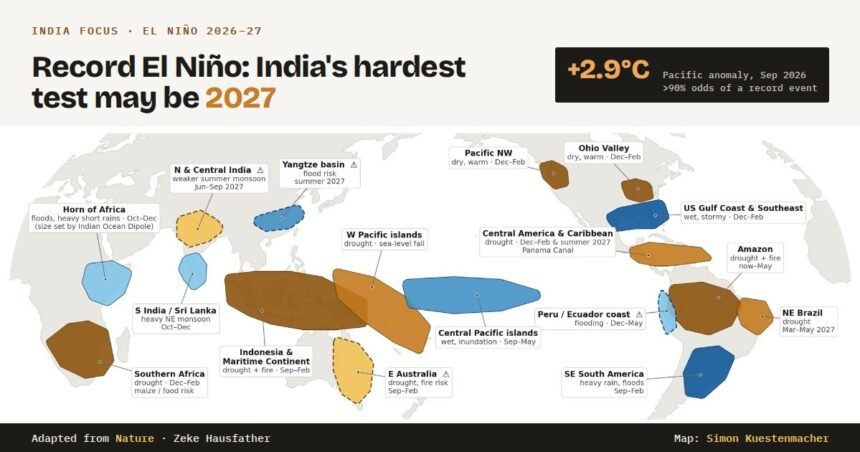
India entered this El Niño on the back foot. In April, IMD forecast 92% of the long-period average (LPA). In May it cut that to 90%, with an 84% chance of a below-normal or deficient season. June rainfall came in 35% below normal. July recovered to about normal, and the gap still stood at 14% on 7 September.
The shortfall is uneven. By early August, Bihar was down 38%, Punjab 33% and East Uttar Pradesh 30%. The South Peninsula, usually a safe bet, had the deepest seasonal gap of any region at −27% by 7 September.
Farmers mostly planted anyway. Kharif acreage reached 108.6 million hectares by 4 September, only 1.6% under normal. Paddy trailed last year at 34.5 against 36.1 million hectares as of late August. Planting was the easy part. The risk now shifts to yields, reservoir levels and the winter season.
History explains why this matters. In most strong El Niño years India’s monsoon has fallen short, as the chart shows. The big exception was 1997, the strongest event of its century, when a positive Indian Ocean Dipole (IOD) kept the rains near normal. This year the IOD has stayed neutral, so that protection is missing.
Monsoon departure in El Niño years
June–September rainfall, % departure from LPA
Deficit year Normal, positive IOD 2026 so far
IMD seasonal totals. 2026 covers 1 Jun–7 Sep. “Deficient” is below −10%.