Featured
oi-AK Khan

In March 1986 four scientists wrote to Deng Xiaoping, China’s paramount leader and the architect of its market reforms. Their letter warned that China would fall permanently behind unless it invested in frontier technology. Deng approved within days, and the plan was named “863” after the date of the letter: 1986, third month. In 2001 Wan Gang, an engineer who had spent a decade at Audi in Germany, came home to run its electric-car project, and in 2007 became China’s Minister of Science and Technology. China, he argued, would never beat the West at building engines, so it should make the engine irrelevant. Twenty-five years later Detroit’s great factories stand empty and China sells 16 million electric cars a year. This is how the car industry moved east: the ruins it left behind, the data behind China’s rise, and how carmakers in the US and Europe changed their plans again and again.
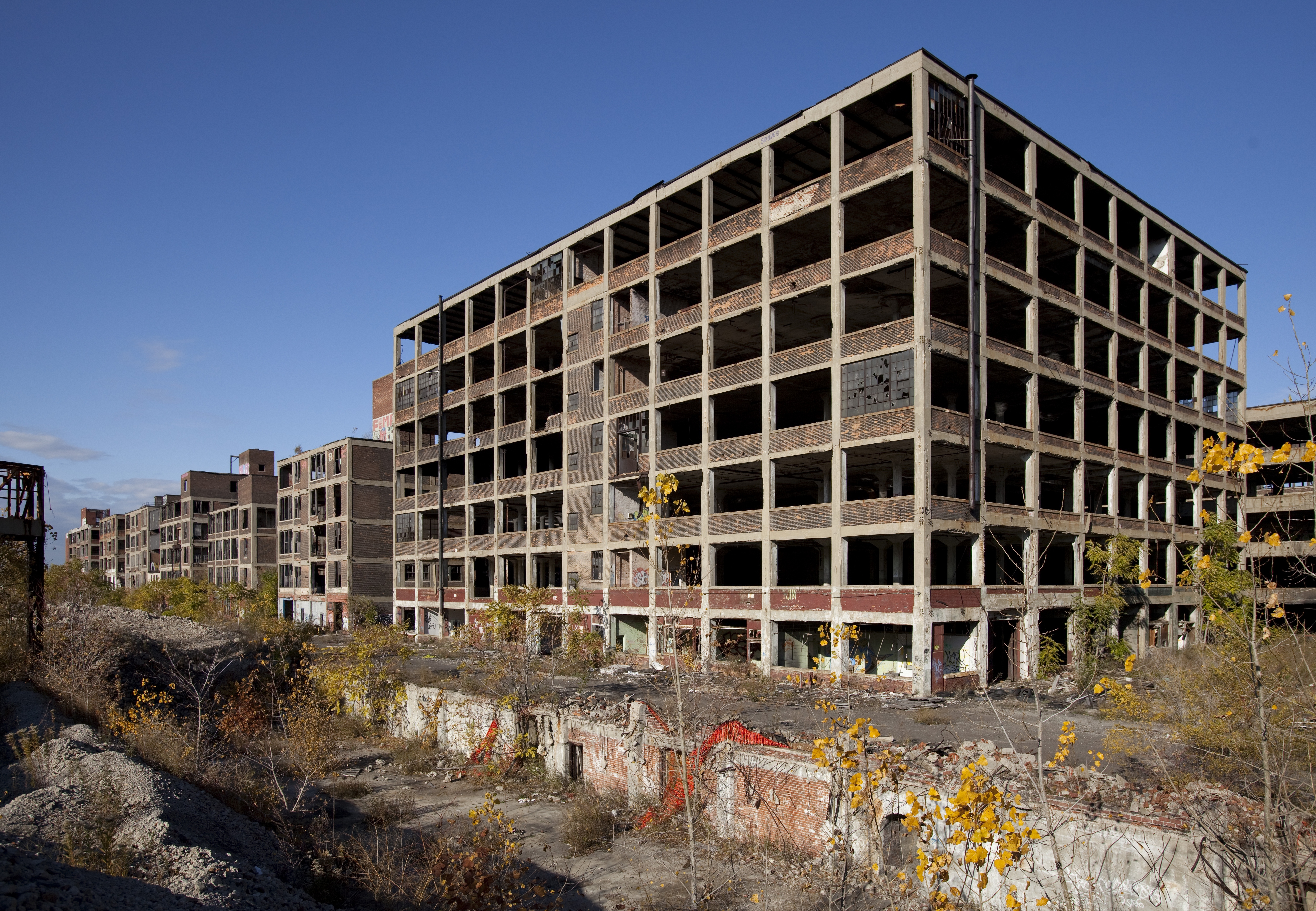
The abandoned Packard plant, East Grand Boulevard, Detroit
Part I · The City of Silence
Three and a half million square feet of nothing
For most of the twentieth century, the Packard plant on Detroit’s east side was a machine that made the future. Albert Kahn designed it, and it was one of the first car factories in America built of reinforced concrete. At its peak it employed 40,000 people in more than eighty trades. They built luxury cars and, during the Second World War, the Merlin engines for the P-51 Mustang.
.jpg)
It closed in 1958. It then spent six decades dying in public. First came scrap-metal thieves and arsonists, then graffiti writers, ravers, film crews and “ruin tourists” from all over the world. In 2013 its 43 parcels went up for auction with a starting bid of $975,000, the back taxes owed, and nobody bid. By the end of 2024 almost all of it had been demolished. Only two façades facing each other across East Grand Boulevard were left standing as a memorial.

How a city of 1.85 million lost two-thirds of its people
In 1900 Detroit was a tidy regional city of 285,000. The car turned it into a boomtown. Between 1910 and 1930 the population more than tripled, as immigrants from Poland, Italy and Hungary and hundreds of thousands of Black Southerners in the Great Migration arrived for assembly-line jobs that needed almost no formal training. By 1950 the city had 1,849,568 residents.

Every census since has counted fewer people. The causes are well documented, and the car was behind most of them. Between 1945 and 1957 the Big Three built 25 new plants in the Detroit area and not one inside the city. They were escaping union density, cramped multi-storey factories and city taxes. The workforce at Ford’s River Rouge plant fell from about 90,000 around 1930 to 30,000 by 1960 and about 6,000 by 1990. Federally funded freeways, built for the cars Detroit made, cut through Black neighbourhoods such as Black Bottom and Paradise Valley. The same freeways made it easy to live in the suburbs and drive in. Redlining and restrictive covenants kept Black families in the oldest housing, while white families left. About 1.4 million of the roughly 1.6 million white residents of the post-war city eventually moved out.

Detroit’s population, 1900–2025
One industry built the city, and the city shrank as that industry moved away. 2025 is the second year of growth after seven decades of decline.
Source: US Census Bureau decennial counts; 2025 Census Bureau estimate (649,095).
−65%
population lost since the 1950 peak (1.85 m → 639,111 in 2020)
$18.5 bn
obligations in the 2013 filing, the largest US municipal bankruptcy
2,700+
violent crimes per 100,000 people at the 1991 peak
800+
fires set around “Devil’s Night” in 1984, mostly in empty houses
Silence, and then crime
As jobs and taxpayers left, the city was left with too much space and too little money: 139 square miles of streets, pipes and streetlights to maintain for a shrinking, poorer population. The five days of unrest in July 1967 left 43 people dead and 2,509 stores looted or burned. Many businesses and families that could leave did so, and the neighbourhoods affected stayed damaged for decades. Coleman Young, the city’s first Black mayor, later wrote that the riot “put Detroit on the fast track to economic desolation.”
The 1970s and 1980s brought heroin and then crack. Empty houses became drug houses, and on the nights before Halloween residents burned them. Detroit was repeatedly called the country’s “murder capital” and “arson capital”. By 2012 its murder rate of 53 per 100,000 was ten times New York’s, and in 2012 Forbes named it America’s most dangerous city for the fourth year in a row. More than half of property owners did not pay property tax that year.
The great dispersal: why the factories left the city
A schematic map. After the war the car industry kept growing, but it grew in the suburbs, and then in other states and other countries.
Source: Thomas Sugrue, “From Motor City to Motor Metropolis” (University of Michigan-Dearborn); Sugrue, The Origins of the Urban Crisis. Schematic, not to scale.
The final blows came from outside. The 1973 oil embargo made small, efficient Japanese cars attractive to American buyers. Chrysler survived in 1979 only with a federal loan guarantee. In 2009 General Motors and Chrysler both went through bankruptcy. Four years later the city followed them.
◆ ◆ ◆
Part II · A Century of the Car
How the car was invented, made cheap, and then remade
Detroit’s story is not only about decline. It is the first act of a longer drama. The industry that Detroit created kept moving to wherever capital, labour, technology and state ambition came together best. For a century that place was Michigan. For a while it was Japan. Today it is the Pearl River and Yangtze deltas of China.
The timeline
● Detroit and the US industry ● US policy ● Europe ● China
- 1896Henry Ford test-drives his Quadricycle through Detroit’s streets at night.
- 1903Ford Motor Company is incorporated; Packard moves to a new Albert Kahn plant on East Grand Boulevard.
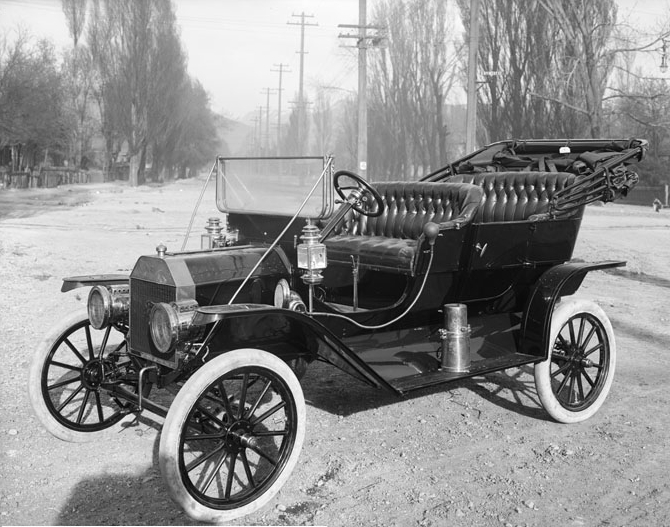
- 1908The Model T arrives — a car for the multitude, not the millionaire.
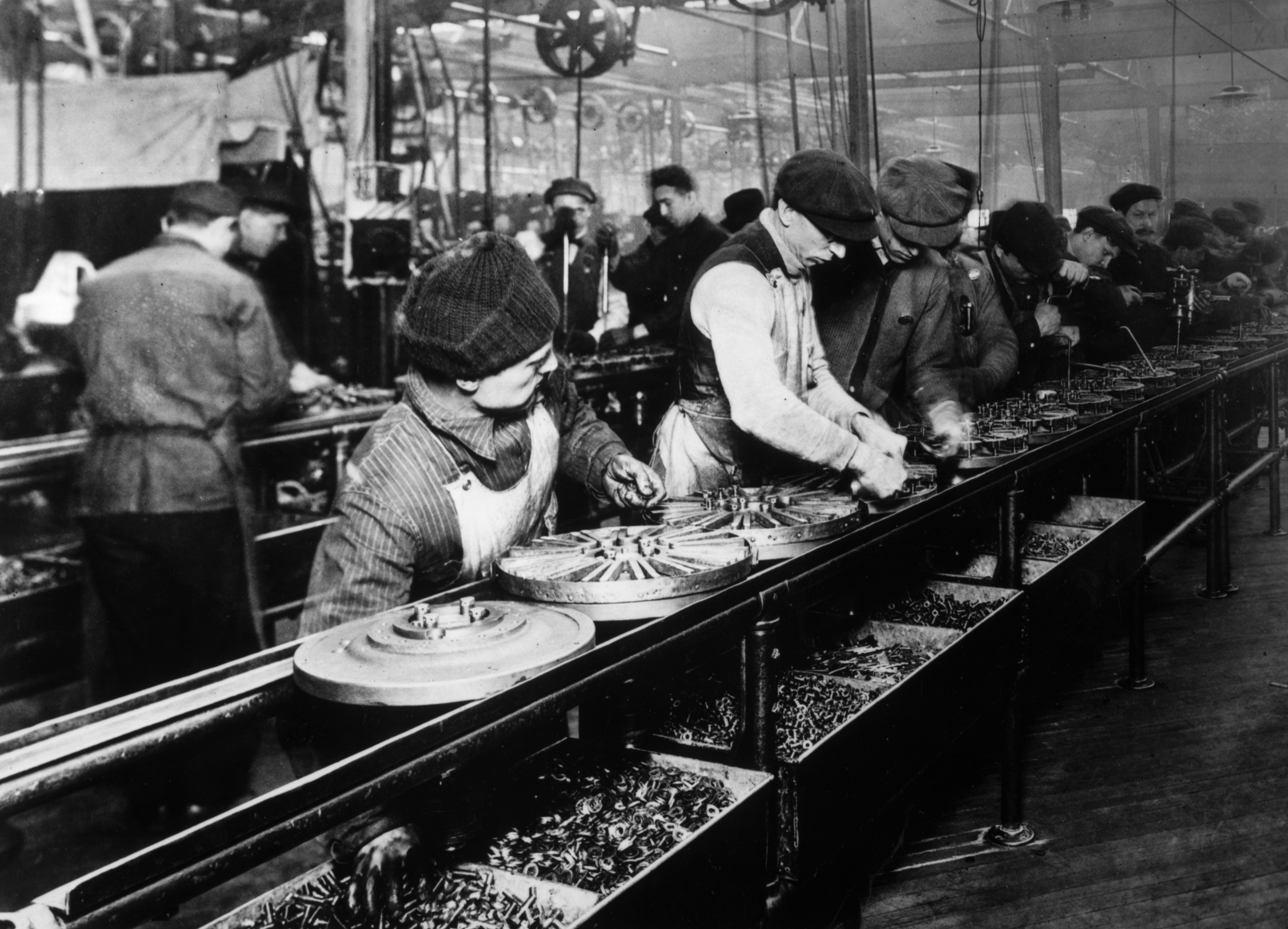
- 1913The moving assembly line starts at Highland Park; chassis time falls from 12 hours to about 90 minutes.
- 1914The “$5 day” doubles wages and pulls workers from across the US, Canada and Europe.
- 1938Wolfsburg is founded to build the “people’s car”. Europe’s mass-market era begins.
- 1950Detroit peaks at 1.85 million people, the fourth- or fifth-largest city in the US.
- 1956The Federal-Aid Highway Act funds freeways that cut through Black Bottom and Paradise Valley.
- 1973The OPEC oil embargo. Small Japanese cars suddenly look like the future.
- 1979Chrysler needs a federal loan guarantee to survive.
- 1981Japan agrees to “voluntary” export limits (1.68 m cars a year), and then builds plants in America.
- 1984Volkswagen forms SAIC-Volkswagen in Shanghai: the first big Western joint venture in China.
- 1988The last train leaves Michigan Central Station. The building becomes the world’s most photographed ruin.
- 1997General Motors (GM), then America’s biggest carmaker, and SAIC Motor (Shanghai Automotive Industry Corporation), China’s largest state-owned carmaker, set up SAIC-GM, a 50/50 joint venture in Shanghai. Under Chinese rules of the time, foreign carmakers could only build cars in China with a local partner. GM supplied the designs and technology, SAIC the factories and market access. SAIC-GM went on to build more than 20 million Buicks, Chevrolets and Cadillacs.
- 2001China joins the WTO. Its “863” research programme starts funding electric-vehicle projects.
- 2003Battery maker BYD buys a small carmaker and enters the auto business.
- 2008The Tesla Roadster ships. China’s car boom is accelerating.
- 2009GM and Chrysler go bankrupt. China becomes the largest car market in the world and launches its “Ten Cities, Thousand Vehicles” EV pilot.
- 2011CATL (Contemporary Amperex Technology Co. Limited) is founded in Ningde, Fujian, by Robin Zeng. It grew out of ATL, a maker of small batteries for phones and laptops. CATL makes the lithium-ion cells and battery packs that power electric cars. Tesla, BMW, Volkswagen, Mercedes-Benz, Ford and many Chinese brands buy from it. Since 2017 it has been the world’s biggest EV battery maker, supplying roughly a third or more of the world’s EV batteries.
- 2013Detroit files the largest municipal bankruptcy in US history (≈ $18.5 bn of obligations).
- 2015Dieselgate breaks. Beijing names NEVs a strategic industry in “Made in China 2025”.
- 2018China lifts foreign-ownership caps for NEV makers. Ford buys Michigan Central Station for $90 m.
- 2019Tesla’s Shanghai Gigafactory, the first wholly foreign-owned car plant in China, starts deliveries.
- 2022The US Inflation Reduction Act ties $7,500 credits to North American supply chains.
- 2023The EU signs its 2035 zero-CO₂ rule into law and opens an anti-subsidy probe into Chinese EVs.
- 2024The US sets a 100% tariff on Chinese EVs and the EU adds duties of 7.8–35.3%. Michigan Central reopens.
- 2025BYD outsells Tesla in battery EVs. US federal EV credits end on 30 September. China sells 16.49 m NEVs.
- 2026GM extends its SAIC joint venture to 2047. Ford ships China-built vans to Europe and China-built Lincoln hybrids to the US.
The pattern repeats. Each time, a newcomer wins by changing how cars are made rather than simply making them cheaper. Ford did it with the moving assembly line. Toyota did it with lean production and just-in-time supply. China is doing it with a vertically integrated battery-and-electronics supply chain, very large production, and software-defined cars developed at a pace legacy carmakers have struggled to match.
◆ ◆ ◆
Part III · China’s Might in Electric Vehicles
A market bigger than America and Europe together, and mostly electric
In 2025 China sold 34.4 million vehicles, its seventeenth year in a row as the world’s largest car market. 16.49 million of them were “new energy vehicles”: battery-electric, plug-in hybrid or fuel-cell. That is 47.9% of all sales. In some months of 2026, more than 60% of new cars sold in China were electric.
16.49 m
NEVs sold in China in 2025 (CAAM), up 28.2% on 2024
≈ 55%
EV share of China’s car sales in 2025 (IEA), vs just under 10% in the US
2.62 m
NEVs exported in 2025, double 2024 (out of 7.1 m total vehicle exports)
4.6 m
BYD vehicles in 2025. 1.05 m sold abroad, up 150%
China’s new-energy vehicle sales, 2015–2026
Millions of units, wholesale, including exports. The hatched bar is the industry association’s 2026 forecast. Sales grew almost fifty-fold in a decade.
Source: China Association of Automobile Manufacturers (CAAM); 2026 forecast CAAM, January 2026.
Overtaking on the curve: how Beijing planned its EV industry
China’s EV lead is often put down to one word, subsidies. Subsidies mattered, and the EU’s own investigation found state support at every stage of the supply chain. But the fuller story is a strategy carried out in steps over thirty years. It rests on one idea. China could not catch up with Germany, Japan and the US in petrol and diesel engines, which had a century’s head start. So it would change lanes and lead in the technology that came next. Chinese planners call this wandao chaoche (弯道超车), “overtaking on the curve”.
1986
The 863 Programme: a letter from four scientists
In March 1986 four senior scientists wrote to Deng Xiaoping, China’s paramount leader. Alarmed by America’s “Star Wars” defence plan and Europe’s Eureka research programme, they warned that China would fall permanently behind unless it invested in frontier technology. Deng replied that the matter should be decided quickly and not delayed. The plan was named “863” after the letter’s date (1986, third month). It funded space, lasers, computing and biotech, and later, electric cars.
2001
“Three verticals, three horizontals”: the EV blueprint
In 2001 the 863 Programme launched a major special project on electric vehicles, with about 880 million yuan in state funding. It was organised as a grid. The three “verticals” were the vehicle types: battery-electric, hybrid and fuel-cell. The three “horizontals” were the parts every type needs: batteries, electric motors and the electronic control systems. Twenty years later, that list reads like the core strengths of BYD and CATL.
2007
Wan Gang: the Audi engineer who became minister
Wan Gang spent the 1990s in Germany, working for Audi at Ingolstadt in planning and production. He saw from the inside how far ahead German engine makers were. He came home in 2001 to Tongji University in Shanghai and became chief scientist of the 863 EV project. In 2007 he was made Minister of Science and Technology, a post he held until 2018. He was rare in China’s cabinet in not being a Communist Party member. His argument was simple: China would never beat Audi at building engines, so it should make the engine irrelevant. He is often called the father of China’s electric cars.
2009 → 2022
From pilot fleets to a mass market
Under Wan the plan moved from laboratories to streets. First came the “Ten Cities, Thousand Vehicles” pilot of 2009, which put electric buses, taxis and government cars on the road. Next were buyer subsidies and, in megacities such as Shanghai and Beijing, free licence plates for electric cars when a petrol plate could cost more than a small car. In 2015 NEVs became a pillar of “Made in China 2025”. A dual-credit mandate from 2018–19 forced every carmaker, foreign joint ventures included, to sell a rising share of NEVs. Also in 2018 foreign-ownership caps were lifted, letting Tesla build its Shanghai factory alone, a “catfish” meant to shake local rivals awake. National purchase subsidies ended in December 2022. By then the industry could stand without them. Prices had fallen, and a fierce price war at home took over from subsidies as the force pushing the industry forward.
Map · China’s EV heartland
China’s EV industry is packed into a few clusters. Battery makers, motor makers, chip designers and car assemblers often sit a few hours’ drive apart, which shortens development times.
- ①Shenzhen — BYD headquarters. Blade battery, DM hybrids, 4.6 m vehicles in 2025.
- ②Shanghai — Tesla Gigafactory (4 m+ cars), SAIC (MG, IM), NIO’s design centre, SAIC-GM and SAIC-VW.
- ③Ningde — CATL, the world’s largest battery maker, founded 2011.
- ④Hangzhou / Ningbo — Geely group (Zeekr, Volvo, Polestar, Lynk & Co), Leapmotor.
- ⑤Hefei — NIO manufacturing, VW Anhui (its “In China, for China” R&D hub), BYD and Chery nearby.
- ⑥Chongqing — Changan (Deepal, Avatr) and Seres/AITO, built with Huawei.
- ⑦Beijing — Xiaomi’s EV plant, BAIC, and much of the self-driving software scene.
- ⑧Guangzhou — GAC Aion and XPeng. XPeng is VW’s engineering partner.
- ⑨Xi’an — One of BYD’s largest vehicle bases.
- ⑩Changchun — FAW, China’s “first automotive works” (1953), with VW and Toyota joint ventures.
Schematic map; locations approximate. Company roles from public company information and IEA reporting.
The battery is the engine and China makes most of them
An EV’s value lies mostly in its battery, motor and software. China dominates the first. Companies such as CATL, founded in Ningde in 2011, and BYD, which began as a battery maker for phones, turned the lithium-iron-phosphate (LFP) chemistry from a cheap, low-range option into the global mass-market standard. BYD’s “Blade” pack of 2020 built the cells into the structure of the car. The IEA estimates that China holds more than three-quarters of the world’s battery-cell manufacturing capacity, and its share of mining, refining and component processing is similar. That supply chain is the real reason Chinese carmakers can sell a small battery-electric car for less than a comparable petrol car. The IEA found that in China’s SUV segment, battery-electric models reached price parity with petrol versions in 2025.

.jpg)
The crown changes hands: BYD vs Tesla, battery-electric sales
BYD (BEV only)Tesla (all deliveries)
Millions of units. Sources: company reports compiled by CnEVPost; 2025 BYD BEV 2,256,714 vs Tesla 1,636,129. BYD also sold 2.29 m plug-in hybrids in 2025.
Electric share of new-car sales, 2025
Percentage of new cars sold that were electric (BEV + PHEV unless noted).
Sources: IEA Global EV Outlook 2026 (China, Europe, US, world); Norwegian road federation (OFV) via industry reporting (Norway BEV share).
Speed as a weapon
Chinese buyers switch brands easily. They expect big screens, voice assistants, driver-assistance features and software updates as standard. They see dozens of new models every year. That has trained Chinese carmakers to work on consumer-electronics cycles, often taking a new model from design to production in roughly half the time of a traditional Western programme. The same pressure has a cost. In 2025 BYD had to cut its sales target as smaller rivals such as Geely and Leapmotor undercut it at home. Regulators warned repeatedly about “involution”, the destructive price war, and China produced far more cars than its home market could buy. Those surplus cars are one reason exports have exploded.
◆ ◆ ◆
Part IV · The Export Wave
Where China’s cars go, and where they cannot
In just four years China went from a minor car exporter to the world’s largest, passing Japan. In 2025 it shipped 7.1 million vehicles abroad, and 2.62 million of them were electrified. Outside China, Europe and the US, Chinese imports made up 55% of electric-car sales in 2025, up from about 10% in 2021.
Map · Export flows from China, 2025–26
Line thickness shows the relative size of each market (schematic). Russia, Europe, Latin America and the Middle East take the most. North America is almost completely closed off by tariffs and software rules. Canada has agreed a small initial quota.
Sources: CAAM export totals; IEA Global EV Outlook 2026 (“Manufacturing and trade”); Gasgoo Automotive Research Institute. Simplified equirectangular projection. Routes are illustrative, not shipping lanes.
China’s vehicle exports, 2021–2025
All vehiclesNew-energy vehicles
Millions of units. Source: CAAM annual data (2025: 7.1 m total, 2.615 m NEVs, +100% year on year). CAAM expects around 7.4 m in 2026.
Emerging markets show the change most clearly. In Brazil, more than 85% of electric cars sold in 2024 were Chinese imports. In Mexico, Chinese models accounted for over 80% of battery-electric sales in 2025 and retailed about 10% below the average petrol car. In Thailand and Indonesia, Chinese brands cut the price premium for EVs sharply, then started building local factories as tariff exemptions ended. Where China’s cars arrive, electric cars stop being a luxury.

_Electric_-_Parkour_Red_-_02-2024,_Front.jpg)
Part V · How the West Changed Course
Fifty years of changing rules
American and European car policy has never followed a straight line. It has swung between fuel economy and horsepower, diesel and petrol, all-electric pledges and retreats. The swings come from oil prices, elections, scandals, and now competition from China. The table below reads across by decade.
Decade
United States
Europe
China
1970s–80s
Oil shocks → CAFE (1975). Japanese competition → export quotas (1981) and bailouts (Chrysler, 1979).
Fuel taxes keep European cars small and diesel-heavy. Germany’s premium makers rise.
Hardly any car industry to speak of. VW’s Shanghai joint venture (1984) sets the model: foreign technology, Chinese partner.
1990s
California’s ZEV mandate (1990) → GM EV1. The mandate is weakened in 2003 and big trucks and SUVs win.
Voluntary ACEA deal: aim for 140 g CO₂/km by 2008. Diesel is sold as the “green” fuel.
The joint-venture era: SAIC-GM (1997), FAW-VW. Foreign firms bring the designs; China learns the craft.
2000s
Hybrids arrive (Prius). The 2008 crash → GM and Chrysler bankruptcies and about $80 bn in rescue loans (2009).
The first binding CO₂ law (2009): 130 g/km by 2015. Europe stays with diesel.
WTO entry (2001), 863 EV research, BYD enters cars (2003). By 2009 it is the world’s biggest market, and EV pilots begin.
2010s
A DOE loan to Tesla (2010). CAFE aims for 54.5 mpg-e, then the 2020 rollback. EVs stay niche.
Dieselgate (2015) kills diesel’s credibility. 95 g/km for 2020–21 and −37.5% for 2030 (2019).
Subsidies, free licence plates, the NEV credit mandate (2018–19), CATL’s rise, and Tesla Shanghai (2019) as a “catfish” to wake up local makers.
2020–23
IRA (2022): huge credits, but only for North American supply chains. Big Three promise to go all-electric.
Fit for 55: zero CO₂ from new cars by 2035, law in 2023. Anti-subsidy probe into Chinese EVs (Sept 2023).
NEV sales jump from 1.4 m (2020) to 9.5 m (2023). Price war. BYD stops making petrol cars (2022).
2024–26
Reversal: 100% tariff (2024), connected-car software ban (from MY2027), credits end (Sept 2025), CAFE penalties set to zero.
Duties of 7.8–35.3% (Oct 2024), then flexibility: 2025–27 averaging, a proposed 90% cut by 2035 (Dec 2025) and minimum-price deals (2026).
16.49 m NEVs (2025), 47.9% of sales. Exports double to 2.62 m NEVs. Western makers come to Chinese partners for technology.
Key terms explained
CAFE (1975) USCorporate Average Fuel Economy: a 1975 US law, passed after the oil embargo, requiring each carmaker’s cars to meet a minimum average fuel economy. Pickups and SUVs got an easier target, so Detroit built more of them.
ZEV mandate (1990) → GM EV1 USCalifornia required big carmakers to sell a share of zero-emission cars. GM built the EV1 electric car in response, then crushed most of them when the rule was weakened in 2003.
ACEA EuropeThe European carmakers’ lobby. Its 1998 voluntary pledge to cut CO₂ failed, so the EU made the limits law in 2009.
FAW-VW ChinaVolkswagen’s 1991 joint venture with FAW, the state carmaker behind the Hongqi limousine. Foreign firms could only build cars in China with a local partner.
Dieselgate (2015) EuropeVW was caught using software to cheat emissions tests on about 11 million diesel cars. The scandal ended diesel’s “green” image and pushed Europe towards EVs.
NEV credit ChinaChina’s version of California’s rule: carmakers must earn “new energy vehicle” credits in proportion to their petrol and diesel sales, or buy them from rivals such as Tesla and BYD.
The “catfish” ChinaOfficials’ name for Tesla, after the catfish put in a tank to keep sardines lively. Tesla was let in without a Chinese partner in 2018 to push local EV makers to improve.
America: from electric pledge to tariff wall
In early 2021 General Motors said it would sell only zero-emission light vehicles by 2035. Ford invested billions in the Mustang Mach-E and the all-electric F-150 Lightning. The 2022 Inflation Reduction Act offered up to $7,500 per car, but only for cars whose batteries and minerals avoided “foreign entities of concern”, meaning China. The policy was built to encourage US industry and keep China out at the same time.
Then the tide turned. Demand for EVs grew more slowly than planned, and losses on EVs ran into the billions. In May 2024 the US quadrupled its tariff on Chinese EVs to 100%. Rules on connected cars now ban Chinese-developed software from vehicles sold in the US from model year 2027, and connectivity hardware from model year 2030. In 2025 the federal EV tax credits ended on 30 September, penalties for missing CAFE fuel-economy standards were set to zero, and Congress revoked California’s waiver to set its own vehicle-emission rules. US electric sales stayed just under 10% of the market and dropped at the end of the year. In December 2025 Ford said it would stop building the all-electric F-150 Lightning and would focus on hybrids and extended-range models instead. Its new plan is a roughly $30,000 electric pickup, built in Kentucky, designed to match Chinese costs.
The tariff wall: import duty on a China-built battery-electric car
Total headline rate. EU rates are anti-subsidy duties for each company plus the standard 10% car tariff. The US rate is before any additional Section 232 auto duties added in 2025.
Sources: USTR Section 301 determination (2024); European Commission definitive countervailing duties, 29 October 2024; Commission guidance on price undertakings, 12 January 2026.
Europe: tariffs, but with the door left open
Europe’s path has been more complicated, because Europe needs Chinese cars in ways America does not. Its climate law of 2023 required new cars to emit zero CO₂ by 2035. Its consumers wanted affordable EVs that European makers were not building. Its carmakers, especially Volkswagen, BMW and Mercedes, earned a large share of their profits in China. So when Brussels opened its anti-subsidy investigation in September 2023, German carmakers lobbied against the resulting duties. Their fear was retaliation against their China business.
The duties came into force in October 2024 but were different for each company. They were set on purpose to leave room for negotiation. Chinese brands answered in three ways. They kept growing (see below). They shifted exports toward plug-in hybrids, which are not covered by the duties. And they started building factories inside Europe. The EU then gave its own industry more room. Carmakers were allowed to average their 2025–27 CO₂ compliance. In December 2025 the Commission proposed replacing the strict 2035 zero target with a 90% cut. In January 2026 it published rules under which Chinese exporters can replace the duties with minimum-price and volume commitments.
Map · China’s beachheads in Europe
Chinese carmakers are getting around the tariff wall by building inside it, often in Spain and Central Europe, and often with Western partners.
- ①Szeged, Hungary — BYD’s first European car plant, ramping up in 2026, inside the EU tariff wall.
- ②Manisa, Türkiye — BYD plant announced in 2024, on the edge of the EU customs union.
- ③Barcelona, Spain — Chery with Ebro at the former Nissan factory.
- ④Zaragoza, Spain — Stellantis builds cars for Leapmotor, in which it bought ≈ 21% in 2023.
- ⑤Valencia, Spain — Ford–Geely joint venture: Geely EVs and a new Ford crossover from about 2027–28.
- ⑥Zeebrugge, Belgium — One of Europe’s main ports for car imports, including China-built cars.
- ⑦Wolfsburg, Germany — VW headquarters. VW now co-develops cars in China with XPeng.
- ⑧Norway — Outside the EU and no China duty. 95.9% of new cars were battery-electric in 2025.
- ⑨United Kingdom — No China-specific duty. MG (SAIC) and BYD are among the top-selling brands.
Schematic map; locations approximate. Sources: company announcements reported by Electrek, Automotive Logistics, JATO Dynamics and CnEVPost.
Europe’s new-car market share, first half of 2025
Chinese brands combined nearly doubled their share in a year, catching Mercedes-Benz and passing Ford. They outsold Mercedes in June, and passed Renault in August at a record 5.5%.
Source: JATO Dynamics, 28 European markets. Chinese brands include MG (SAIC), BYD, Chery’s Omoda and Jaecoo, Leapmotor and XPeng.
Part VI · The Paradox
China is becoming the centre of America’s and Europe’s future cars
For decades, American and European carmakers treated China as a huge market and a cheap factory. That relationship is changing fast. China is becoming something much more important to them: the place where their next generation of cars is designed and developed.
From factory to innovation centre
The old model
US / European technology→Chinese factory→Chinese consumer
The emerging model
Chinese engineers+Chinese suppliers+Chinese technology+Chinese manufacturing→Global consumers
US and European carmakers increasingly use China’s huge EV supply chain, its engineers, its driver-assistance technology and its factories to build products that can compete outside China. China’s advantage is not just cheap production. Its enormous home market lets companies test products at scale, react quickly to buyers and shorten development cycles. Battery makers, electronics companies, parts suppliers and tech firms are packed closely together, which makes new ideas spread faster.
Ford: “In China, for the world”
- Transit City electric van, co-developed with partner Jiangling Motors (Ford owns 32%) and built in Nanchang. The first 1,000 units shipped to Europe in September 2026.
- Lincoln Corsair Hybrid 2027, imported from China to US showrooms (announced August 2026).
- Ford–Geely joint venture at Valencia: Geely EVs and a new Ford crossover for Europe.
- Ford China exported nearly 170,000 vehicles in 2024 and ended seven straight years of losses.
- CEO Jim Farley has warned staff that Chinese brands could enter the US within five to ten years.
GM: signed until 2047
- The SAIC-GM joint venture was extended by 20 years, to 2047, in August 2026. It had more than 20 million vehicles built since 1997.
- At least 30 NEVs by 2030 on the China-developed “Xiaoyao” architecture.
- Buick Electra models developed in China go on export from October 2026 to the Middle East, Africa, South America, Mexico and Asia-Pacific. The US is not on the list.
- Chevrolet stops making new models at SAIC-GM. The business was cut back to a size where it makes money.
Europe’s carmakers: learning in China
- Volkswagen took a stake in XPeng (2023) to co-develop cars and built a China R&D hub in Hefei.
- Stellantis bought ≈ 21% of Leapmotor and now sells and builds Leapmotor cars in Europe.
- Renault developed its new electric Twingo with an engineering team based in China, in about two years.
- Volvo, Polestar and Lotus are owned by Geely. MG is owned by SAIC.
The Tesla effect
- Shanghai has built more than 4 million Teslas (the mark was passed in December 2025) and has since moved toward 4.5 million.
- More than a third of its output is shipped abroad. It is Tesla’s largest export hub. Exports in the first seven months of 2026 were more than in all of 2025.
- The lesson: China provides not just factories but a whole ecosystem that can make globally competitive cars quickly and at scale.
What happened to the old China business
Joint-venture sales collapsed as Chinese brands took about 70% of their home market. The Western response has been to learn from Chinese partners, not to leave.
Millions of vehicles. Sources: Electrive; GoodCarBadCar (citing Caixin); CAAM (Chinese-brand share ≈ 70% of passenger-car sales in 2025).
The paradox at the heart of it
This is a striking geopolitical contradiction. Washington and Brussels are trying to reduce strategic dependence on China, protect their own car industries and slow Chinese carmakers’ expansion into their markets. Yet their own car companies increasingly need China’s ecosystem to design and build the next generation of vehicles. GM and Ford responded differently, days apart in summer 2026. Ford is trying to copy the Chinese cost structure in Kentucky. GM is paying to use it in Shanghai, in every market where the two systems are still allowed to meet. Both start from the same assumption: China now sets the lowest cost in the global car industry.
The question is no longer “Can Western carmakers sell cars in China?” It is: “Can Western carmakers develop the cars of the future without China’s technology, suppliers, engineers and factories?”That is a much bigger question.
The next phase: beyond the car
The relationship may soon go beyond electric cars. China’s car industry is increasingly tied to self-driving technology, artificial intelligence, batteries and robotics. The same motors, sensors, chips and battery packs go into humanoid robots and drones. Reports of Tesla working with Chinese suppliers for its Optimus humanoid-robot programme are an early sign that this industrial relationship could spread well beyond cars.
China was once the factory for America’s and Europe’s carmakers. It is increasingly becoming the place where their future cars are developed.
◆ ◆ ◆
Epilogue · Detroit, again
The station that came back
In June 2024 Detroit’s most famous ruin came back to life. Michigan Central Station, a grand railway station opened in 1913 and abandoned in 1988, had become a global symbol of the city’s decline. Ford bought it in 2018 for $90 million and spent more than $900 million restoring it. That meant pumping 3.5 million gallons of water out of the basement, restoring 29,000 Guastavino tiles and using 3-D scans to recreate carvings stolen by scrappers. The station reopened as a hub for mobility and technology research, with a hotel due on its upper floors in 2027.
.jpg)
Detroit is growing again, slowly: about 649,000 residents in 2025, the first sustained growth since the 1950s. Midtown and downtown have filled up with new investment. Many long-time residents in outer neighbourhoods still live with high poverty, vacant lots and the highest property taxes of any big US city. The recovery is real, but uneven.
The story that started in Detroit holds a warning for today’s winners. Detroit did not decline because Americans stopped buying cars. It declined because the way cars were made moved elsewhere: to the suburbs, to the South, to Japan, to Mexico. It lost the jobs, the tax base and, finally, the technology. China’s carmakers now face the same forces from the other side. Their home market is saturated and their factories make more than it can buy. Every big market is putting up tariffs, so they have to build abroad. Their Western rivals have decided to learn from them instead of retreating.
What to watch, 2026–2030
▲ Signals of Chinese strength
- Whether the NEV share in China stays above 55% as purchase-tax breaks are halved in 2026–27.
- Whether BYD reaches its 1.5–1.6 m overseas sales target and gets its Hungarian and Turkish plants running.
- More Western models “developed in China” for global markets, like the Buick Electra and Transit City.
- Minimum-price deals with the EU replacing duties, one company at a time.
▼ Signals of resistance
- Enforcement of US connected-car software rules from model year 2027 and hardware rules from 2030.
- Ford’s ≈ $30,000 Kentucky-built electric pickup and whether it matches Chinese costs.
- Whether the EU’s 90%-by-2035 compromise becomes law.
- Growing inventories of Chinese cars overseas and the end of China’s price war, which could slow exports (IEA).
Notes and sources
Data sources
- China Association of Automobile Manufacturers (CAAM), 2025 full-year data and 2026 forecast, via CnEVPost and SCIO.
- International Energy Agency, Global EV Outlook 2026: Trends in electric cars and Manufacturing and trade (CC BY 4.0).
- BYD and Tesla 2025 sales: CnEVPost; BYD overseas sales: Asia Financial.
- EU duties and price undertakings: European Commission; company rates via EV (eletric-vehicles.com).
- US tariffs: Federal Register, Section 301; connected-vehicle rule: TechSpot.
- EU 2035 revision: Euronews.
- Chinese brands in Europe: JATO Dynamics.
- GM–SAIC to 2047: CnEVPost, Electrive, GoodCarBadCar.
- Ford Transit City: Just Auto; Lincoln Corsair Hybrid from China: Detroit News; Ford–Geely Valencia: Electrek.
- Tesla Shanghai 4 million mark: Shanghai government.
- Detroit history and statistics: Decline of Detroit, Packard Automotive Plant, Michigan Central Station (Wikipedia, with underlying citations to Sugrue, the Census Bureau and the Detroit press).
- Part VI draws on the essay “China Is Becoming the Centre of America’s and Europe’s Future Cars” supplied with this brief.
Photo credits
All photographs are freely licensed or public-domain images hosted on Wikimedia Commons, embedded directly by absolute URL. Authors and licences are listed on each file’s Commons page. Maps are simplified schematics drawn for this page. Figures for 2026 are provisional.