



India
oi-Prakash KL

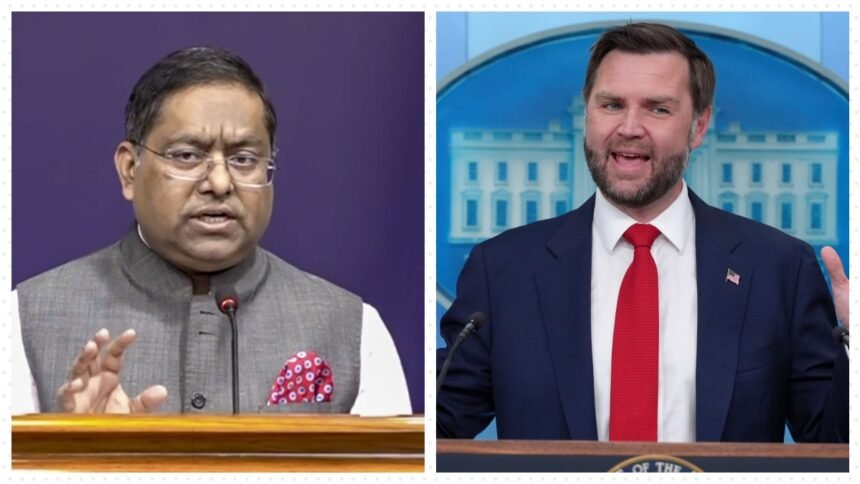
India has strongly pushed back against remarks made by the US Vice President about Indian professionals, calling descriptions that carry painful historical and colonial associations “deeply offensive”, even as it raised concerns over Washington’s suspension of green card-related applications for employees of certain companies.
In a statement issued on October 9, the Ministry of External Affairs (MEA) said Indian professionals in the United States were highly educated and skilled contributors to the country’s economy and innovation ecosystem. It also reminded Washington of the role generations of immigrants have played in building the country’s prosperity.
India’s MEA called US remarks on professionals “deeply offensive” and raised concerns over PERM suspensions, emphasizing skilled workers’ economic contributions and mutual talent mobility benefits, while clarifying suspended applications do not affect existing H-1B visas.

“Resorting to terminology that carries painful historical and colonial legacy connotations is deeply offensive,” the ministry said, responding to the remarks without naming the US Vice President in the statement.
The strong response came alongside India’s concerns over the US Department of Labor’s decision concerning the Permanent Labour Certification (PERM) programme, which is used by eligible foreign workers to pursue employment-based permanent residency.
MEA Says PERM Suspension Will Not Affect Existing H-1B Visas
Clarifying the implications of the US decision, the MEA stressed that the PERM programme is separate from the H-1B visa system.
The suspension of PERM applications does not, by itself, affect the validity of existing H-1B visas or the immigration status of visa holders and their dependents. However, eligible employees of the affected companies could face delays or other difficulties in their green card process, the ministry said.
India also questioned the broader implications of the move, arguing that the movement of skilled professionals benefits both countries.
“Talent mobility adds value to both economies,” the statement said, pointing out that Indian professionals help US companies access advanced skills while contributing to innovation, research, productivity, competitiveness and job creation.
The MEA added that skilled migration also helps create shareholder wealth in the US and described talent mobility as an area of significant mutual benefit for the two countries. “The steps announced by the US do not advance the shared ambitions of both countries,” it said.
The ministry added that it was continuing to monitor developments surrounding the issue.
Indian IT Companies Assess Impact Of US Restrictions
The PERM suspension has raised concerns for Indian technology companies with employees working in the US. Major firms affected by the restrictions include Tata Consultancy Services (TCS), Infosys, Wipro, HCL Technologies, Cognizant, Microsoft and Capgemini.
However, analysts expect the immediate business impact on Indian IT companies to be limited, given their reduced dependence on the PERM route in recent years.
According to ICICI Securities, Indian IT firms accounted for less than 2% of PERM applications filed between October 2024 and September 2025. The brokerage said the development was more likely to affect investor sentiment and longer-term employee retention than trigger an immediate hit to revenue.
Industry body Nasscom has also noted that technology companies have expanded local hiring in the US and reduced their dependence on H-1B visas. It said relatively few workers move from H-1B status to permanent residency through the PERM process.
TCS, India’s largest IT services exporter, has said it does not expect the suspension to affect its workforce strategy or client engagements, citing the single-digit number of PERM applications it filed over the past two years.
Immigration Uncertainty Adds To IT Sector Pressures
The latest development comes as India’s $315 billion IT industry grapples with AI-led disruption, concerns over technology spending and tighter US immigration policies. The Trump administration had earlier increased fees for the H-1B visa programme, adding to the challenges faced by companies hiring skilled foreign workers.
Although the PERM suspension may not immediately disrupt operations, prolonged uncertainty over permanent residency could complicate long-term workforce planning and make it harder for companies to retain some employees in the US.
Analysts have also warned that greater reliance on US-based hiring and subcontracting could raise costs and put pressure on margins.
For India, the issue extends beyond the immediate impact on technology companies. The MEA’s latest statement makes clear that New Delhi views skilled Indian professionals as contributors to the US economy and expects their role to be recognised as part of the wider economic relationship between the two countries.