



India
oi-Gaurav Sharma

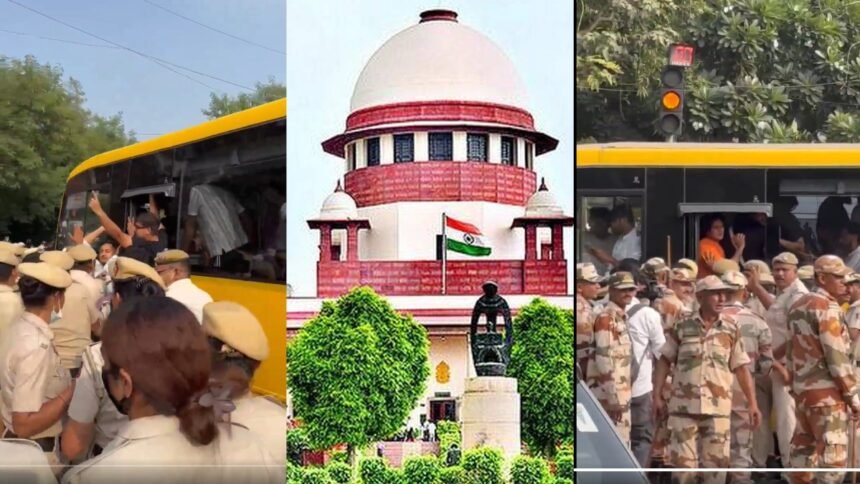
The Supreme Court on Sunday directed authorities to ensure that people participating in peaceful gatherings are not illegally detained, amid allegations of police excesses during protests in Delhi seeking the resignation of Chief Election Commissioner Gyanesh Kumar over alleged irregularities in the Special Intensive Revision (SIR) of electoral rolls.
A bench of Justices Joymalya Bagchi and V Mohana said any detention must follow the procedure established by law. It emphasised that peaceful protesters should not be detained illegally, particularly in areas not covered by prohibitory orders under Section 163 of the Bharatiya Nagarik Suraksha Sanhita (BNSS).
The Supreme Court directed authorities not to illegally detain peaceful protesters and to ensure normal functioning of Metro, rail, and internet services, addressing concerns over police actions during Delhi demonstrations. Notices were issued to the Union Home Secretary, Delhi Police Commissioner, and DMRC regarding contempt proceedings.

The court also directed authorities to ensure the normal functioning of Metro and railway services unless restrictions were necessary to maintain public order. Internet services should remain operational in accordance with the law, while the movement of people and traffic should be facilitated, subject to lawful restrictions and traffic requirements.
The bench issued notices to the Union Home Secretary, Delhi Police Commissioner and Delhi Metro Rail Corporation (DMRC) in contempt proceedings over alleged non-compliance with earlier court directions concerning transport restrictions during the protests.
It also ordered the removal of notices announcing Section 163 restrictions in and around the Supreme Court premises, if they were still in place, and said lawyers must be allowed to carry out their professional duties without obstruction.
Supreme Court Examines Barricading and Transport Restrictions
The special Sunday hearing followed petitions challenging the police response to Saturday’s demonstrations. The pleas alleged that political leaders, lawyers, journalists and ordinary citizens had been detained, while some advocates and mediapersons were allegedly assaulted.
Petitioners also raised concerns over internet restrictions and the closure of 45 Metro stations, arguing that the measures affected citizens’ ability to reach the protest site at Jantar Mantar and exercise their right to peaceful assembly.
During the hearing, senior advocate Kapil Sibal questioned the restrictions on movement and the reported disruption of transport services. He sought the court’s intervention to ensure that people could travel to Delhi and access the designated protest venue, subject to lawful limitations.
The bench asked authorities to review barricading arrangements in light of public-order concerns and traffic requirements. It also sought a map from the DMRC identifying the Metro stations that had been closed and those that remained operational.
Solicitor General Tushar Mehta informed the court that all Metro stations had reopened by 10 pm on Saturday and that internet services had been restored.
Pleas Raise Questions Over Alleged Illegal Detentions
Several petitions questioned the legality of the police measures, including alleged preventive detentions of political leaders and lawyers and the use of force against advocates and mediapersons.
One petition alleged that authorities had breached an earlier Supreme Court order concerning restrictions on Metro and railway services into Delhi. Other pleas challenged the imposition of prohibitory orders and questioned whether the restrictions outside the Supreme Court premises had been properly communicated to those affected.
The bench indicated that the government would have to respond to the allegations concerning illegal detentions, excessive force and possible violations of statutory obligations.