


India
oi-Swastika Sruti

Two different groups of America’s renowned Harvard University, have created buzz after two contrasting statements over the police action against protesters in Delhi demanding the resignation of Chief Election Commission (CEC) Gyanesh Kumar.

Two Harvard University-affiliated groups issued contrasting statements on Delhi police action during protests for CEC Gyanesh Kumar’s resignation; one letter alleged rights violations, while the Harvard Club of India expressed concern over critiques of India’s constitutional institutions.
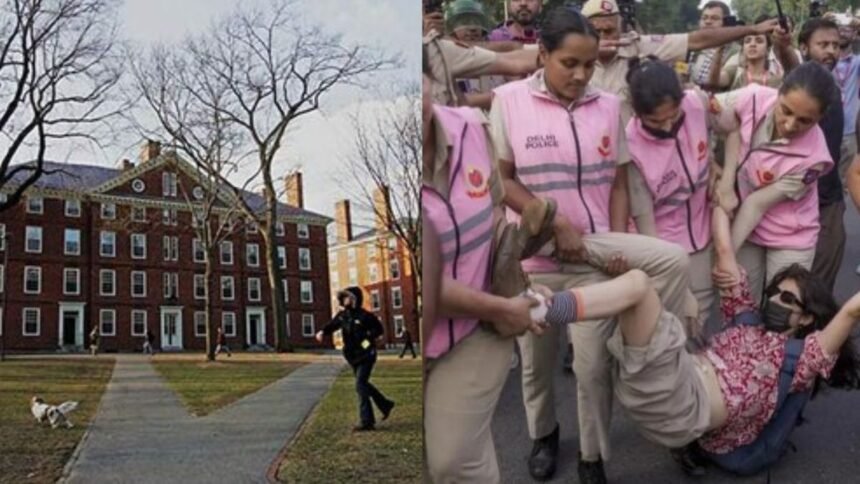
The first letter which was issued on October 12 and signed by 100 Harvard-affiliated faculty members, staff and students, criticised what it described as police brutality, arbitrary detention and violations of the constitutional rights of peaceful protesters.
The signatories described the situation in the national capital as an “unprecedented siege of Delhi by police and paramilitary forces”. They also alleged that the authorities had taken arbitrary, illegal and unconstitutional action against peaceful protesters.
The letter referred to two Harvard graduates, Shadan Farasat and Meher Pasricha, who were reportedly caught up in the police action.
This statement, issued by individuals affiliated with Harvard University, raises concerns over the use of the university’s name to lend credibility to a political campaign without proper authorisation.It also addresses rhetoric targeting India’s constitutional institutions, including the Election Commission, the Supreme Court, the Office of the Chief Justice of India and Parliament. It emphasises that allegations against constitutional authorities must be backed by evidence and that due process, public trust and institutional accountability must be upheld.Constitutional responsibility, institutional integrity and respect for democratic institutions must take precedence over political convenience.Read the full statement below. ⬇️
— BJP (@BJP4India) October 14, 2026
Farasat, a 2009 graduate of Harvard Law School, was allegedly detained and manhandled by police while trying to prevent the detention of a peaceful protester. Pasricha, who graduated from the Harvard Kennedy School in 2025, was reportedly taken away by police despite not participating in the demonstration.
According to the letter, Pasricha was detained for around 13 hours. The signatories called on the government and law enforcement authorities to stop alleged violations of constitutional rights and ensure accountability for any wrongdoing.
The statement placed particular emphasis on the rights of peaceful demonstrators and the need for the authorities to follow constitutional safeguards while maintaining public order.
Harvard Club Of India Issues Rebuttal
Within 48 hours, the Harvard Club of India issued a separate statement expressing concern over what it called a campaign against India’s constitutional institutions. It questioned the language used to criticise authorities and warned that such statements could weaken public trust in democratic institutions.
The Harvard Club of India issued a contrasting statement within two days of the first letter.
Describing itself as the official alumni body connecting graduates and affiliates of Harvard’s various schools across India, the club expressed concern over what it called a “negative public discourse and concerted campaign against India’s constitutional institutions”.
The statement referred to the Election Commission of India, the Supreme Court, the office of the Chief Justice of India and Parliament. It questioned language describing India as being under “siege” and the use of terms such as “thieves” for constitutional authorities.
According to the club, such language raised concerns about attempts to undermine public confidence in democratic institutions.
The statement also said that the actions of law enforcement agencies deserved fair scrutiny. However, it argued that sweeping accusations and abusive language could not replace evidence, due process or institutional accountability.
The club stressed that the Constitution, the rule of law and civil liberties must be respected consistently, regardless of political interests.
The statement was widely circulated on X by BJP supporters and members of the ruling party, adding to the political debate over the protests.
Harvard Club Member Says Earlier Letter Was Not Official Position
The issue was further discussed by Rajat Sethi, who is a member of the executive committee of the Harvard Club of India, in his conversation with news agency ANI.
According to him, some people have issued a letter regarding the recent protests and arrests, yet he made it clear that this letter does not reflect the position of the Harvard Club of India officially.
The difference matters, as the former letter was signed by the alumni of Harvard University, whereas the latter one was issued by the alumni club.
As a result, there were two separate positions that the people connected with Harvard University expressed in their letters. The former one concerned the violation of the rights of the protesters, whereas the latter one pointed out to the need to protect constitutional institutions from unfounded accusations.
Protests Against Gyanesh Kumar Fuel Wider Debate
The demonstrations were organised amid criticism of the Election Commission and demands for action against Gyanesh Kumar. Opposition parties and other groups have raised concerns about the commission’s functioning and the Special Intensive Revision (SIR) of electoral rolls.
The protesters’ demand for Kumar’s resignation has since become part of a broader political dispute involving electoral processes, institutional accountability and the right to peaceful dissent.