



India
oi-Venkatesh Raghavendra

A young American discovers what a LPG cylinder is, the usefulness of a mosquito net and bonds with young girls to explore the true meaning of empowerment
When Jira reached Class 12 at Yuwa School in rural Jharkhand, Payton Souders and the school principal knew they needed to have a difficult conversation with her. Jira worked extraordinarily hard, but academics had never come easily to her, and as college applications approached, they worried that she might not receive the same acceptances as some of her classmates. They wanted to prepare her for that possibility without making her feel that the adults around her had stopped believing in her. Jira, however, seemed far less worried than they were. “Didi, I am not afraid,” she told Payton. “Why would I want to go to a college that doesn’t want me there? I will find my place.”
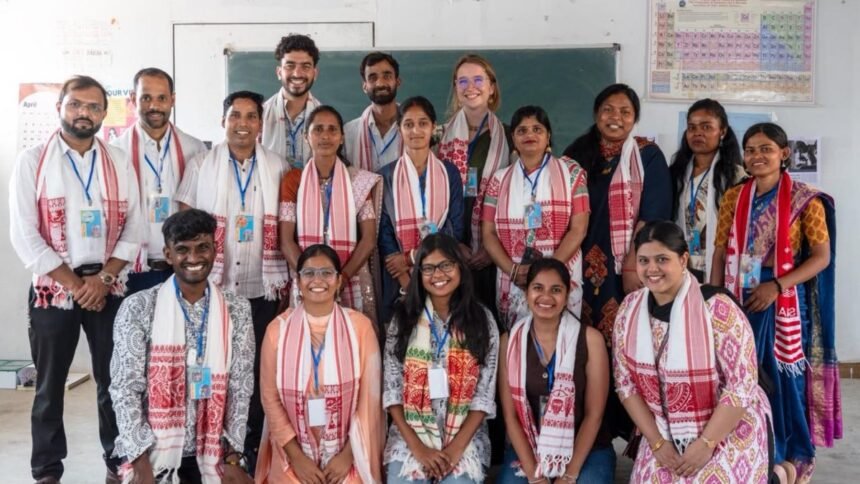
An American educator, Payton Souders, working with Yuwa in Jharkhand, discovered empowerment lies in supporting girls’ self-led journeys, highlighted by student Jira’s scholarship to Tamil Nadu. She emphasizes community resilience and fostering internal confidence and agency over external ’empowerment’.

Two years later, Jira has done exactly that. She is studying at a university in Tamil Nadu on a full scholarship, and the memory of that conversation still brings tears to Payton’s eyes. For her, Jira’s response captured something that three years of living and teaching in Jharkhand have steadily taught her about confidence, education and empowerment. A teacher can provide encouragement, opportunities and support, but ultimately, the confidence to say I will find my place has to belong to the student herself. This is why Payton believes,”the number one thing I have learned about empowerment is that actually, I cannot ’empower’ anyone, all I can do is walk hand in hand with a person as they walk their own, self-led journey of empowerment.”
It is a lesson Payton could hardly have anticipated when she first travelled from America to work with Yuwa, an organisation based in rural Jharkhand that works with girls through education, football and life skills. She first heard about Yuwa through a mentor and was immediately drawn to stories of girls challenging social expectations, stepping onto football fields and pursuing their education. Her decision to go was also personal. Payton describes herself at the time as a “rather sheltered American kid” who knew there was a much bigger world beyond the one she had experienced. “I wanted to live in a context other than my own and build an appreciation for it,” she says. She imagined she would stay for perhaps a year or two; her family assumed the same. Three years later, leaving has become far harder to imagine. “My life is filled with so much love and growth, and I wouldn’t change it for anything.”
Some of that growth began with decidedly ordinary challenges. When Payton first moved to the village where Yuwa School is located, she did not know how to use an LPG cylinder, where to buy groceries or how to manage everyday village life. She had never bathed using a bucket or experienced an Indian monsoon, and on her first night she made the mistake of sleeping without a mosquito net. She woke the next morning covered from head to toe in bites. “I still have the pictures to remind me of how much I have learned and how far I’ve come,” she says. The story makes her laugh now, but it captures something about what followed; Payton had arrived intending to teach and quickly realised how much she herself had to learn.
That learning has happened inside the classroom as much as outside it. Payton arrived at Yuwa relatively inexperienced as a teacher; today, she is Head Teacher of the Secondary School and teaches English, History and Gender Studies, while also supporting teachers, working on safeguarding, supporting students with learning disabilities and helping students think through college and career pathways. Her understanding of teaching has evolved alongside those responsibilities. “A teacher must begin from the heart,” she says. Students need to feel safe, loved and supported before meaningful learning can happen. “The person who sets limits for students is often the teacher, not the students themselves. If you challenge students, they will rise to meet that challenge.” For Payton, expecting more from students can itself be an expression of faith in them.
Jira’s journey illustrates the point. Payton and the school could help her navigate a difficult moment, think about what came next and continue to believe in her potential, but Jira’s refusal to see rejection as a verdict on her future came from somewhere deeper. In development work, we often try to quantify qualities such as confidence and agency through indicators and outcomes. Sometimes, however, they are visible in something much simpler: a young woman deciding that somebody else’s decision about her will not determine how she sees herself.
Payton has encountered another kind of education by spending time in the communities where her students live. She visits families, celebrates festivals, takes part in farming activities and has become familiar with the lives students return to after the school day ends. The women she has met have particularly reshaped her understanding of what it means to be “educated”. She has watched women work as daily-wage labourers on construction sites, sow and harvest crops, carry vegetables long distances to markets and sustain their households, often without much recognition or fair compensation. Many have little formal schooling, but Payton does not see that as an absence of knowledge. “Sure, maybe they did not pass their 12th board exams, but they have learned to navigate a very difficult path in life which most of us ‘educated’ folks would not be able to do,” she says.
What impresses her most are mothers who have faced difficult circumstances themselves but remain determined that their daughters should have more choices. “I know so many mothers who work tirelessly in order to make a comfortable life for their children in which they can pursue an education,” Payton says. “I cannot imagine the type of selflessness that this takes.” She has also discovered the physical reality of that work firsthand. “If you ever want a workout, plant rice with them at the beginning of the rainy season. Then you will know what hard work really feels like!” It is easy for development work to begin with deficits, what a community does not have, which indicators lag behind, what needs to be fixed. Payton’s experience has made her more conscious of what gets missed when the conversation begins there – the knowledge, resilience and capability that already exist.
The same is true of Jharkhand itself. When Payton tells people where she lives, some know little about the state, while others question why she would choose to live somewhere they see primarily as “undeveloped”. She does not dismiss its challenges, economic opportunities remain limited for many families, and migration in search of work is a reality in many communities. But reducing Jharkhand to these problems, she believes, misses much of what makes it distinctive. “Jharkhand is also full of life, color, and potential,” she says.
She has been especially drawn to its Adivasi communities and traditions. Jharkhand is home to communities including the Munda, Santhal, Oraon and Ho, each with its own histories, languages and cultural traditions, and Payton has been particularly struck by the relationship with nature embedded within many of them. “In today’s world of climate crisis and overconsumption, we could learn a lot from them,” she says. At the same time, she is careful not to position herself as an authority on cultures that are not her own and readily points to Adivasi activists and educators as the people best equipped to speak about their histories and experiences. What she does challenge is the assumption that people without conventional educational credentials have less knowledge to offer.
That instinct, to listen before assuming that you know what another person or community needs, lies at the heart of what Payton has come to understand about empowerment. We use the word constantly, talking about empowering girls through education, women through livelihoods and communities through resources. But the word can subtly suggest that one person possesses power and another is waiting for it to be handed over. Payton’s three years at Yuwa have complicated that idea. “All people have a right to their own agency,” she says. “It is wrong to force a person to do anything, even if you think that is best for that person.”
She has also learned that women’s empowerment does not happen in isolation. A girl may become more confident, educated and ambitious, but she remains part of a family and community, where parents, boys, teachers and others around her influence the choices that are realistically available. Creating opportunities for girls therefore requires more than working with girls alone. That is what Payton values about Yuwa’s approach: education, football and engagement with the wider community work alongside one another, recognising the environment in which a girl is trying to build her future. “When they say it takes a village, they aren’t lying,” she says.
Perhaps Jira’s story brings that idea full circle. Payton and the people around Jira could teach, encourage and advocate for her; they could help create opportunities and stand beside her when the future felt uncertain. But they could not manufacture the belief that made an 18-year-old girl calmly say that if one college did not want her, she would find somewhere that did. That belonged to Jira. Perhaps this is a more useful way to think about empowerment: the role of a teacher, NGO, donor or development practitioner may not be to “give” someone power, but to create the conditions in which people have choices, opportunities and the confidence to exercise their own agency.
For Payton, what began as a journey across the world to teach has therefore become something much more reciprocal. She has taught girls in Jharkhand, but she has also been shaped by Jira, by the mothers she has met, by her colleagues and by communities she has embraced as her own.
Pragya Raj Singh is a development and philanthropy professional working at the intersection of global partnerships, social innovation, and India-U.S. engagement. Venkatesh Raghavendra is a social entrepreneur working on issues of access to safe water, youth and opportunity-creation and related areas.