Lifestyle
oi-Oneindia Staff

Cities have always been machines for manufacturing loneliness. They gather millions of people into a single geography and then persuade each person that intimacy remains a private accident. The modern city especially performs this contradiction with remarkable efficiency: it crowds cafés, metro stations and parks with bodies while steadily widening the distance between internal lives. Delhi, perhaps more than most cities, understands this paradox. It can appear immense and indifferent in the morning and suddenly intimate by evening, as if the city itself were capable of mood swings.

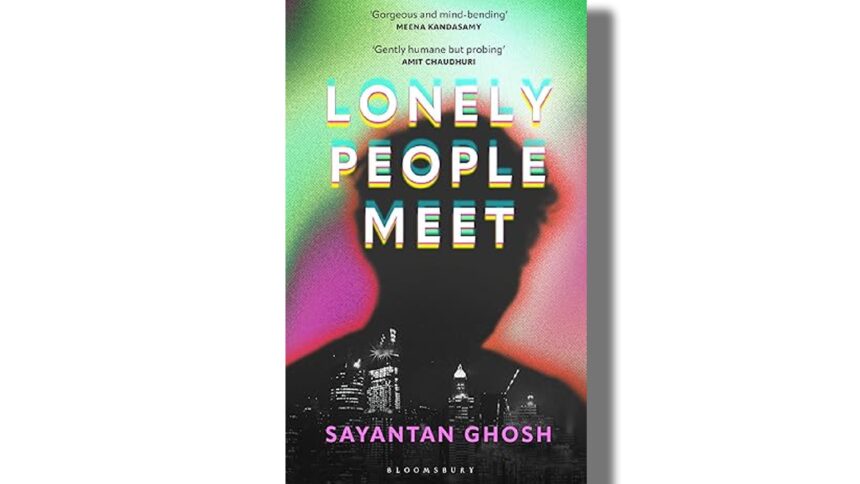
Sayantan Ghosh’s novel “Lonely People Meet” explores urban loneliness and the construction of identity in Delhi, following Karno and Devaki as they question love, memory, and curated selves in contemporary life.
Sayantan Ghosh’s Lonely People Meet unfolds inside this emotional weather. It begins with what appears to be a familiar literary arrangement: a young aspiring writer named Karno encounters Devaki, and chance slowly hardens into companionship. There are bookstores, coffee houses, long walks, conversations that stretch into the night. Their meetings carry the gentle, cinematic haze that contemporary urban romances often inhabit. The city itself appears to participate in the affair, offering corners where temporary certainties become possible.
Yet Ghosh is pursuing something larger than a love story. He is interested in the architecture beneath human connection, the invisible scaffolding that allows people to become meaningful to one another.
Love, Memory and the Fiction of the Self
Love in this novel is not simply attraction between two people. It emerges as a construction of memories, assumptions and stories. We rarely love another person in any complete sense. More often, we love versions of people assembled inside our minds.
The novel gradually asks a disquieting question: if identities can be altered, fabricated or borrowed, does emotional truth disappear with factual truth? Or are human beings already involved in such acts of fabrication every day?
The question feels remarkably contemporary. We inhabit a world increasingly occupied by curated selves. Social media profiles, edited histories and carefully constructed personalities have transformed performance into a near substitute for authenticity. People arrive before us as narratives rather than individuals. Loneliness itself has acquired a public dimension. We reveal fragments of ourselves while carefully withholding others.
Ghosh does not make these observations through overt social commentary. Rather, they emerge quietly from the movement of the narrative, from conversations and moments of reflection that repeatedly return to the unstable nature of identity itself.
Karno and the Modern Urban Self
Karno inhabits precisely such a world. He is not a heroic protagonist in any traditional sense. Nor does Ghosh seem interested in making him one. Karno belongs to that growing tribe of urban literary men who possess cultural fluency and emotional uncertainty in equal measure. He knows books, films and music. He carries references with him almost like identity cards. Yet beneath his cultivated self-awareness lies a persistent anxiety: the suspicion that life is happening elsewhere and perhaps to someone else.
There is something deeply recognizable about him because contemporary cities are full of Karnos. One encounters them in cafés, publishing offices, university campuses and bookstores: intelligent young people whose emotional lives have become entangled with self-consciousness.
Karno’s loneliness does not arise from isolation alone. It emerges from excess awareness. He observes himself constantly, measuring emotions against ideas and experiences against expectations.
The City as Character
Some of the most compelling passages in Lonely People Meet emerge not from dramatic revelations but from ordinary moments of urban drift. Ghosh appears attentive to wandering as an emotional condition. His Delhi is not the monumental Delhi of historical memory or political spectacle. It is instead a city of coffee houses, sidewalks, bookstores and accidental meetings.
The city repeatedly acquires texture and mood. Streets appear not merely as physical spaces but as emotional territories through which characters travel in search of connection. There is a quiet tenderness in these descriptions, an attentiveness to the fragile rhythms of everyday urban existence.
Delhi in the novel often feels less like a setting than a participant. It listens, absorbs and occasionally seems to intervene. Like loneliness itself, it remains crowded and empty at the same time.
Philosophy and the Weight of Reflection
Yet one occasionally senses the novel wanting to say too much.
Ghosh’s characters frequently move into extended reflections on literature, memory, politics and existence itself. Some of these passages possess genuine beauty and intellectual force. Certain observations linger after the page has been turned. But the accumulation occasionally becomes heavy. Characters begin to resemble one another in voice and rhythm. At times they feel less like individuals speaking to one another and more like different versions of the same consciousness thinking aloud.
Still, perhaps this excess belongs organically to the emotional universe of the novel.
Loneliness often produces commentary. People who spend long periods in solitude become narrators of themselves. They interpret and reinterpret experience because narration itself becomes a substitute for companionship. Perhaps Karno’s relentless interiority is not entirely a weakness. Perhaps it is also a symptom.
Ultimately what remains with the reader is not the speculative machinery beneath the novel, nor even its romance. What remains is a quieter sadness.
Lonely People Meet may occasionally wander too deeply into its own philosophical corridors, but beneath its meditations on identity and memory lies a familiar human fear: that the person standing beside us may remain unknowable, and that we ourselves may remain hidden even from those who love us.
That anxiety feels less like fiction than documentary.
Which is perhaps why the novel continues to linger after it ends.