


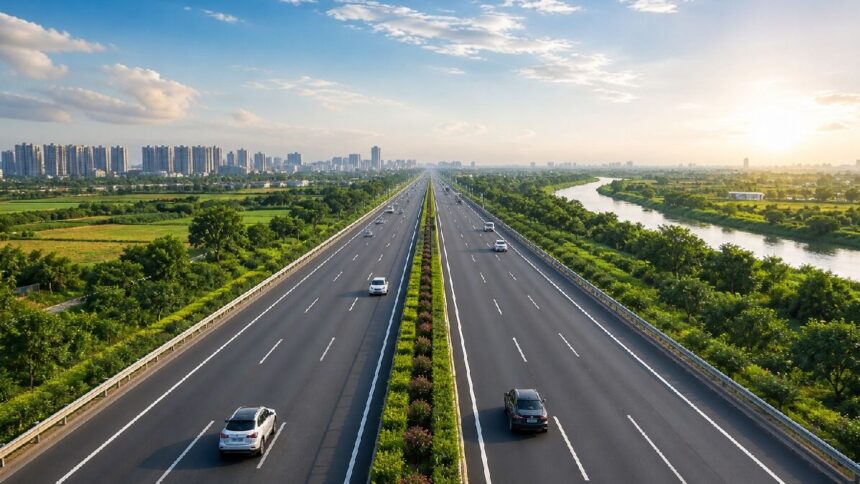
A 37-kilometre eight-lane link from Greater Noida to the Ganga Expressway has gained formal approval, offering a direct, signal-free route. The development is expected to cut travel times and spur regional economic activity, including freight movement and real estate growth in the Greater Noida area.
India
-Ashish Rana

Greater Noida is set to gain a direct high-speed link to the Ganga Expressway, with a 37-kilometre connector getting formal approval. The new road is expected to cut road travel to about 30-45 minutes, and vehicles may reach near the Yamuna Expressway within 45 minutes.

Greater Noida will gain a direct, signal-free link to the 594 km Ganga Expressway via a newly approved 37-kilometre, eight-lane connector to the Hapur bypass, reducing travel time to 30-45 minutes and expected to boost regional economic activity.
Officials said the Greater Noida Industrial Development Authority has cleared this 37-kilometre stretch as an extension of the existing network. The corridor will be built as an eight-lane route. It will extend up to the Hapur bypass, creating a straight expressway link that should sharply reduce congestion and travel time.
Ganga Expressway connectivity and Greater Noida economic boost
With faster access to the Ganga Expressway, planners expect industrial and commercial activity around Greater Noida to rise. The region could see quicker freight movement and smoother daily travel. Officials also believe real estate and services in nearby areas may benefit from this upgraded connectivity and shorter commute window.
Chief Minister’s advisor Avnish Awasthi shared details of the approval through a post on social media platform X. According to the information, the link road is designed as a rapid corridor. The aim is to give Greater Noida a direct, signal-free connection to the Ganga Expressway through the Hapur side.
Ganga Expressway network, Greater Noida link and UP expressways
The Ganga Expressway itself runs for 594 kilometres across Uttar Pradesh. After its launch, Uttar Pradesh became the state with seven operational expressways, the highest number in the country. Together, these seven expressways now cover 1,911 kilometres inside the state, forming a dense high-speed corridor network.
Government data notes that about 60 percent of the national expressway network now lies within Uttar Pradesh. The Ganga Expressway also includes a 3.5-kilometre airstrip. This stretch has been prepared so that Indian Air Force fighter aircraft can conduct emergency landings whenever needed during crises or special operations.
On the route near Hapur, the Ganga Expressway crosses the Ganga river at Brajghat through a bridge about one kilometre long. Further ahead, it passes over the Ramganga river using a 720-metre bridge. The project includes 381 underpasses, 14 main bridges, 126 minor bridges and 929 culverts along its length.
Plans propose linking the Ganga Expressway in future to Haridwar and Jewar airport. Land acquisition has already started for some new expressways in the state. Authorities say these fresh corridors could change connectivity for several districts, while economic activity in both rural and urban belts is likely to grow faster.
According to officials, 12 districts are connected with the Ganga Expressway. The Agra-Lucknow Expressway links 10 districts, the Purvanchal Expressway reaches nine, the Bundelkhand Expressway covers six, the Gorakhpur Link Expressway touches five, the Meerut-Delhi Expressway covers three and the Yamuna Expressway connects five districts.
Districts mentioned with these corridors include Chitrakoot, Banda, Mahoba, Jalaun, Etawah, Gorakhpur, Santkabirnagar, Azamgarh, Hapur, Firozabad, Mainpuri, Kannauj, Kanpur, Hardoi, Barabanki, Amethi, Sultanpur, Ayodhya, Mau, Ghazipur, Vrindavan, Mathura, Bulandshahr, Amroha, Sambhal, Badaun, Shahjahanpur, Raebareli, Pratapgarh and Prayagraj. Jewar’s international airport has given the area wider recognition, while improved access to smaller spiritual towns near big cities has also supported their growth.
Journalist Deep Narayan Pandey has been reporting Uttar Pradesh news for Live Hindustan for around eight years. With more than 15 years in digital, television and print, Deep Narayan Pandey is considered a senior journalist. Work areas include politics, crime, society, infrastructure, tourism, education and health.
Deep Narayan Pandey prefers clear, simple Hindi while writing news for readers and also takes interest in literature. After completing BA and MA in Mass Communication, Deep Narayan Pandey, originally from Gonda in Uttar Pradesh, worked in Lucknow, Varanasi and Gorakhpur with television and print outlets, and has covered major assembly, Lok Sabha and panchayat elections.