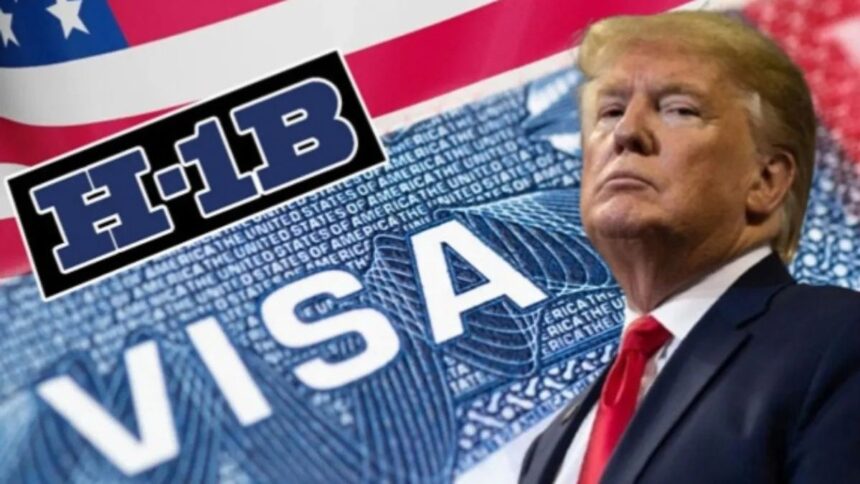
The proposed H-1B visa reforms aim to tie selection to salary and role specialisation, potentially raising costs for sponsors and narrowing access for new graduates. The changes may shift hiring towards mid-career professionals and increase mobility to Canada, Australia, and Germany, influencing global talent flows and long-term migration trends.
International
-Prakash KL

A major plan to reshape the H-1B visa is worrying many Indian students and professionals, who have long seen this route as a bridge to careers in the United States. Early drafts suggest tighter rules, higher costs for companies, and new ways of ranking skilled workers that may limit access.
Indians form the largest group of H-1B visa holders, so any policy change hits this community directly. The proposal links selection more closely to salary levels and role specialisation, while also combining with existing green card backlogs. Together, these factors may raise uncertainty for those hoping to settle in the US.
Proposed US H-1B visa reforms introduce tighter rules, higher company costs, and salary-based selection, potentially limiting opportunities for Indian students and professionals and increasing uncertainty due to combined green card backlogs.

H-1B visa impact on Indian students and fresh graduates
Many Indian students in STEM and business courses rely on Optional Practical Training before attempting the H-1B visa. The draft law aims to favour better-paid and more specialised roles during selection. This appears merit based, yet it risks sidelining fresh graduates who usually start on lower salary bands.
Entry-level packages tend to be modest compared with pay for experienced staff, even in technology. If wage thresholds increase, employers may avoid sponsoring recent graduates and instead choose mid-career professionals. Indian students, who often invest substantial savings in US degrees expecting post-study work, could therefore face fewer offers and tougher competition.
H-1B visa changes for Indian IT companies and outsourcing
Another central feature of the proposal is higher visa fees and tighter compliance rules for companies using the H-1B visa. Large Indian IT firms, which have traditionally filed many applications, may see onsite deployment become more expensive and administratively burdensome, especially for project-based or short-term client engagements.
As costs rise, firms could adjust their models by hiring more staff directly in the United States or by growing delivery centres in India and other locations. That shift may support job creation in Indian cities but reduce chances for staff seeking overseas roles. The bill also reflects pressure in the US to move work from offshore outsourcing to local delivery centres.
H-1B visa reforms and long-term migration trends
Service-based Indian IT professionals, especially in routine coding, maintenance, or support, may see fewer onsite chances under the revised H-1B visa rules. Instead, companies may target a smaller pool of specialists in areas such as artificial intelligence, cybersecurity, cloud architecture, and advanced data science, where skills are scarcer and salaries are already higher.
For those with niche expertise, demand is likely to remain strong, and employers may still justify sponsorship despite steeper costs. However, professionals in more generic roles could find that international assignments decline. This may encourage many skilled workers to build careers in India itself, contributing to a form of reverse brain gain, but also limiting cross-border knowledge exchange.
Long-term plans for Indian workers are further complicated by existing green card queues, which are heavily backlogged because of country-wise limits. Stricter H-1B visa conditions may lengthen the period people spend on temporary status. This extended uncertainty can delay decisions about buying property, moving families, or committing fully to a long career in the US.
With the American route appearing less predictable, Indian professionals are increasingly exploring other countries offering clearer pathways for skilled migrants. Canada, Australia, and Germany are among those easing entry rules and permanent residency options. As a result, global Indian talent may spread more widely, instead of concentrating so heavily in Silicon Valley and other US hubs.
H-1B visa outlook for Indian professionals
The proposed H-1B visa overhaul does not fully block Indian participation but narrows the route and heightens competition. Students may now need stronger academic records, specialist skills, and higher-paying job offers to succeed. Working professionals will have to adapt through upskilling and flexibility, while also weighing growing opportunities beyond the United States.