



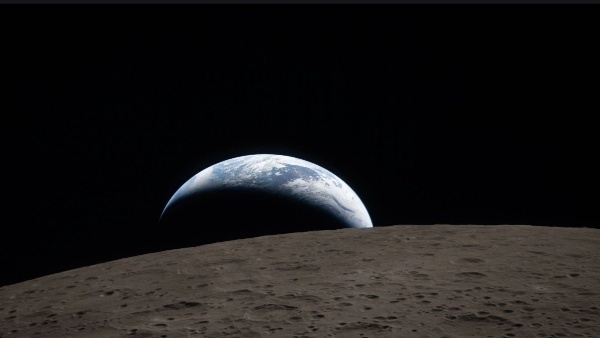
On April 1, 2026, at 6:35 p.m. EDT, a Space Launch System rocket lit up the sky above Kennedy Space Center’s Launch Pad 39B, carrying four humans toward the Moon on the most ambitious crewed flight since the Apollo era. Ten days later, they were home — carrying with them images and memories that no human had experienced in half a century.

The Artemis II mission, the first crewed test flight of NASA’s Orion spacecraft and SLS rocket, was by any measure an extraordinary success. Commander Reid Wiseman, Pilot Victor Glover, and Mission Specialists Christina Koch and Jeremy Hansen became the first humans to fly around the Moon since the crew of Apollo 17 in December 1972.
Along the way, they shattered the record for the farthest any humans have ever traveled from Earth — surpassing the Apollo 13 crew’s 54-year-old mark by more than 4,000 miles. They passed behind the Moon and lost contact with Earth for 40 minutes. They watched Earthset. And on April 6, they witnessed something no human had ever seen before: a total solar eclipse, from space, near the Moon.
Mission timeline
Ten days that changed spaceflight
Apr 1
Day 1
Launch from Kennedy Space Center
Liftoff at 6:35 p.m. EDT from Launch Pad 39B. SLS — the most powerful rocket ever to fly humans — sends Orion on a 25-hour Earth orbit before the translunar injection burn.
Apr 2
Day 2
Translunar injection — bound for the Moon
A 5-minute 49-second burn at 7:49 p.m. EDT sends Orion onto its lunar trajectory. The crew departs Earth orbit and begins the four-day coast to the Moon.
Apr 6
Day 6
Lunar flyby — farthest humans in history
Orion passes within 4,067 miles of the lunar surface. At maximum distance, the crew reaches 252,756 miles from Earth — surpassing the Apollo 13 record set in 1970. A 40-minute communications blackout as Orion passes behind the Moon. The crew witness Earthset, Earthrise, and a total solar eclipse.
Apr 8
Day 8
Radiation shelter demo & manual piloting tests
The crew demonstrates construction of a radiation shelter inside Orion and runs manual piloting tests — critical data for future deep space missions.
Apr 10
Day 10
Splashdown — Pacific Ocean, San Diego
Orion re-enters Earth’s atmosphere at 25,000 mph. The service module separates at 400,000 feet. Splashdown at 5.35 AM IST off the coast of San Diego.
The crew
Four humans, one historic orbit
The Artemis II crew represented multiple firsts: Koch was the first woman to fly to the Moon’s vicinity; Glover the first Black astronaut; Hansen the first non-American to fly beyond low Earth orbit. Together they became the first humans to fly around the Moon in more than 50 years.

The Artemis II crew wearing eclipse viewers aboard Orion, April 6, 2026. From top left: Christina Koch, Victor Glover, Reid Wiseman, Jeremy Hansen. Credit: NASA
RW
Reid Wiseman
Commander · NASA 🇺🇸
VG
Victor Glover
Pilot · NASA 🇺🇸
CK
Christina Koch
Mission Specialist · NASA 🇺🇸
JH
Jeremy Hansen
Mission Specialist · CSA 🇨🇦
“I’m not ready to go home. I can’t believe that something this cramped of quarters can fly by and still be fun every single minute.”
— Christina Koch, Mission Specialist, speaking after the lunar flyby
Lunar flyby · Day 6
Face to face with the Moon
As Orion swung around the far side, an external camera captured one of the most striking images in the history of human spaceflight: the Orion service module — its solar panels stretched wide, its NASA and ESA markings glinting in sunlight — suspended in the darkness beside a first-quarter Moon, its craters etched in razor-sharp detail.

NASA’s Orion spacecraft lit by the Sun, with the first-quarter Moon visible behind it. Taken by an external camera during the lunar flyby on April 6, 2026. Credit: NASA
At closest approach, the crew flew just 4,067 miles above the surface — close enough to make out individual craters with the naked eye. They reported color nuances in the lunar terrain: shades of brown and blue that can reveal mineral composition and the age of geological features.
“As we came around the near side of the Moon, seeing all the sites that we’ve seen from Earth for all our lives, but from a completely different perspective.”
— Commander Reid Wiseman, speaking with President Trump after the flyby
By the numbers · lunar flyby
4,067
miles from lunar surface at closest approach
60,863
mph — Orion’s speed relative to Earth at closest approach
~7 hrs
duration of lunar observation period
40 min
communications blackout behind the Moon
Earthset
Watching our world disappear
As Orion passed behind the Moon at 6:41 p.m. EDT on April 6, the crew had only minutes to witness Earthset — the sight of our planet sinking below the lunar horizon. The crescent Earth, glowing blue and white, slipped behind 2,000 miles of ancient cratered rock and vanished. For 40 minutes, they were cut off from all communication with home.
It was the first time any human had seen this sight since the crew of Apollo 17 in December 1972. When Orion emerged from the far side, the crew saw the mirror image — Earthrise. “The crew witnessed an Earthrise as Orion emerged from behind the Moon,” NASA reported, “moments before the Deep Space Network reacquired the spacecraft’s signal.”
Solar eclipse · April 6, 2026
A black orb with a halo of fire
At 8:36 p.m. EDT on April 6, the Sun disappeared behind the Moon from the perspective of the Artemis II crew — the beginning of a total solar eclipse that would last nearly an hour. It was the first time in history that humans had witnessed a total solar eclipse from near the Moon.

“The sun has gone behind the Moon. The corona is still visible and it’s bright, and it creates a halo under almost the entire Moon. The Moon is just hanging in front of us — this black orb.”
— Pilot Victor Glover, reporting from Orion during the eclipse
The crew used the eclipse to study the solar corona — the Sun’s outermost atmosphere — and watched for flashes of light from meteoroids striking the lunar surface. They could see stars and planets behind the Moon. The Sun reappeared at 9:32 p.m. EDT, ending nearly an hour of observations that scientists called unprecedented.
Return to Earth
2,000 miles of descent, home
On April 10, after trajectory correction burns on days 7, 8, and 9, the crew donned spacesuits and compression garments for re-entry. At approximately 400,000 feet above Earth, the Orion service module separated from the crew capsule. Orion plunged into the atmosphere at 25,000 miles per hour — generating temperatures on the heat shield of around 5,000°F.
Entry interface – the point where the capsule first bites into the upper atmosphere – occurred 2,000 miles from the California coast, near Hawaii. Over the next few minutes, parachutes deployed and Orion splashed down at 5.35 AM IST in the Pacific Ocean off San Diego.

NASA’s official graphic showing the entry interface point (2,000 miles out, near Hawaii) and the landing area off San Diego, California. Credit: NASA
What comes next
Artemis III: boots on the Moon
Artemis II was the rehearsal — a proof that humans can safely fly the Orion spacecraft to the Moon and back. The next mission, Artemis III, will attempt what humanity has not done since December 1972: land people on the Moon.
The target is the lunar south pole, where permanently shadowed craters are believed to harbor water ice — a resource that could sustain future long-duration stays and even support missions to Mars. The lander will be SpaceX’s Starship Human Landing System.