



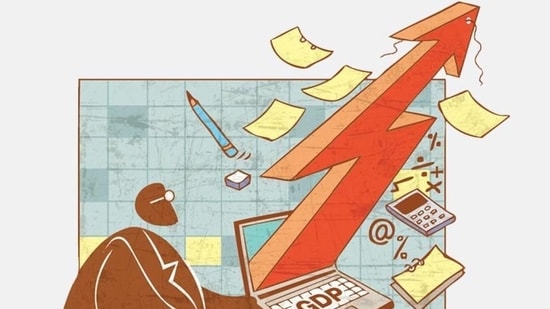
Every morning in India, the economy begins its day before the markets open. It runs on unpaid labour, largely invisible, rarely acknowledged in policy or productivity metrics, and almost entirely carried by women.

A report released in December 2025 by the United Nations Development Programme (UNDP) highlights that women’s unpaid domestic and care work in India is valued at an estimated 15–17% of the country’s GDP. It describes this as a “silent engine” – a vast, multi-trillion-rupee system that relies on labour which remains largely unpaid and unprotected. It suggests that women are not voluntarily stepping away from the workforce; rather, they are often compelled to do so due to caregiving responsibilities that remain invisible in economic calculations.
A critical but often overlooked constraint is time. When a significant share of it is absorbed by unpaid responsibilities, the capacity for paid work or skill-building shrinks. In that sense, improving female labour force participation is not only about job creation, but about enabling a more equitable distribution of time.
For decades, economic inclusion has been approached as a supply problem: train more women, connect them to jobs, and participation will follow. But this assumes that women are starting from the same baseline as men. When unpaid work already occupies a disproportionate share of a woman’s day, the real constraint is not intent or ability; it is bandwidth.
The most effective livelihood models recognise this. They are not necessarily the most scalable on paper, but they are the most adaptive in practice. They work because they start with a simple premise: women do not enter the workforce as blank slates. They come with layered responsibilities, social expectations, and often limited room for negotiation. Designing around this reality, through proximity, flexibility, or hybrid pathways, is not a concession. It is an economic necessity.
There is also a second layer that is less visible but equally decisive, internal barriers shaped over time. Data can tell us how many women are outside the workforce, but it rarely captures how many have opted out before even attempting entry. Confidence, or the lack of it, is often treated as a “soft” factor. In reality, it functions as hard infrastructure. Without it, access does not convert into participation.
This is why livelihood programmes that integrate life skills with employability skilling are seeing stronger retention, not just higher placements. A technically skilled candidate without decision-making or confidence is more likely to exit at the first point of conflict. One who is equipped to negotiate, adapt, and persist is far more likely to stay and grow. Over time, this distinction compounds into significantly different outcomes.
The third shift underway is digital, but not in the way it is often described. This is among the most recent national datasets, released in mid-2025 by MoSPI, focusing on internet usage, mobile access, and ICT skills. While nine in ten men and four in five women aged 15 and above report using a mobile phone for calls or internet access, ownership reveals a clear gap: 84% of men own a mobile phone, compared to just 56% of women.
This disparity extends beyond access to actual digital capability. A majority (56%) of Indians aged 15 and above are unable to use email services, with the gap widening among women – nearly two-thirds (64%) cannot send or receive emails. Similarly, in online banking, women trail men by 24 percentage points, underscoring a deeper divide in digital and financial inclusion.
What matters more, however, is not access, but agency.
A smartphone in itself does not change economic participation. What changes outcomes is how confidently and purposefully it is used, to seek work, to learn, to transact, and to build networks. Digital inclusion, therefore, is less about connectivity and more about capability.
Perhaps the most underestimated shift is what happens when a woman earns for the first time. Not because of the immediate income effect, but because of what economists would call expectation resetting.
In households where women have historically not participated in paid work, the first income quietly alters decision-making dynamics. Spending patterns shift. The perceived “return” on women’s work changes, influencing whether younger girls in the same household are encouraged to pursue similar pathways. This is where female labour force participation intersects with intergenerational mobility.
And even as we recognise these shifts, the broader system continues to measure success in narrow terms: the number of jobs created, the number of women placed, and short-term income gains. What we do not measure adequately is continuity.
How many women stay in the workforce beyond the first year? How many transition to higher productivity roles? How many build assets, financial, social, or professional, over time? Without this lens, participation risks becoming episodic rather than transformative.
India’s growth story is closely linked to the participation of its women, but the opportunity is not just about increasing numbers. It is about redesigning systems.
According to a report by Magic Bus India Foundation and Bain & Company, for India to reach its $30 trillion GDP target by 2047, female labour force participation must nearly double from the current 35–40% to 70%. Achieving this shift will require more than expanding job opportunities. It calls for rethinking how work is structured to better reflect women’s time, realities, and aspirations.
Designing livelihoods for women whose workday starts before dawn is not about adding to what they already carry. It is about creating pathways that acknowledge their realities and amplify their strengths. Because when that happens, livelihoods do more than create employment. They create stability, agency, and the possibility of a very different future.
(The views expressed are personal)
This article is authored by Jayant Rastogi, Global CEO, Magic Bus India Foundation.