


India
oi-Swastika Sruti

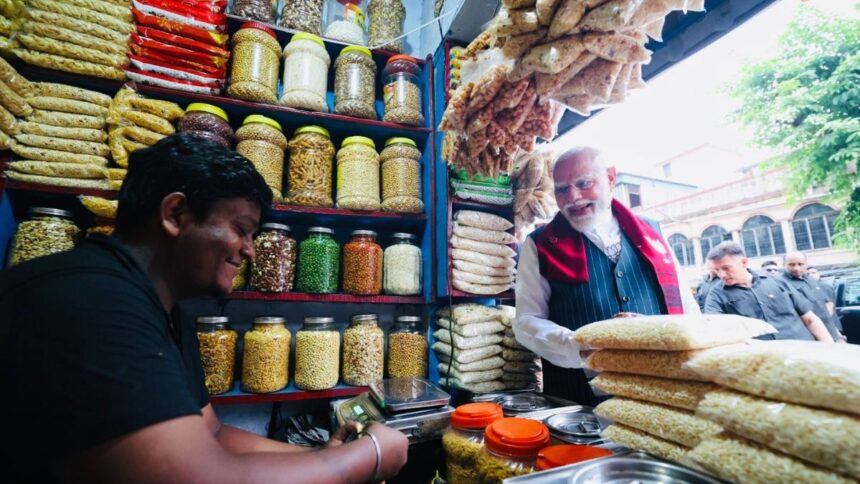
A simple roadside interaction during Prime Minister Narendra Modi’s visit to West Bengal has now taken an unexpected turn. The jhalmuri vendor who met the Prime Minister in Jhargram has given different names in separate media interviews, creating confusion and raising questions.

Prime Minister Narendra Modi’s visit to a Jhargram jhalmuri stall led to overnight fame for the vendor, who has reportedly given two different names, Deepak Kumar and Vikram Shaw, in media interviews, causing confusion.
However, after Prime Minister Narendra Modi’s quick snack break, the humble street vendor he visited unexpectedly shot to fame overnight. What was once a quiet, unnoticed stall has now turned into a bustling hotspot, with people flocking from far and wide just to taste his jhal muri.
The craze has grown so intense that long queues can be seen even at midnight, as curious visitors and food lovers eagerly wait their turn.
The vendor, once leading a simple life, is now overwhelmed by the sudden attention, as his small shop continues to draw crowds inspired by the Prime Minister’s visit.
What Happened During the Visit
During his visit to Jhargram, PM Modi made a surprise stop at a small roadside stall and tasted jhalmuri, a popular local snack.
The vendor later shared that the Prime Minister liked the food very much. He also said that PM Modi spoke to him in a friendly way, asking about his name, education, and family background.
According to the vendor, PM Modi stayed at the stall for around 10 minutes and even interacted with children present there.
ব্যস্ত রবিবারে পশ্চিমবঙ্গ জুড়ে চারটি জনসভার ফাঁকে, ঝাড়গ্রামে সুস্বাদু ঝালমুড়ি খেলাম। pic.twitter.com/VqIrc0zrmR
— Narendra Modi (@narendramodi) April 19, 2026“>
Two Different Names in Two Interviews?
The situation became confusing when the same vendor appeared in different media interviews and introduced himself with two different names.
- In one interaction, he identified himself as Deepak Kumar.
#WATCH | Jhargram, West Bengal: Vendor of the local shop where PM Modi had jhalmuri, Deepak Kumar says, “After eating, he said that he liked it very much. He asked my name and also asked what level I had studied… He stayed there for 10 minutes, and the children were also with… https://t.co/hBUauWFwtm pic.twitter.com/raaQEBlXgP
— ANI (@ANI) April 20, 2026“>
- In another interview, he claimed his name was Vikram Shaw.
Both interviews described the same incident-PM Modi eating jhalmuri, asking about his studies (up to Class 9), and discussing his daily earnings and family. However, the difference in names has raised doubts.
Details Shared by the Vendor
In his statements, the vendor shared several personal details about his life:
- He said he studied up to Class 9 but could not continue due to financial difficulties
- He runs the stall to support his family
- His daily earnings are around ₹1,000 to ₹1,200
- He belongs to Gaya in Bihar and lives with his parents
- He also mentioned that PM Modi insisted on paying for the jhalmuri, even when he initially refused to take money.
No Political Talk, Says Vendor
The vendor also clarified that there was no political discussion during the interaction. According to him, the conversation remained simple and personal.
He added that the Prime Minister advised him to live well and continue his work. The vendor later said he regretted not taking a photo or autograph to remember the moment.
Why the Confusion?
The difference in names has now become a talking point. There could be several possible reasons:
- A reporting or communication error during one of the interviews
- Confusion caused by multiple people present at the stall
- Misidentification by media outlets
- Or the possibility that more than one vendor was involved
As of now, there is no official clarification on why two different names were given.
The incident has sparked curiosity among people, especially on social media. Many are asking whether it was the same person giving conflicting details or a mix-up by the media.
Such inconsistencies often lead to questions about the accuracy of on-ground reporting during high-profile visits.
But the question remains that why two names?