




MUMBAI: The Dadar kabutarkhana, which was at the centre of a controversy last year when a section of people protested against its closure following a Bombay High Court order, is back in the news. Mahim legislator Mahesh Sawant, in a letter to municipal commissioner Ashwini Bhide, has recommended that the pigeon-feeding spot, which was shut down in August 2025 and currently stands covered with a tarpaulin sheet, be narrowed down to make space for road-widening at the crowded junction.
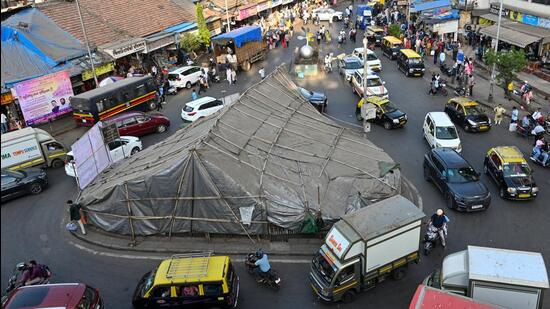
The issue, however, is complicated. The kabutarkhana continues to be contested in court, a concern raised by local corporator Yashwant Killedar. “This matter is sub-judice and the status quo will have to be maintained here,” he said. Killedar also argued that since the kabutarkhana served as the junction of three roads, it would need to be retained as a traffic island for smooth vehicular flow. “If road congestion is the issue, the solution could also be to get setbacks from the redevelopment of nearby buildings,” he said.
Sawant countered this by pointing out that the court proceedings could be a long-drawn affair as would the future redevelopment of all the buildings around the kabutarkhana. “Some solutions need to be worked out in the interim period to deal with the congestion issue,” he said.
The Jain community, which has challenged the closure of the kabutarkhana, has a different viewpoint. “It is the hawkers at this junction who cause traffic congestion,” said Sandeep Joshi, a trustee of Jinraksha International Yuva Group. “Strict action against hawkers has already eased the traffic situation here.” Joshi, who is associated with the Jain community, said that pigeons were thirsty during the exceptionally hot summer, and people needed to be sympathetic towards them rather than reduce their space. “The kabutarkhana is the identity of this part of Dadar and needs to be renovated and beautified rather than curtailed or closed,” he said. “The BMC should reconsider allowing us to feed pigeons for two hours every morning.”
Considering the sentiments involved, the BMC has adopted a guarded approach. “We will study the proposal to understand if any changes need to be introduced,” a senior civic official told HT. “Since the kabutarkhana is a heritage structure, that will have to be factored in. Being a high-footfall zone with three roads converging at that point, a traffic island would help define clear boundaries and prevent traffic from spilling over into other lanes. These days, even road dividers could serve the purpose. But these are all technical issues that need to be studied.”
Killedar recalled the time when the kabutarkhana patch had just a small drinking water point and a water fountain but got converted into a pigeon-feeding spot over the years thanks to feeding by visitors from the local Jain temple and encouragement from local grain sellers.
Chetan Kamble, a civic activist and resident of Senapati Bapat Marg, however, felt that traffic bottlenecks were a genuine issue at this point, adding that the existing covered structure was full of dust, which needed to be addressed. “But health and hygiene have improved considerably since the pigeon feeding point was shut down,” he said.