


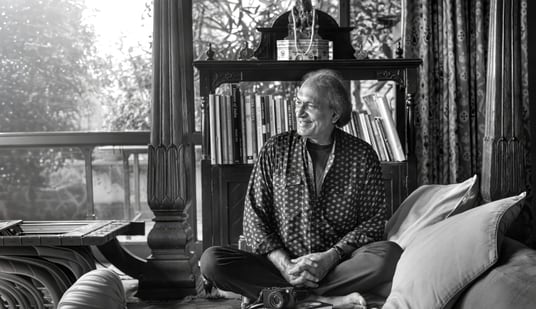
Raghu Rai, one of India’s most renowned photographers, died at a private hospital in Delhi on Sunday. He was 83. His son, photographer Nitin Rai, said he had been battling cancer for the past two years. This interview is an excerpt from Rohit Chawla’s 2016 interview with Raghu Rai for Open Magazine.

PRELUDE
I meet my god through my camera.
Raghu Rai
b. 1942, Jhang (now in Pakistan) / s. New Delhi / p. photography
Coincidences sometimes complete a cycle in hardly imagined ways. My love affair with photography had its genesis in the early 1980s as I watched a tall, lanky man sitting on a balcony across the road with a camera, focusing on life in the street below, as I waited for my school bus. Curiosity led me to climb the stairs one morning and discover the obsessive photographic world of S. Paul who, as I was to find out later, was Raghu Rai’s elder brother — but, more importantly, his mentor too. Though I had not met Raghu in person then, the magic of his wide angle lens had left an indelible imprint through the pages of India Today. In an ironic turn of events, my own photographic journey took me to India Today as creative director thirty years later, following in Raghu’s large footsteps, albeit a tad gingerly.
In my early advertising years at JWT, Raghu’s gritty photojournalism and books provided the inspiration most Indian photographers required. Raghu’s ode to Indian classical musicians remains my favourite photographic series till date. Given Raghu’s own love for music, he was a familiar sight at classical concerts, camera in tow, eyes closed, swaying rhythmically, his languorous frame blocking the view of lesser photographer mortals like myself. But it was the launch of his book of portraits on the occasion of him completing fifty years of photography, that egged me to interview him for Open Magazine in 2016. That interview still remains pertinent and I have abbreviated it here for my own book of artist portraits.
PORTRAIT OF AN ARTIST
Excerpts from that interview:
On staging an image
Conceptual photographic experimentation is everywhere and digital manipulation a big part of it. Fine art photography and abstraction happens after years of tapasya and dedication, where you zero in on a given situation that captures massive power, energy and form with minimal tamasha of content. But this current flavour of photographing walls, of a beautiful girl’s face cut in half and marrying it with forms and textures, is a travesty. I remember the painter Raza saying, “I have put red on my canvas, but the red is staring back at me. I can’t go any further because my gods have still not arrived.” A photographer needs to be particularly mindful because most concepts are created intellectually in his head but they need to be executed physically. As a creative individual, you need to make yourself available mentally, physically, spiritually, and intuitively to a given situation. You need to channelise supreme energy to create that magical image that is the quintessential moment of darshan through which all art is born. The rest is simply form and textures.
On his partiality for wide angle lens
I am partial to it — even for my portraits that are about people, the individual, but equally the atmosphere and surroundings. Most of my work revolves between the 24 mm to the 60 mm lens range. India is a country where so many simultaneous moments exist in a physical space and it is my desire to assimilate them all in my work.
On digital as his preferred medium
Digital has freed us from the tyranny of film. The ability to see the image instantly is half the magic. With the help of digital technology, you can play around and create an image without even taking a picture. But for me the purpose of photography is still to capture the time we live in, otherwise painters are there, writers are there — anybody can do anything with a subject.
On his ‘Indian’ eye
At an idea exchange in Australia, photojournalist Martin Parr asked me if there was an Indian way of seeing things, to which I responded by asking if there was a British way of seeing things. I work in India and am more sensitively attuned to its cultural nuances and details. I understand them better and that is the little extra I have as a sensitive photographer. But there is no Indian way of seeing things. You don’t need a taxi to make sense of a good photograph. Your image is good if it can speak for itself.
On his favourite portrait subject
Unquestionably, His Holiness the Dalai Lama. The intensity and spiritual energy he exudes is so amazing, so magnetic. In approaching your subject, you have to be impartial because the portrait has to reflect the moment, the experience of the person, the energy of the person in any given time. But if you carry your own mental baggage of the subject, that baggage keeps making noise. As a documentary photographer, you need to keep your palette clean and embrace the moment.
On photography festivals
They tend to be chaotic and sometimes showcase below par imagery that is derivative in nature. It’s a fast-food attitude to showcasing photography minus any serious thought — the fast-food generation married to the digital generation — that has started producing below par work. When you look at these images a second time, they hold nothing. Unfortunately, we do not have many committed, sensitive curators to write lucidly about photography — no names come to mind. What is being shown and shared is creating more confusion in the minds of young photographers who do not know where we need to draw a line. A bright and talented photographer told me, “I don’t really know what to do with photography!” The increasing banality reflected in the chosen images at these festivals is directly related to clicks not having any economic cost — it is image making that costs you nothing. It is also perhaps the insular nature of the photographic community that is not working collaboratively enough. The running school of photography and playing curators are in some cases failed photographers. When your personal vision has not matured, how can you hold a mirror to the rest? If you don’t have civilisation continuity and depth, if you don’t have a peculiar penetration of your own, are you fit to teach and showcase photography to the rest?
On photography as intrusive
There are times when wielding a camera feels a bit like invading personal space. But I am reminded of my artist friend Himmat Shah who said that you don’t have the right to call a small rock from the Himalayas unless what you sculpt out of it has the experience of the Himalayas. If in a difficult situation a photograph manages to capture the essence, the magnitude, the depth of that experience that is honest and intuitive and at par with what nature holds as a mirror to you, then the camera has served its purpose.
On what drives him
Once I pick up my camera, I am driven by the ever-changing energy of life and nature. When you have invested mentally, physically, and spiritually in situations and take pictures constantly, it is like investing in a bank of life in which the returns keep getting bigger and the energy keeps you going. Wherever I go, my darshan is always through my camera. I meet my god through my camera.
The interview shared above is from Rohit Chawla’s upcoming book, Portrait of an Artist.