



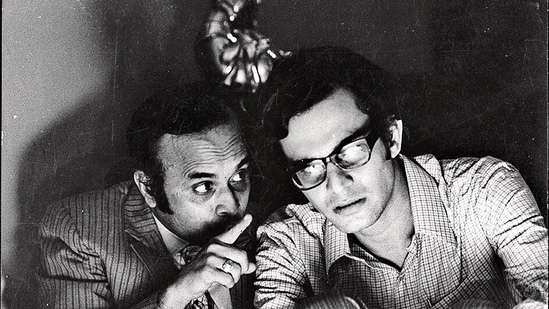
In the Bengali film Aranyer Din Ratri (Days and Nights in the Forest, 1970), directed by Satyajit Ray, four young men from Calcutta drive down to Palamau (then in Bihar, now Jharkhand) for an impromptu holiday. Adapted from Sunil Gangopadhyay’s novel with the same title, the film opens with one of the characters, Sanjoy (Subhendu Chatterjee), reading from a 19th-century Bengali travelogue, Palamou, by Sanjib Chandra Chatterjee, the brother of Bankim Chandra Chatterjee, author of India’s national song Vande Mataram. “Bengalis are accustomed to seeing plains, so the slightest suggestion of hillocks fills them with alacrity,” reads Sanjoy as the landscape outside the car windows changes.

Described by American filmmaker Wes Anderson as “criminally underseen”, a 4K restored version of the film was screened at the Cannes Film Festival last year. If the screening sparked any interest among those without access to Bengali culture, they could turn to the recently published The Bengali Reader: The Finest Fiction, Non-Fiction, Poetry and Plays from the Bengali . Translated and edited by Arunava Sinha, the most prolific translator from the language in recent decades, this volume includes an extract from Palamou, poetry by Gangopadhyay, and also an extract from Ray’s screenplay for his 1976 film, Jana Aranya (The Middleman). At nearly 600 pages, this volume is the definitive, canon-making anthology of Bengali literature for our times.
This anthology performs three essential tasks. First, it provides an ambitious collection of Bengali literature from a little over 200 years, starting in 1800, when the volume of printed books and newspapers in the language expanded significantly with the establishment of the Mission Press in Serampore. Second, it uses translation as an instrument for canon-making. American translator and theorist Lawrence Venuti writes, in a 2008 paper, that “Translation contributes to canon formation by inscribing the foreign text with an interpretation that has achieved dominance in academic and other cultural institutions.” An anthology of this magnitude, helmed by an arbiter of Sinha’s reputation, naturally takes up a significant space in the market and in public discourse, thereby defining the canon.
It is, therefore, important for the editor of such a volume to be inclusive across multiple intersections of gender, caste, class, as well as genre and form. Sinha performs this task in two ways — first, by the inclusion of genres, such as recipes, screenplays, speeches, sketches, songs, etc., that have traditionally not found a space in the Bengali literary canon, possibly because of gatekeeping by an upper-caste, Hindu, middle-class sensibility. Sinha also includes writing by people who have been traditionally excluded from this canon, such as folk singers like Lalon Fakir, 19th century women writers (Rassasundari Dasi, Krishnabhabini Dasi, Binodini Dasi), revolutionaries (Dineshchandra Gupta, Subhas Chandra Bose, Kanu Sanyal, etc.), songwriters (Salil Chowdhury, Kabir Suman), Dalit (Adwaita Mallabarman) and Queer (Abhijit Majumder). I call them “unusual suspects”, and their inclusion is code for democratic desires that are steadily in retreat in our times of narrowly defined identities.
Sinha organises his material chronologically into five uneven periods — The Argumentative Bengali (1818-1890), The Home and the World (1891-1930), Independent Voices (1931-1949), Revolutionary Fires (1950-1980) and Modern Times (1981-2019). It is possible to debate each of these categories, and even the raison d’être of chronological classification, but for a reader who has no access to the language, it provides a robust, signposted route through the gnarled tropical forest of Bengali literature. The translator also provides short introductions to each section, justifying his decision. For instance, he argues that the first section reflects the emerging public sphere in Bengal, aided by print culture, Rabindranath Tagore casts a long shadow over the second section, while the third section is described as the “golden age” of the Bengali reader. The communist movement, especially the far-left Naxalites, influences the “revolutionary fires” of the fourth section, while the fifth section brings us to our contemporary times.
Each of these sections, naturally, includes the usual suspects. For instance, in the first two sections, a reader will encounter long-canonised writers such as Rammohun Roy, Ishwarchandra Vidyasagar, Michael Madhusudan Dutt, Bankim Chandra, Rabindranath Tagore, Sarat Chandra Chattopadhyay, Kazi Nazrul Islam and Swami Vivekananda. At the same time, these sections include, as I mentioned earlier, Lalon Fakir, who rejected the strictures of religion and caste, and influenced Tagore. Also included are Rassasundari Dasi, arguably the first Bengali to write an autobiography, Krishnabhabini Dasi, the first Bengali woman to write a travelogue, and Binodini Dasi, arguably the first stage celebrity of Bengal, whose remarkable life has inspired recent Bengali films.
Like Binodini, Manada Devi, an educated, Brahmin woman who entered sex work in Calcutta in the early 20th century, challenges the patriarchal framing of the public sphere, and also the act of canon-making. Another notable inclusion is an extract from food writer and cook Bipradas Mukhopadhyay’s Pak Pronali (Methods of Cooking), providing recipes of gul-kebab, ginger jelly and Chinese pineapple chaatni. As scholar Samapan Saha writes in a 2021 paper, cookbooks, like Mukhopadhyay’s, addressed a desire among the “Bengali middle-class for a global taste”, evident through the proliferation of cakes, custards, jellies and other similar items. It is a desire for cosmopolitanism that directly challenges more recent trends of exclusionary nativism.
On a personal note, the most satisfactory inclusion of “unusual suspects” for me are the Hungry Generation writers, such as Malay Roy Choudhury, Subo Acharya, Shaileswar Ghosh and Falguni Roy in the fourth section of the book. (Shakti Chattopadhyay, whose poems are included in this volume, was also an early member of the group, though he later distanced himself from it.) The Hungry Generation was a loosely connected group of radical and avant-garde post-Independence Bengali writers, who published their first pamphlet from Patna — notably, not Calcutta — in November 1961, launching their movement. Besides Roy Choudhury, the other signatories were his elder brother Samir Roy Choudhury, Shakti Chattopadhyay and Debi Roy, who sometimes used the pseudonym Haradhon Dhara.
Through the early 1960s, the group continued to publish their works and also indulged in provocative actions, such as inviting Calcutta’s literary figures to a topless procession (which never took place). On 2 September 1964, Malay, Samir, Debi, and two other writers, Subhash Ghosh and Shaileshwar Ghosh, were arrested on charges of obscenity. Malay was convicted in the lower courts for his poem Stark Electric Jesus, eventually being acquitted by the Calcutta High Court on 26 July 1967. Their inclusion is satisfying not only because of my personal connection to them, but also because they have been traditionally ignored by the Bengali literary establishment, with Malayda even telling me that he found no publishers for his novels. This volume will perhaps lead to more interest in their work.
A definitive anthology like this one will also be read for its exclusions. One notable exclusion is Bangladeshi writer Taslima Nasreen, whose novel, Lajja, has been translated into English as Shameless by Sinha. In fact, there are few writers from post-Partition east Bengal in the collection. Similarly, while Sinha includes screenplays, Bengali theatre has not been well represented, and playwrights such as Girish Ghosh, Utpal Dutt or Badal Sircar are notable exceptions. Exclusions like these are often a function of quotidian reasons, such as permissions or author contracts; however, it is always helpful for a reader to be made aware of these conditions.
In the introduction to the anthology, Sinha writes: “I have ended up with writings that I personally responded to strongly — mostly with love, often with admiration, sometimes with exasperation, and, on some occasions, with sadness.” Unlike a typical translator’s note, the introduction is a letter to Swati and Satyen, the protagonists of Buddhadeva Bose’s 1949 novel Tithidor (translated into English by Sinha as When the Time is Right and included here). In the letter, Sinha asks the intended readers to imagine that they are time travellers, going through 200 years of Bengali literature, becoming “my Bengali reader”. It is a process of creating an identity through literature, and, as I have shown, Sinha’s choices as translator and editor imagine this identity to be inclusive, cosmopolitan and democratic. This is an essential political act for our troubled times.
Uttaran Das Gupta is an independent writer and journalist.