



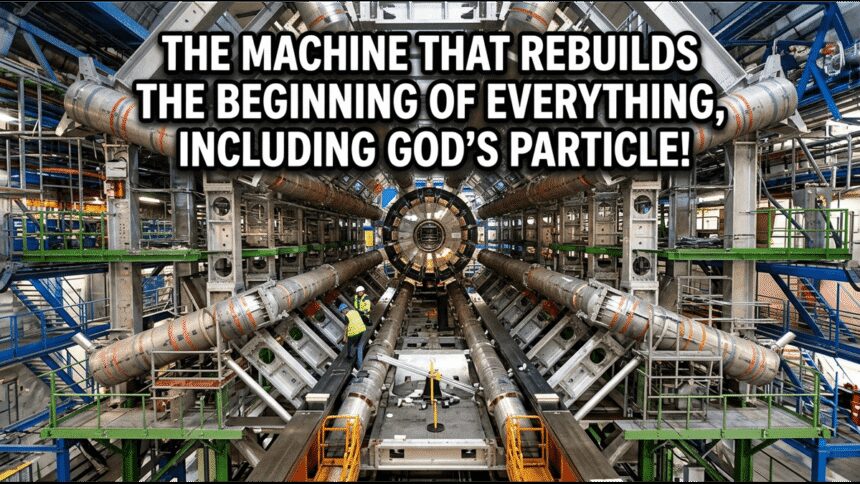
How a 27-kilometre ring under the Swiss-French border learned to recreate the first moment of the universe — and why it is going dark this week, for the first time in years.
Location: Geneva, Switzerland / France border
Founded: 29 September 1954
Ring length: 27 km
Status: Long Shutdown 3 begins 29 June 2026
LAT 46.2333° N · LON 6.0500° E · DEPTH −100 M · OBJECT CLASS: PARTICLE ACCELERATOR
Log 01 / The Dream That Started After a War
A Continent Looks for a Quiet Piece of Ground
Picture a small room in Paris, not long after the Second World War. Europe’s best physicists have scattered — many now work in American laboratories, because their own countries cannot afford the machines modern physics needs.
Quantum physicist Louis de Broglie stands up at a conference and says something simple: no single country in Europe can build what is needed alone. So why not build it together? Over the next two years, scientists quietly travel the continent looking for the right patch of earth — rock that doesn’t shake, a site reachable by train, and above all, neutral land that no army would ever be tempted to fight over.

They settle on farmland straddling the border between France and Switzerland, just outside Geneva. On 29 September 1954, eleven governments sign the paper that gives the new laboratory its name — the European Organization for Nuclear Research, known by its old French initials: CERN.
Log 02 / The Big Idea
Why Smash Tiny Things Together at All?
Scientists cannot travel back in time to the birth of the universe, so instead they bring a tiny piece of the Big Bang into the lab.
Take something as ordinary as a tank of hydrogen gas, strip away its electrons, accelerate the bare protons left behind to nearly the speed of light, then smash two of them together. In a space smaller than an atom, you recreate conditions that have not existed since the universe was less than a billionth of a second old.
Energy and matter are two sides of the same coin. Squeeze enough energy into one tiny point, and it condenses into brand-new matter — the same way water vapour condenses into raindrops.

That single idea — Einstein’s E = mc² — is the entire engine behind everything CERN does. Speed becomes energy. Energy, concentrated enough, becomes matter. And whatever new matter appears in that instant tells scientists something true about how the universe is built.
Log 03 / The Size of the Thing
Just How Big Is CERN, Really?
Most people picture CERN as one building. It is actually a small underground city — a 27-kilometre buried ring, four detector caverns the size of cathedrals, and a surface campus spread across two countries.
ATLAS — a seven-storey camera
At one collision point sits ATLAS, a detector roughly 46 metres long and 25 metres tall — about the height of a seven-storey building, built entirely underground. Its job: photograph the debris of a proton collision in every direction at once, thousands of times a second.

CMS — the compact giant
A few kilometres away sits CMS, the Compact Muon Solenoid. “Compact” is relative — it weighs about 14,000 tonnes, heavier than the Eiffel Tower, built around a magnet far stronger than a hospital MRI machine. ATLAS and CMS are deliberately built differently from each other, so that if one spots something new, the other can check whether it’s real.

100 mDepth underground
46 mLength of ATLAS
14,000 tWeight of CMS
2Countries it spans
Above ground, the campus looks almost ordinary — office blocks, a data centre, assembly halls, and the Globe of Science and Innovation, a wooden dome visitors can walk into. The drama is all underground, in tunnels most of the 17,000 people who work here will never personally see in full.
Log 04 / The Hunt for the Right Metal
Magnets That Should Not Exist
To make protons travel in a circle at 99.9999991% of the speed of light, you cannot just push them — you have to bend their path using magnetic fields stronger than almost anything else on Earth. That meant CERN’s engineers had to go hunting across the planet for one rare, stubborn metal: niobium.
A normal magnet is the kind stuck to your fridge. A CERN magnet stretches 15 metres, weighs 35 tonnes, and must be cooled to −271.3°C — colder than outer space — using liquid helium flowing through the ring.
Where the raw materials actually came from
- Niobium — mined mostly in Brazil and Canada, refined in the United States and Germany into hair-thin superconducting filaments.
- Titanium — sourced from Australia, South Africa and the United States, alloyed with niobium to make wire that carries current with zero resistance.
- Liquid helium — drawn from natural-gas fields in the United States, Qatar and Algeria, used to chill the entire 27-km ring colder than outer space.
- Non-magnetic steel — forged in Japan and Europe, strong enough to hold magnets together under crushing internal stress without distorting their own fields.
Once the raw metal arrived, three industrial giants — Ansaldo Energia in Italy, Alstom in France, and Babcock Noell in Germany — split the job of winding 1,232 superconducting magnets, each a 15-metre blue cylinder. Lay them end to end, and they would circle the ring twice over.
Log 05 / The Global Engineering Army
The Olympics of Engineering
No single company built CERN. It was assembled like a relay race across continents:
| Country | Contribution |
|---|---|
| France | Magnet construction |
| Germany | Core components & superconducting wire |
| Italy | Magnet winding & system assembly |
| Japan | Precision sensors & steel |
| USA | Advanced magnet technology |
| Switzerland | Hosting & operations |
Every nation contributed a piece, and the pieces only made sense once welded into one ring spanning more than 110 countries’ worth of collaboration today.
Log 06 / What the Machine Actually Does
Four Simple Steps Inside the Ring

1. Strip the protons bare
Technicians take an ordinary bottle of hydrogen gas and use an electric field to strip away its electrons, leaving only bare protons — the smallest possible passengers for the journey ahead.
2. Send them through the warm-up rings
A chain of three smaller accelerators — nicknamed the Booster, the PS and the SPS — kick the protons faster and faster, the way a series of swings might push a child a little higher each time.
3. Let them loose in the big ring
Once the protons are moving at 99.9% of light-speed, they are injected into the main 27-km tunnel, split into two beams travelling in opposite directions.
4. Smash them together
At four points around the ring, magnets squeeze the beams until they collide head-on — up to one billion times every second. For a fraction of an instant, the conditions of the early universe reappear, right there underground.
27 kmRing circumference
1.9 KMagnet temperature
1 billionCollisions per second
110+Countries involved
Log 07 / Seventy Years of Answers
What ATLAS and CMS Actually Found
The most famous discovery came in 2012, when ATLAS and CMS together confirmed something physicists had only guessed at for fifty years: the Higgs boson — nicknamed the “God’s particle” — the particle tied to the invisible field that gives all matter its mass.
No massparticles would stay massless
No atomsmatter could not hold together
No starsgravity would have nothing to clump
No humansnone of this would exist
The surprises did not stop there. Scientists trapped antimatter atoms long enough to study them. They recreated a liquid, primordial state of matter that last existed microseconds after the Big Bang. They found more than seventy entirely new composite particles never described in textbooks — including, just before this current shutdown, the final missing member of a particle family physicists had hunted for over sixty years.
Log 08 / What CERN Quietly Gave the World
Spillovers You’ve Probably Touched
Almost by accident, the laboratory changed daily life for everyone, everywhere. A CERN scientist named Tim Berners-Lee built a simple way for physicists to share documents over a network in 1989 — and gave it away for free. Today we call it the World Wide Web.
- World Wide Web Tim Berners-Lee, 1989
- PET scanners Built from antimatter-detection sensors
- Touchscreens Invented at CERN in the 1970s
- Proton-beam cancer therapy Spares healthy tissue
- Cargo-scanning machines Compact accelerator designs
Why this story, right now
The machine is switching off — on purpose, and it matters
On 29 June 2026, the Large Hadron Collider goes quiet for the first time in years. This is not a breakdown — it is a planned pause called Long Shutdown 3, and the timing makes this a genuine hinge point rather than routine maintenance news.
Two honest reasons explain why now:
- The old magnets are wearing out. Years of radiation near the collision points have pushed the inner magnets close to their physical limit. Running them further risks real failure.
- A bigger machine is waiting to be born. Engineers will replace 1.2 kilometres of the ring with new niobium-tin magnets, multiplying collisions roughly tenfold — turning the LHC into the High-Luminosity LHC.
The restart is planned for June 2030. What gets found — or ruled out — in the data collected just before this shutdown, and in the machine that wakes up after it, will shape what physicists know about dark matter and the universe’s missing pieces for a full generation.
Log 09 / The Rebuild Timeline
Four Years, Step by Step
Machine operations stop — Long Shutdown 3 begins
Tunnel and infrastructure work
New niobium-tin magnets installed
Cryogenic testing of new hardware
First beams return as the High-Luminosity LHC
Note: published CERN schedules can shift as the upgrade progresses — treat these as planning-stage dates rather than fixed commitments.
✦
CERN is a circle. Inside it, protons race in endless laps, searching for clues about the beginning of time itself. Many faiths see existence in a similar way — birth, death, and rebirth; endings that become beginnings. Perhaps that is the deeper symbolism of CERN.
CERN · Founded 1954 · Restarting June 2030