



International
oi-Prakash KL

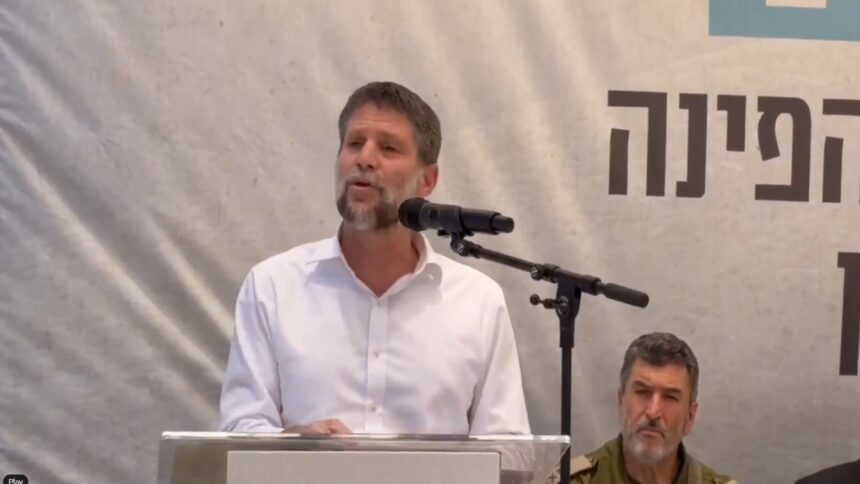
Israeli Finance Minister Bezalel Smotrich on Tuesday announced the he had “cancelled” the 1997 Hebron Accords signed by Israel and the Palestinian Authority. The move removes several powers previously held by Palestinian authorities in Hebron, including control over urban planning and construction.
“I have annulled the Hebron Agreements,” said Smotrich, a prominent figure in the hardline wing of Benjamin Netanyahu’s government. He declared that authority over Hebron and its holy sites – including the Tomb of the Patriarchs – would no longer rest with what he called “the terrorist municipality of Hebron.”
Israeli Finance Minister Bezalel Smotrich canceled the 1997 Hebron Accords, returning administrative powers over Hebron and holy sites like the Tomb of the Patriarchs to Israel. This move revokes Palestinian authority over urban planning and construction previously established by the 1997 protocol.

“These powers now return fully to the State of Israel,” he wrote on social media, describing the decision as “a historic correction” that goes beyond planning matters. He framed it as part of a wider effort to regulate settlements, strengthen governance, and entrench Israeli sovereignty in Judea and Samaria, the biblical term for the West Bank.
Smotrich argued that settlements in the area form Israel’s “security belt,” adding that “anyone looking from Hebron towards the coastal plains understands that Judea and Samaria are not a remote periphery.”
What Is The Hebron Accords?
The Hebron Accords, formally known as the Hebron Protocol (or “Protocol Concerning the Redeployment in Hebron”), is a 1997 Israeli-Palestinian agreement that implemented a partial Israeli military withdrawal from the West Bank city of Hebron, dividing it into two sectors with separate security control.
The protocol was signed on January 15, 1997, in Jerusalem by retired Israeli General Dan Shomron, representing Prime Minister Benjamin Netanyahu, and PLO negotiator Saeb Erekat, representing PLO Chairman Yasser Arafat. It served as a follow-up to the Oslo II Accord (the 1995 Israeli-Palestinian Interim Agreement), which had outlined a phased withdrawal of Israeli forces from Palestinian territories but had not yet covered Hebron, the only major West Bank city still under full Israeli military control.
The core of the agreement divided Hebron into two distinct areas: Area H-1, covering approximately 80% of the city (about 18 square kilometers), was transferred to Palestinian control under the Palestinian Authority, while Area H-2, the remaining 20% of the city, remained under Israeli military control. Area H-2 includes around 20,000 Palestinians and the Al-Ibrahimi Mosque (Cave of the Patriarchs), and was kept under Israeli authority to ensure the security of approximately 400-500 Jewish settlers living in five small settlement clusters within the city.
The protocol established detailed guidelines for the redeployment of Israeli military forces, including the transfer of the Imara building (the former Israeli municipal headquarters) to the Palestinian side as the headquarters of the Palestinian Police in Hebron upon completion of the redeployment.
Both sides reaffirmed their commitment to the unity of Hebron, stating that the division of security responsibility would not divide the city politically. The agreement outlined security measures, civilian affairs management, and provisions for freedom of movement, including Palestinian authority over bus stops, traffic arrangements, and traffic signalization in the city, with any subsequent changes in Area H-2 requiring cooperation between both sides through a transportation sub-committee.
Municipal services were guaranteed to be provided regularly and continuously to all parts of Hebron at the same quality and cost, ensuring that the division of security control would not affect basic services. The protocol also included security cooperation mechanisms to protect Jewish settlers while maintaining Palestinian civilian control in H-1.
The agreement was approved democratically on both sides: the Knesset approved it by a vote of 87 for and 17 against the day before signing, and the Palestinian Authority and PLO Executive Committee approved it the previous day. However, the protocol has been criticized as a “watered-down” implementation of Israel’s prior commitments, as the Palestinian Authority was forced in exchange to accept Israel’s retreat from other prior agreements and place the size and timing of further redeployments at Israel’s discretion.
The Hebron Protocol remains a critical but now-defunct component of the Oslo peace process, representing one of the most difficult and sensitive implementations of Israeli-Palestinian security division due to Hebron’s unique religious significance, mixed population, and intense conflict history.