


India
oi-Swastika Sruti

With political wrangling ongoing regarding the Election Commission and the Special Intensive Revision (SIR) of the electoral roll, 42 former judges have sent an emphatic open letter to defend constitutional bodies and warning against accusations which, according to them, lack factual basis.

42 former judges defended India’s Election Commission and the Special Intensive Revision (SIR) of electoral rolls against unsubstantiated accusations, urging that criticism should not denigrate institutions and that objections must use legal channels to maintain democratic trust.
The former judges were disturbed about a deliberate move against the Election Commission, the judiciary and other statutory authorities.
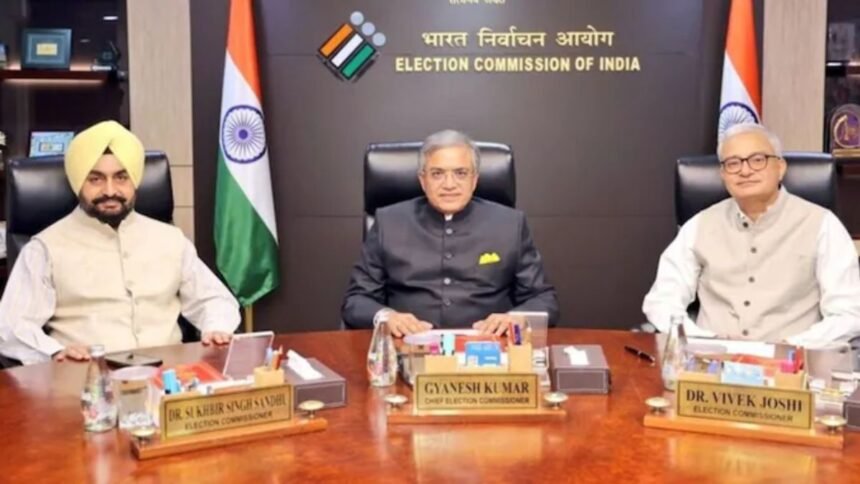
This is amidst protests against Chief Election Commissioner Gyanesh Kumar and the SIR process by opposition political parties who claim there are malpractices in the electoral roll revision process.
‘Criticism Is A Democratic Right, Denigration Is Not’
The former judges said political parties and citizens have the right to question constitutional institutions, but argued that criticism should not turn into attacks that damage public confidence.
42 former judges write an open letter and warn against attempts to undermine Election Commission. https://t.co/2nwEuTXIdF
— Press Trust of India (@PTI_News) October 8, 2026
“Criticism of institutions is a democratic right. Denigration is not,” the letter said.
The signatories also questioned the repeated use of terms such as “vote theft”, “thieves” and “compromised” for constitutional authorities.
“We write because, in moments like these, silence is no longer a neutral choice. Our concern is grave. India’s constitutional bodies are under sustained attack,” the letter said.
The former judges specifically mentioned the Election Commission, the higher judiciary and statutory agencies, saying these institutions should not be undermined without evidence being placed before the appropriate legal forums.
Former Judges Question ‘Vote Theft’ Allegations
The letter raised the question as to why such charges of electoral malpractice on a grand scale were being made in the open air without, in the opinion of the signatories, any proof of the same through judicial processes.
The retired judges observed that “charges of vote theft” were being raised in press statements rather than in courts and raised doubts as to the constant accusations against Electronic Voting Machines post-election defeats.
They also alluded to what they called an inconsistency in challenging the system of elections only when you lose the election and accept victories gained through the same system.
The retired judges appealed to political parties to raise their objections to the decisions with which they disagreed through legitimate judicial and constitutional channels.
‘Trust Is The Currency Of Democracy’
The signatories argued that elections depend not only on voting but also on public confidence in the institutions conducting them.
“Trust is the currency of democracy,” the letter said.
They warned that repeated efforts to portray constitutional institutions as illegitimate could have wider consequences for democratic stability.
The letter also stated that when confidence in the ballot weakens, political disputes could increasingly move from institutional and legal forums to the streets.
“When the ballot loses meaning, the street gains it,” the former judges warned.
They further wrote that “unrest begins with a narrative”, cautioning that a vacuum created by declining institutional trust could be exploited by fringe or anarchic elements.
Former Judges Defend The SIR Exercise
The former judges also defended the Special Intensive Revision of electoral rolls.
They described SIR as a legally established exercise aimed at maintaining clean and accurate voter lists.
The SIR process has, however, become a major political controversy. Opposition parties and several civil society groups have raised concerns about the deletion of voters’ names and the procedure used to verify electors.
The Election Commission has maintained that electoral-roll revision is necessary to ensure accurate voter lists and has also announced measures to identify and enrol eligible voters who may have been left out.
42 Judges Include Former Supreme Court Judges
The signatories include former Supreme Court judges, former Chief Justices of High Courts and other retired judicial figures.
Among those named as signatories are former Supreme Court judges Justice Hemant Gupta and Justice Pankaj Mittal.
Their intervention comes at a time when the Election Commission has become the centre of an intense political dispute over SIR and the functioning of CEC Gyanesh Kumar.
Justice Rohinton Nariman Raises A Different Concern
The letter comes days after former Supreme Court judge Justice Rohinton Fali Nariman publicly raised serious concerns over the functioning of the Election Commission.
Speaking against the backdrop of the SIR controversy, Nariman said the “right to vote” was at “great peril” and called for the Supreme Court to intervene.
“You can’t have an Election Commission which functions or malfunctions like this,” Nariman said.
He also referred to claims concerning the deletion of around 90 lakh voters in West Bengal during the SIR exercise and questioned whether the Supreme Court had responded strongly enough to the issue.
Nariman’s comments represent a contrasting view from the concerns raised by the 42 former judges, highlighting the wider debate over the Election Commission’s functioning and the SIR process.
Justice Ujjal Bhuyan Also Raises Voting Rights Concern
Justice Ujjal Bhuyan has also spoken about the impact of voter-list revisions on citizens’ voting rights.
He said that any process that removes the voting rights of a large number of citizens would amount to “a negation of the constitutional order”, while stressing that no authority should be able to do so without legal justification.
These comments have added another dimension to the ongoing debate over SIR and electoral-roll revisions.
SIR Debate Continues Amid Political Protests
The open letter from the 42 former judges comes as Opposition parties continue their protests demanding accountability from the Election Commission and calling for CEC Gyanesh Kumar’s resignation.
At the same time, the Election Commission has defended the SIR process and pointed to mechanisms through which eligible voters can seek inclusion or correction in electoral rolls.
The dispute therefore involves two competing concerns: the need to maintain accurate electoral rolls and the need to ensure that eligible citizens are not wrongly excluded.