



India
oi-Oneindia Staff

After the session ended, most parents left quickly – slippers scraping the floor, bags slung over shoulders, rushed goodbyes at the door.
Asha didn’t. (Name changed.)
Asha shifted from prioritizing chores to making time to sit with her son and engage in simple learning activities, overcoming self-doubt about her ability to teach and prioritizing his need for attention.
She stood near the edge of the room, not quite stepping forward, as if she wasn’t sure she had earned the right to take up space. She waited until the room thinned out – until it felt safer to speak without being overheard.

Then she came up quietly and said, almost apologetically,
“I thought teaching was for people who studied.”
She paused, like she was waiting to be corrected.
“I didn’t want to say something wrong,” she added.
“So I stayed quiet.”
At home, learning belonged elsewhere – inside schools, inside books she
never touched. In Asha’s house, there was routine. There was care. But
there wasn’t much conversation.
As she spoke, a picture formed on its own.
Earlier, when her son asked questions, Asha would keep working.
The rice needed washing. The stove needed watching.
And his questions – the small “why” and “how many” questions – floated for a moment, then fell back into the room, unanswered.
Not because she didn’t love him.
Not because she didn’t care.
Because the day was full – and somewhere along the way she had decided: I’m not the kind of mother who can teach.
Then Asha said something that stayed with me.
“Now I try,” she said. “Even if I don’t know.”
I asked her what “trying” looked like – not in a session, not in theory, but at home.
She smiled a little, like the question surprised her.
“In the evening,” she said, “I sit.”
She didn’t say I teach.
She didn’t say I’m confident now.
She said: I sit.
Because in her house, sitting down isn’t a small thing. It means the work is still waiting – but the child is not waiting alone.
Asha told me it isn’t perfect. Some evenings she still gets pulled back into routine. Some days she still doubts herself. But something has shifted in how the room feels.
And then she described a moment I could see clearly.
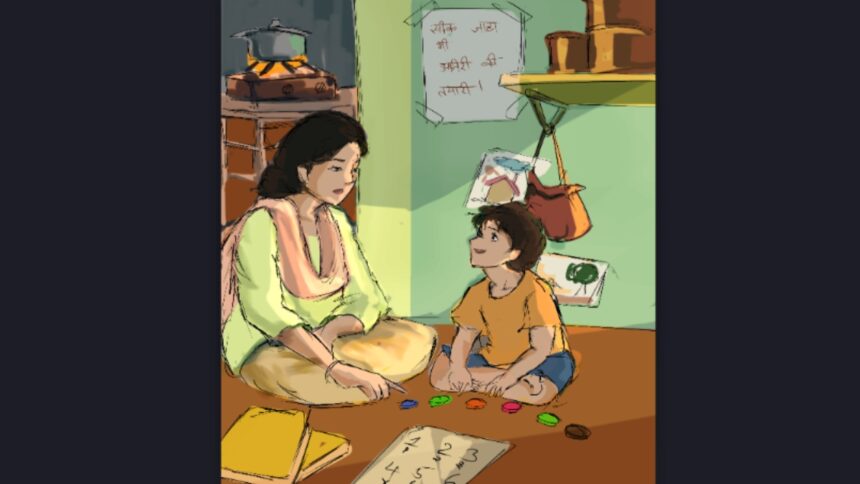
It’s evening. The floor is cool. The day’s noise has softened, though the day’s work hasn’t disappeared.
Her son sits in front of her, lining up bottle caps like they matter.
He looks up at Asha, waiting – not for the right answer, just for
attention.
“Mumma… kitne?” he asks.
Asha looks at him. Not at the stove. Not at the rice.
“Ek… do… teen…” she counts, slowly.
Then she asks him back.
“Aur do aa jaayein… toh kitne honge?”
The child pauses. Thinks. Smiles.
Asha stays there on the floor with him.
It isn’t perfect.
But it’s different.
(Shraddha Thopate works with the Gyan Prakash Foundation in Pune)