


India
pti-Swastika Sruti

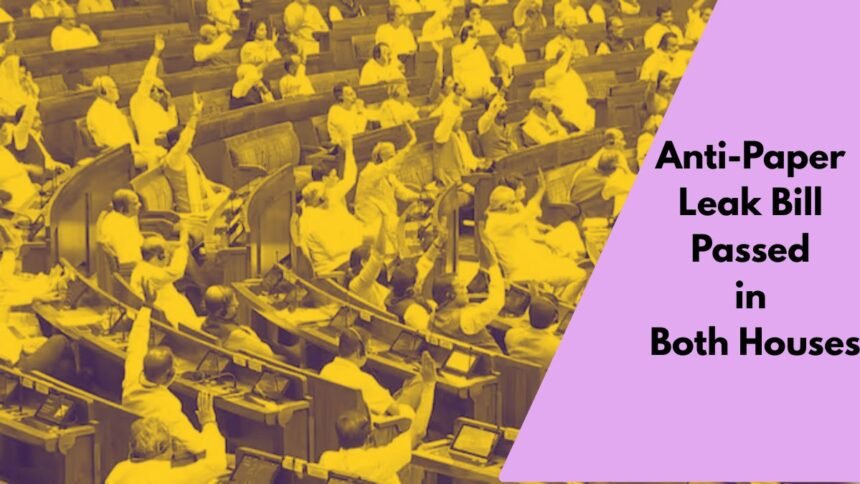
The Rajya Sabha after a day long debate has passed the Public Examinations (Prevention of Unfair Means) Amendment Bill, 2026, on Thursday. The bill is commonly referred to as the anti-paper leak bill, has cleared both Houses of Parliament.

The Rajya Sabha passed the Public Examinations (Prevention of Unfair Means) Amendment Bill, 2026, also known as the anti-paper leak bill, on Thursday, following its approval in the Lok Sabha and ahead of President Droupadi Murmu’s assent.
The Upper House passed the legislation, a day after it was passed in Lok Sabha. The bill will now be sent to President Droupadi Murmu for her assent before it becomes law.
Bill Passed Amid Opposition Walkout
In the time leading up to the passing of the bill, there were heated debates in the Rajya Sabha, initiated by Congress, which resulted in an exit from the legislative body prior to voting on the bill.
Earlier in the day, the Minister of State in the Ministry of Personnel, Public Grievances and Pensions, Mr. Jitendra Singh, presented the bill in the Upper House. The bill was presented as another attempt at safeguarding the students and making sure that the examinations are held in a fair manner.
The Public Examinations (Prevention of Unfair Means) Amendment Bill, 2026, has been passed in the Rajya Sabha. pic.twitter.com/UsXfOrKD5U
— ANI (@ANI) July 30, 2026
The Opposition had raised several issues about the conduct of the government regarding recent examination leaks, such as the NEET paper leak.
Opposition Questions Government Over Student Protests
In the discussion going on in the Rajya Sabha, Leader of the Opposition, Mallikarjun Kharge, lashed out against the government, questioning the silence of Prime Minister Narendra Modi and Home Minister Amit Shah regarding the incidents of violence that occurred at the student agitation.
The Lok Sabha passed the Public Examinations (Prevention of Unfair Means) Amendment Bill, 2026 to further strengthen the legal framework to prevent unfair means in public examinations and safeguard the interests of students and youth.
Read more: https://t.co/F3iiQQQmhq… pic.twitter.com/mwuoanUbdG
— Ministry of Information and Broadcasting (@MIB_India) July 30, 2026
Kharge had also made certain statements about the Manusmriti which were subsequently removed from the records after the objections of the Leader of the House, JP Nadda.
Government Defends the Legislation
JP Nadda reacted to the walkout of the Opposition and said that the government had provided enough time to each and every member to air their opinions during the eight-hour long discussion.
He further said that the Opposition decided to walk out instead of hearing the reply of the minister and said that this indicated that they were not interested in discussion. He also accused the Opposition of being disrespectful towards the parliamentary process.