


India
oi-Prakash KL

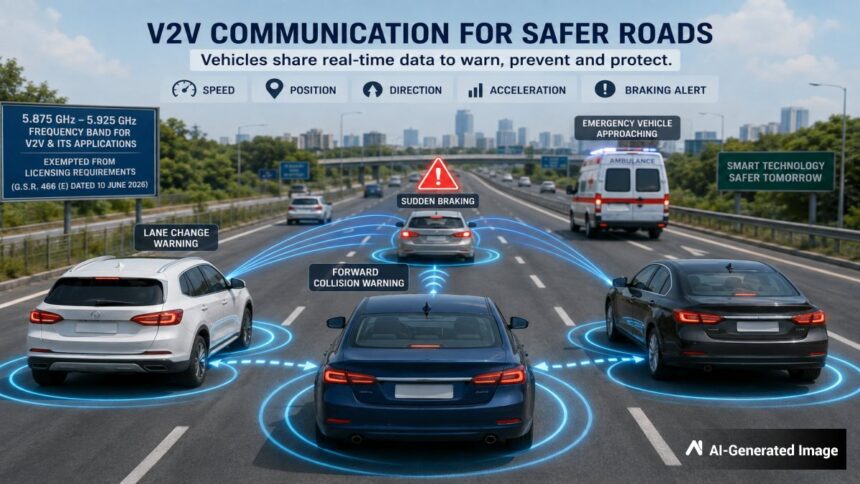
Imagine you’re driving a highway, and several cars ahead, someone slams on their brakes. You can’t see it yet, maybe a truck is blocking your view. But your car knows. Before you even see those brake lights, your dashboard flashes a warning: “Sudden braking ahead.”
The Ministry of Road Transport and Highways has proposed a plan that could make this kind of vehicle-to-vehicle (V2V) communication mandatory in new cars within the next couple of years.
India’s Ministry of Road Transport and Highways proposes mandatory vehicle-to-vehicle (V2V) communication using the 5.875-5.925 GHz band, requiring compliance from October 2028 for vehicle categories L, M, and N to enable real-time safety warnings.

The Centre has said that the 5.875 GHz to 5.925 GHz frequency band has been considered for V2V and other Intelligent Transportation System applications, a statement from the ministry noted.
At its core, vehicle-to-vehicle (V2V) enables nearby vehicles to exchange real-time information, including their speed, position, direction, acceleration, etc. The Ministry says, “This information can provide advance warnings to drivers or vehicle systems in safety-critical situations, including sudden braking, forward-collision risk, unsafe lane changes and the approach of emergency vehicles.”
The notification from the Centre explains: “Unlike conventional vehicle-safety systems, which primarily depend on onboard sensors and driver reaction, V2V communication can provide information beyond the direct line of sight. It is therefore expected to complement Advanced Driver Assistance Systems (ADAS) and support proactive accident prevention, connected mobility and future intelligent transport applications.”

The Timeline: When Will This Actually Happen?
The Ministry has laid out a phased roadmap. Vehicles in categories L, M and N manufactured on or after October 1, 2027, will be required to comply with AIS-230 if they are fitted with V2V communication systems. From October 1, 2028, vehicles in these categories will be required to be fitted with V2V communication systems conforming to AIS-230.
This gives adequate time for vehicle manufacturers and other stakeholders to prepare for the implementation of the new requirements.

How the Tech Actually Works
The communication happens through something called C-V2X-Cellular Vehicle-to-Everything. Think of it as a dedicated chat channel for cars, operating in a specific frequency band (5.875 GHz to 5.925 GHz) that the Department of Telecommunications recently exempted from licensing requirements.
The standard covers factory-installed communication units that continuously broadcast your car’s status to nearby vehicles. When another car receives that data, its systems can instantly assess whether there’s a safety risk.