

By using this site, you agree to the Privacy Policy and Terms of Use.
Accept
Next India Magazine
  • Home
    • Home 2
    • Home 3Hot
    • Home 4
    • Home 5New
  • Home
  • Opinion

    That Provide Critical Analysis on Political Decision-Making

    krutikadalvibiz@gmail.com

    Analyzing Global Dynamics and Unraveling Key Policy Initiatives

    krutikadalvibiz@gmail.com

    Luxurious Stays Redefining Hospitality at Hotel Havens

    krutikadalvibiz@gmail.com

    Electric Cars Subsidies by German Taxpayers End Up on Foreign Roads

    krutikadalvibiz@gmail.com

    Challenge and Inspire Future of Political Thought

    krutikadalvibiz@gmail.com

    Assessing the Diplomatic Challenges and Global Security

    krutikadalvibiz@gmail.com
  • World
  • Politics
  • Market
  • Health
  • Insurance
  • Pages
    • Blog Index
    • Contact US
    • Search Page
    • 404 Page
    • Technology
    • World
  • Pages
    • Blog Index
    • Search Page
    • 404 Page
  • Technology
    TechnologyShow More
    Dr. Nishant Sawant: The Mind Behind Secure Digital Progress
    4 Min Read
    NASA’s Artemis II Mission Rekindles Humanity’s Dream of Deep Space Exploration
    5 Min Read
    Buying a Car Will Soon be Like Buying a Phone, Why Your Next Car Could be an EV
    Hands-On With the iPhone 13, Pro, Max, and Mini
    4 Min Read
    Explained: What are Smart Glasses and How Do It Work?
    4 Min Read
  • Posts
    • Post Layouts
      • Standard 1
      • Standard 2
      • Standard 3
      • Standard 4
      • Standard 5
      • Standard 6
      • Standard 7
      • No Featured
    • Gallery Layouts
      • Layout 1
      • Layout 2
      • layout 3
    • Video Layouts
      • Layout 1
      • Layout 2
      • Layout 3
      • Layout 4
    • Audio Layouts
      • Layout 1
      • Layout 2
    • Post Sidebar
      • Right Sidebar
      • Left Sidebar
    • Review
      • Stars
      • Scores
      • User Rating
    • Content Features
      • Highlight Shares
      • Inline Mailchimp
      • Print Post
      • Inline Related
      • Source/Via Tag
      • Reading Indicator
      • Content Size Resizer
    • Table of Contents
      • Full Width
      • Left Side
    • Sponsored Post
  • Contact
  • Pages
    • Search Page
    • 404 Page
Reading: V2V Communication Explained: How Cars Share Data To Improve Road Safety
SUBSCRIBE
Next India MagazineNext India Magazine
Font ResizerAa
  • My Saves
  • Economics
  • Technology
  • My Interests
  • World
  • My Feed
  • History
  • Business
  • Technology
  • Lifestyle
  • Fashion
  • Health
  • Technology
  • World
Search
  • Pages
    • Blog Index
    • Contact Us
    • Search Page
    • 404 Page
  • Home
    • Home 1
    • Home 2
    • Home 3
    • Home 4
    • Home 5
  • Home
  • Blog
  • Categories
    • Technology
    • Lifestyle
  • Personalized
    • My Feed
    • My Saves
    • My Interests
    • History
  • Demos
  • Categories
    • Technology
    • Business
    • Fashion
    • Economics
  • Bookmarks
  • Categories
    • Technology
    • Health
    • World
  • More Foxiz
    • Blog Index
    • Sitemap
  • Bookmarks
  • Contact
  • More Foxiz
    • Sitemap
Have an existing account? Sign In
Follow US
  • Home
  • World
  • Contact
  • Blog
© Foxiz News Network. Ruby Design Company. All Rights Reserved.
World

V2V Communication Explained: How Cars Share Data To Improve Road Safety

India Times Now
Last updated: August 7, 2026 9:25 am
India Times Now
3 Min Read
Share
SHARE

India

oi-Prakash KL

Time
Published: Friday, August 7, 2026, 14:35 [IST]

Imagine you’re driving a highway, and several cars ahead, someone slams on their brakes. You can’t see it yet, maybe a truck is blocking your view. But your car knows. Before you even see those brake lights, your dashboard flashes a warning: “Sudden braking ahead.”

The Ministry of Road Transport and Highways has proposed a plan that could make this kind of vehicle-to-vehicle (V2V) communication mandatory in new cars within the next couple of years.

India’s Ministry of Road Transport and Highways proposes mandatory vehicle-to-vehicle (V2V) communication using the 5.875-5.925 GHz band, requiring compliance from October 2028 for vehicle categories L, M, and N to enable real-time safety warnings.

V2V Communication Explained How Cars Share Data To Improve Road Safety

The Centre has said that the 5.875 GHz to 5.925 GHz frequency band has been considered for V2V and other Intelligent Transportation System applications, a statement from the ministry noted.

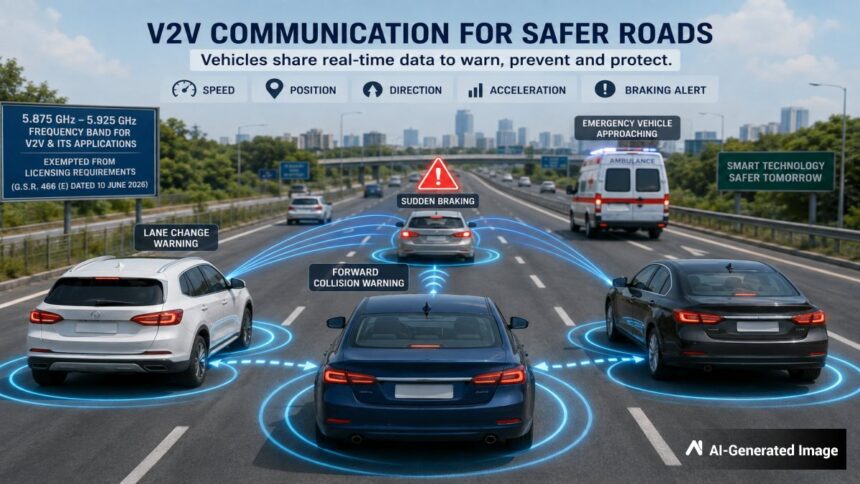
At its core, vehicle-to-vehicle (V2V) enables nearby vehicles to exchange real-time information, including their speed, position, direction, acceleration, etc. The Ministry says, “This information can provide advance warnings to drivers or vehicle systems in safety-critical situations, including sudden braking, forward-collision risk, unsafe lane changes and the approach of emergency vehicles.”

The notification from the Centre explains: “Unlike conventional vehicle-safety systems, which primarily depend on onboard sensors and driver reaction, V2V communication can provide information beyond the direct line of sight. It is therefore expected to complement Advanced Driver Assistance Systems (ADAS) and support proactive accident prevention, connected mobility and future intelligent transport applications.”

How Does V2V Work How Connected Cars Can Detect Hidden Road Dangers

The Timeline: When Will This Actually Happen?

The Ministry has laid out a phased roadmap. Vehicles in categories L, M and N manufactured on or after October 1, 2027, will be required to comply with AIS-230 if they are fitted with V2V communication systems. From October 1, 2028, vehicles in these categories will be required to be fitted with V2V communication systems conforming to AIS-230.

This gives adequate time for vehicle manufacturers and other stakeholders to prepare for the implementation of the new requirements.

How V2V Technology Works How Cars Can Warn Each Other About Road Hazards

How the Tech Actually Works

The communication happens through something called C-V2X-Cellular Vehicle-to-Everything. Think of it as a dedicated chat channel for cars, operating in a specific frequency band (5.875 GHz to 5.925 GHz) that the Department of Telecommunications recently exempted from licensing requirements.

The standard covers factory-installed communication units that continuously broadcast your car’s status to nearby vehicles. When another car receives that data, its systems can instantly assess whether there’s a safety risk.


TAGGED:CarsCommunicationDataExplainedImproveRoadSafetyShareV2V
Share This Article
Facebook Email Copy Link Print
Previous Article Karnataka legislative council chairman Basavaraj Horatti resigns, says ‘don’t know why Congress asked me to leave’
Next Article DC movie review: Lokesh Kanagaraj might debut as a hero, but Anirudh Ravichander steals the show
Leave a Comment Leave a Comment

Leave a Reply Cancel reply

Your email address will not be published. Required fields are marked *

You Might Also Like

World

PM Modi Says Congress Has Inherited ‘This Politics From The British’ On Delimitation Row

India oi-Ashish Rana Published: Saturday, April 18, 2026, 21:24 Turning…

3 Min Read
World

MP Road Accident: 9 Killed As Van Swept Away In Overflowing Drain In Rajgarh

India oi-Gaurav Sharma Published: Monday, August 10, 2026, 16:54 In…

1 Min Read
World

‘PM Modi Is Forcibly Imposing Ethanol on Indians To Please US President Trump’: Arvind Kejriwal

India oi-Oneindia Staff Published: Saturday, August 1, 2026, 19:35 Aam…

8 Min Read
World

Tripura DGP Anurag Dhankar Found Dead At Police Headquarters; Suicide Suspected

India oi-Swastika Sruti Published: Monday, July 20, 2026, 15:12 In…

3 Min Read
Next India MagazineNext India Magazine
Follow US
© 2026 Next India Magazine powered by India Times Now. All Rights Reserved.
Welcome Back!

Sign in to your account

Username or Email Address
Password

Lost your password?