



India
oi-Prakash KL

For nearly four decades, India’s strategic missile arsenal has belonged to a single institutional universe: the Defence Research and Developmental Organisation (DRDO) laboratories. These laboratories have been feeding designs into their own universe of public sector manufacturers such as Bharat Dynamics Limited (BDL). That universe is now cracking open.
DRDO’s decision to invite private Indian firms as development-cum-production partners for its strategic systems, potentially including future Agni variants and submarine-launched weapons, is not a bureaucratic footnote, though to some, it may appear so. It is one of the more consequential shifts in Indian defence policy in years, and it deserves to be read on its own terms rather than folded into the general “Make in India” narrative.
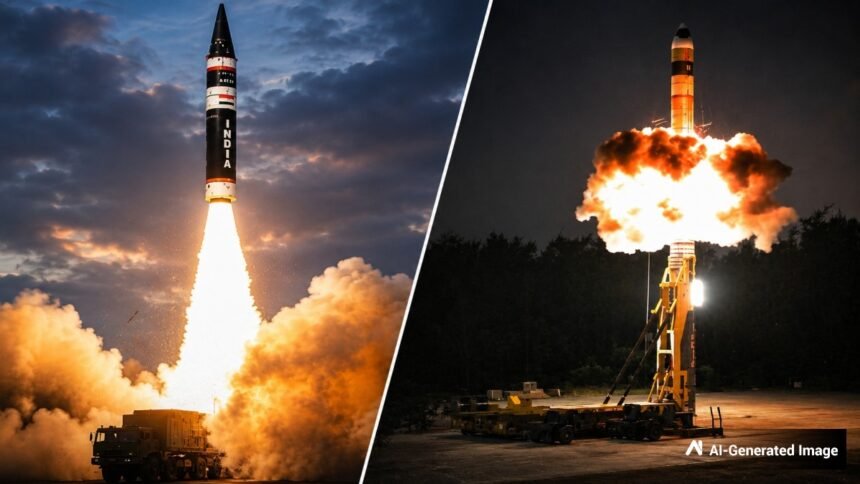
India’s DRDO is involving private firms like Tata Advanced Systems in strategic missile development and production, moving beyond BDL due to capacity limits, necessitating strict security vetting and oversight for systems like potential Agni variants.

The proximate driver is capacity, not ideology. BDL, for all its institutional weight, is stretched thin. Export orders (Indonesia’s interest in the Astra missile is the most cited example), rising domestic requirements from a three-service missile force planned across short, medium and long ranges, and the sheer breadth of DRDO’s pipeline have outgrown what a handful of public sector units can produce at scale.
The government has already tested this model with the AMCA fighter programme, bringing in private consortiums alongside HAL. Extending it to strategic missiles is the logical, if far more sensitive, next step.
The Case for Opening Up
There is a genuine argument here, and it should not be dismissed as industrial lobbying dressed up as policy. India’s strategic missile programme has long carried the familiar ailments of monopoly production: long timelines, capacity bottlenecks, and little incentive for cost or process innovation. Companies like Tata Advanced Systems and Solar Industries already build sophisticated subsystems, propellants and aerostructures for both DRDO and export markets. They are not novices being handed the keys to the kingdom.
Under a development-cum-production partner model, where at least two private firms compete for each project and prototypes are tested before any production order is placed, DRDO retains the control over the design and doctrine seat while the manufacturing load is spread more widely. Done well, this could compress timelines on programmes like Agni-VI and free up BDL’s capacity for the steady-state production India already needs.
There is a quieter strategic logic too. Production capacity distributed across multiple firms and sites is, in a crude sense, harder to disrupt than production concentrated on a few public sector campuses, a consideration that only grows as India’s adversaries sharpen their own precision-strike capabilities.
A Pause of Caution
None of this changes the fact that the Agni-series missiles are nuclear-capable strategic systems, and India’s nuclear command and control has always rested on a small, tightly controlled circle of custodians precisely because that narrowness is the point. Widening the industrial base for these systems raises three questions that deserve more public scrutiny than they have so far received.
The first is classification and vetting. Bringing private firms into co-development of nuclear-associated systems means sensitive design data, propellant formulations, guidance algorithms and re-entry technology will sit inside corporate IT systems and workforces that DRDO does not directly control. India’s record on defence-related information security is uneven, and the scale of this shift is not trivial. This is not outsourcing a radar sub-assembly. It touches the credibility of the deterrent itself.
The second is accountability under the nuclear command structure. Production of missiles is not the same as control over them, and nothing here suggests warheads or command authority move outside the tightly controlled framework of the Strategic Forces Command. But the line between assembling delivery systems and gaining visibility into India’s deterrent capability is not always crisp in practice, and India will need explicit, publicly stated firewalls, not merely assumed ones, around where private sector involvement stops.
The third is industrial concentration dressed up as diversification. If, as reporting suggests, a short list of large conglomerates ends up as the perennial frontrunner for every major tender, India will simply have swapped a public sector oligopoly for a private one, without the innovation dividend the policy is meant to deliver. Genuine diversification means deliberately drawing mid-sized firms and MSME suppliers into the ecosystem, not formalising primacy for two or three national champions.
A Comparison Between Distinct Systems
India is not inventing this model from scratch. The United States has relied on prime contractors like Lockheed Martin and Northrop Grumman for its strategic missile systems for decades, under a dense web of security clearances, facility clearances and government oversight bodies built specifically for that purpose. If India is serious about this shift, the institutional scaffolding must be built with the same seriousness as the industrial policy itself. That means robust vetting regimes, classified-facility standards and a dedicated oversight authority distinct from ordinary defence procurement. Ideally, these should be established ahead of the policy rather than alongside it.
This policy shift amounts to a bet: that India’s strategic deterrent will be more credible, not less, if backed by a broader and more competitive production base, and that the country’s private defence sector has matured enough to be trusted with a role once reserved for the state. That bet may well pay off. India’s private defence manufacturers have earned real credibility over the past decade. But the payoff depends entirely on the quality of the guardrails that accompany it.
A strategic missile programme is not the place to discover institutional gaps after the fact. If the security architecture around vetting, information control and command separation is built with the same ambition as the industrial policy, this could strengthen India’s deterrent in real terms. If it is an afterthought, India will have traded a slow but tightly controlled system for a faster one carrying new and less understood vulnerabilities.
About the author:
Group Captain Anupam Banerjee is a decorated Indian Air Force combat pilot with three decades of experience flying various MiG fighter variants. He took part in the Kargil conflict and later became the spokesperson for the Indian Air Force. Following his retirement, he served in the Society of Indian Defence Manufacturers (SIDM) and HENSOLDT India.