



India
oi-Prakash KL

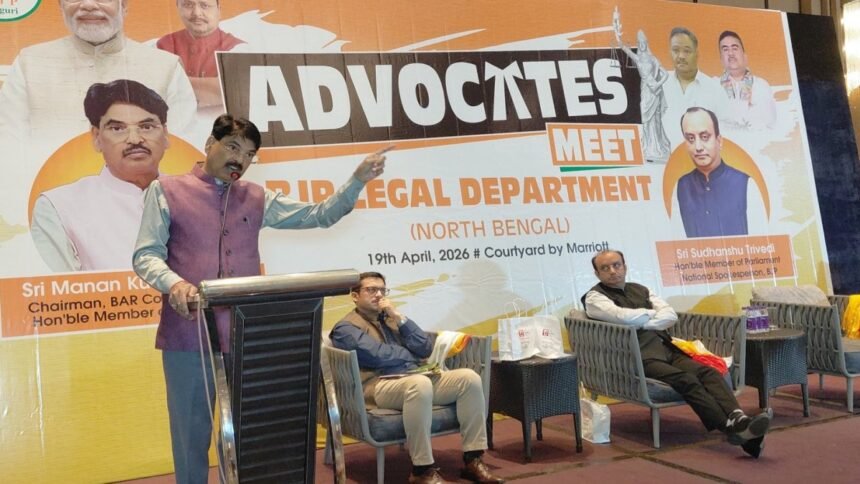
The Supreme Court’s latest remarks on Manan Kumar Mishra have once again put the spotlight on one of the most powerful figures in India’s legal establishment.
Mishra is not only the long-serving chairman of the Bar Council of India (BCI), the country’s apex statutory body regulating the legal profession, but is also a BJP Rajya Sabha MP from Bihar.
The Supreme Court ruled Manan Kumar Mishra’s position as BCI chairman is temporary until a new council is elected, requiring AG/SG consultation for policy decisions, amidst scrutiny over his long tenure and political stances.

On Wednesday, the Supreme Court made it clear that Mishra’s continuation as BCI chairman is only “pro tem” (meaning temporary), until a freshly constituted Bar Council of India elects its office-bearers, according to a report in PTI.
A bench headed by Chief Justice Surya Kant also said that the BCI should consult the Attorney General for India and the Solicitor General before taking policy decisions during this transitional period.
The court stressed that its concern was not the conduct of any individual, but the institutional functioning and integrity of the BCI.
So, who exactly is Manan Kumar Mishra, and why has his role at the BCI become controversial?
A long innings at the Bar Council of India
Manan Kumar Mishra is a senior lawyer from Bihar and has been associated with the BCI for several years. He was first elected BCI chairman in 2012. He briefly stepped down in 2014, but returned as chairman in November that year and has remained at the helm since then, apart from that short break.
He secured his seventh term as chairman in early 2025.
The BCI is not an ordinary lawyers’ association. It is a statutory body created under the Advocates Act, 1961. Among other responsibilities, it lays down standards for legal education, recognises law degrees and oversees the regulation of advocates through the State Bar Councils.
That gives the BCI chairman considerable influence over the legal profession.
Why is his tenure before the Supreme Court?
The immediate legal controversy concerns the length of Mishra’s tenure.
A petition filed by advocate Yogamaya M G has challenged his continuation as BCI chairman and the April 21, 2025 Gazette notification extending his tenure up to 2030.
The petition argues that BCI rules prescribe a two-year term for the chairman and vice-chairman, or until they cease to be members, whichever comes earlier.
But in April 2025, the BCI passed a resolution extending the chairman and vice-chairman’s tenure from three years to five years. Mishra was then unanimously elected chairman for the period from April 17, 2025 to April 16, 2030.
The petitioners have argued that the provision intended to prevent an administrative vacuum cannot be used to avoid elections and keep existing office-bearers in power.=
The NALSAR controversy
Mishra came under renewed criticism in August 2026 after the BCI issued a circular concerning graduates of NALSAR University of Law, Hyderabad.
The August 13 circular directed State Bar Councils not to enrol the university’s 2026 graduates as advocates.
The order followed a campaign by around 450 NALSAR students against the university’s decision to invite Chief Justice Surya Kant to its convocation. The students had reportedly objected to remarks made by the CJI during a July 2026 Supreme Court hearing concerning alleged police excesses against protesters in Delhi.
The BCI order triggered strong criticism from students, academics, lawyers and civil society groups, who questioned the decision to penalise an entire graduating batch.
The BCI subsequently withdrew the order, acknowledging that most students were not responsible for the issue. Mishra also offered a conditional apology to the students if his words or letters had caused hurt.
The controversy did not end there.
BCI Co-Chairman Y R Sadasiva Reddy later sought Mishra’s resignation, raising several allegations, including claims concerning the management of Council funds, the functioning of a private trust and appointments involving family members. These are allegations made by Reddy and are not findings of a court.
Why his political statements have drawn criticism
Mishra’s critics have also questioned his use of the BCI’s official platform to comment on political developments, protests and judicial matters.
One such instance came during the protests against the Citizenship Amendment Act in 2019, according to a report in The Print.
Mishra signed a BCI letter expressing solidarity with the police and armed forces and appealed to Bar leaders and young students to help diffuse disturbances and violence.
Some lawyers subsequently objected to the use of the BCI platform, arguing that individual office-bearers could express personal opinions but should not present those views as representing the Bar as a whole.
His political interventions continued.
In 2022, after the BJP won four state Assembly elections, Mishra issued a statement as BCI chairman congratulating Prime Minister Narendra Modi and Union Home Minister Amit Shah and praising their leadership, the report noted.
In January 2024, he also wrote to then Chief Justice D Y Chandrachud requesting a holiday for courts on January 22 to allow members of the legal fraternity and court staff to participate in or observe events linked to the Ram Mandir consecration ceremony in Ayodhya. The request was not approved.
His stand on marriage equality
In April 2023, the BCI passed a resolution asking the Supreme Court not to decide the marriage equality petitions and instead leave the issue to Parliament.
The resolution said the Bar was the “mouthpiece of the common men” and expressed concern over what it described as a highly sensitive issue.
The position was in line with the stand taken by the government before the Supreme Court at the time.
Clash with Prashant Bhushan
Mishra has also publicly taken on prominent lawyers.
In 2022, he criticised senior advocate Prashant Bhushan after Bhushan questioned the Supreme Court’s record on civil liberties and basic rights.
Mishra described Bhushan’s remarks in strongly worded terms and warned lawyers against crossing what he called the “Laxman Rekha”.
He also asserted that the Bar Councils had the authority to act against lawyers for conduct and etiquette issues, even when the Supreme Court might hesitate to initiate contempt proceedings.
A similar public exchange took place with senior advocate Dushyant Dave.
After Dave criticised the judiciary and alleged that successive Chief Justices had compromised cases under the Modi government, Mishra issued a detailed response from the BCI platform defending the Supreme Court and arguing that the judiciary had often asserted its independence from the executive.
From lawyer to politician
Mishra’s influence extends beyond the legal profession.
In August 2024, he was elected unopposed to the Rajya Sabha from Bihar as a BJP candidate in a by-election.
That means Mishra now occupies two prominent positions – he is the long-serving head of India’s apex statutory body for lawyers and a member of Parliament representing the BJP.
This combination has also contributed to scrutiny over how he uses the BCI’s institutional platform.
What the Supreme Court said this time
The latest Supreme Court hearing is significant because the bench carefully separated the individual from the institution.
The court said it was not influenced by allegations against Mishra and was not examining the conduct of any individual. Its focus, it said, was the institutional functioning of the BCI.
At the same time, the bench said it was not putting its stamp of approval on the existing arrangement, PTI reported.
The court indicated that Mishra could continue only until a fresh BCI is constituted following elections to the State Bar Councils.
Until then, routine administrative functioning can continue. But for policy decisions, the court said participation of the Attorney General as a permanent ex-officio member was necessary, and the Solicitor General would also have to be consulted.
The matter will be heard again on September 23.