

By using this site, you agree to the Privacy Policy and Terms of Use.
Accept
Next India Magazine
  • Home
    • Home 2
    • Home 3Hot
    • Home 4
    • Home 5New
  • Home
  • Opinion

    That Provide Critical Analysis on Political Decision-Making

    krutikadalvibiz@gmail.com

    Analyzing Global Dynamics and Unraveling Key Policy Initiatives

    krutikadalvibiz@gmail.com

    Luxurious Stays Redefining Hospitality at Hotel Havens

    krutikadalvibiz@gmail.com

    Electric Cars Subsidies by German Taxpayers End Up on Foreign Roads

    krutikadalvibiz@gmail.com

    Challenge and Inspire Future of Political Thought

    krutikadalvibiz@gmail.com

    Assessing the Diplomatic Challenges and Global Security

    krutikadalvibiz@gmail.com
  • World
  • Politics
  • Market
  • Health
  • Insurance
  • Pages
    • Blog Index
    • Contact US
    • Search Page
    • 404 Page
    • Technology
    • World
  • Pages
    • Blog Index
    • Search Page
    • 404 Page
  • Technology
    TechnologyShow More
    Ramya Sudha Vinukonda: A Biology Teacher Turning Government School Classrooms into Spaces of Possibility
    6 Min Read
    Dr. Nishant Sawant: The Mind Behind Secure Digital Progress
    4 Min Read
    NASA’s Artemis II Mission Rekindles Humanity’s Dream of Deep Space Exploration
    5 Min Read
    Buying a Car Will Soon be Like Buying a Phone, Why Your Next Car Could be an EV
    Hands-On With the iPhone 13, Pro, Max, and Mini
    4 Min Read
  • Posts
    • Post Layouts
      • Standard 1
      • Standard 2
      • Standard 3
      • Standard 4
      • Standard 5
      • Standard 6
      • Standard 7
      • No Featured
    • Gallery Layouts
      • Layout 1
      • Layout 2
      • layout 3
    • Video Layouts
      • Layout 1
      • Layout 2
      • Layout 3
      • Layout 4
    • Audio Layouts
      • Layout 1
      • Layout 2
    • Post Sidebar
      • Right Sidebar
      • Left Sidebar
    • Review
      • Stars
      • Scores
      • User Rating
    • Content Features
      • Highlight Shares
      • Inline Mailchimp
      • Print Post
      • Inline Related
      • Source/Via Tag
      • Reading Indicator
      • Content Size Resizer
    • Table of Contents
      • Full Width
      • Left Side
    • Sponsored Post
  • Contact
  • Pages
    • Search Page
    • 404 Page
Reading: Roundabout | Mentor-disciple tradition lights path of Urdu poetry
SUBSCRIBE
Next India MagazineNext India Magazine
Font ResizerAa
  • My Saves
  • Economics
  • Technology
  • My Interests
  • World
  • My Feed
  • History
  • Business
  • Technology
  • Lifestyle
  • Fashion
  • Health
  • Technology
  • World
Search
  • Pages
    • Blog Index
    • Contact Us
    • Search Page
    • 404 Page
  • Home
    • Home 1
    • Home 2
    • Home 3
    • Home 4
    • Home 5
  • Home
  • Blog
  • Categories
    • Technology
    • Lifestyle
  • Personalized
    • My Feed
    • My Saves
    • My Interests
    • History
  • Demos
  • Categories
    • Technology
    • Business
    • Fashion
    • Economics
  • Bookmarks
  • Categories
    • Technology
    • Health
    • World
  • More Foxiz
    • Blog Index
    • Sitemap
  • Bookmarks
  • Contact
  • More Foxiz
    • Sitemap
Have an existing account? Sign In
Follow US
  • Home
  • World
  • Contact
  • Blog
© Foxiz News Network. Ruby Design Company. All Rights Reserved.
BusinessLifestyleStartup

Roundabout | Mentor-disciple tradition lights path of Urdu poetry

India Times Now
Last updated: September 12, 2026 3:14 pm
India Times Now
6 Min Read
Share
SHARE

India has had an age-old tradition of passing knowledge, skills and spirituality from the teacher to the disciple. This practice has always had a very special place in the creative arts, ranging from music, dance, painting and sculpture to, more particularly, poetry, which traditionally calls for rhyme and rhythm. It was in this context that the Haryana Sahitya Akademi in Panchkula organised a seminar to explore this tradition in Urdu poetry. Titled ‘Ustad-Shagird Parampara’ in Urdu poetry, it delved into the history of the giver and the taker, which continues to this day in both formal and informal ways.
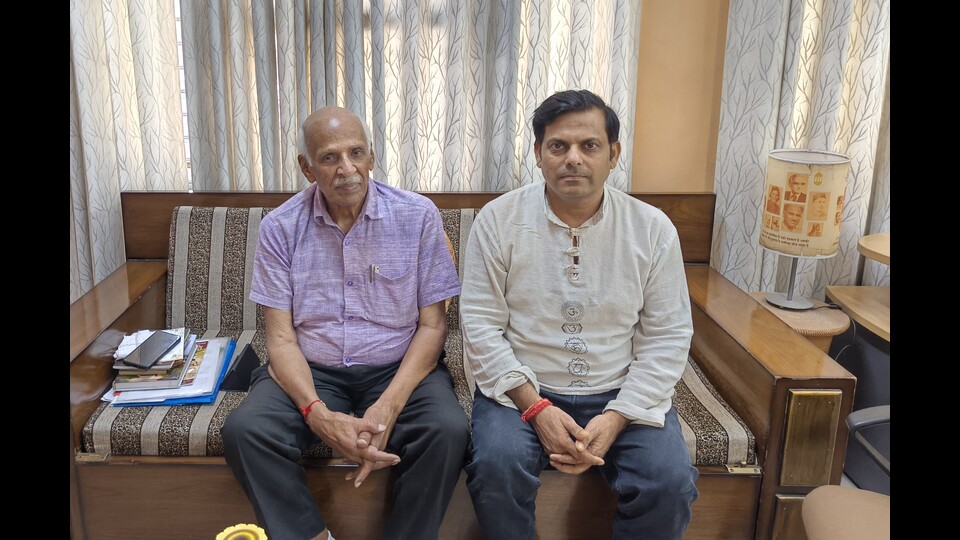
Littérateurs Chander Trikha and Jatinder Parvaaz at the Haryana Sahitya Akademi in Panchkula to pay tribute to legendary Urdu poets Mirza Ghalib and Mohammad Ibrahim Zauq. (Sourced)

Held under the guidance of the senior members of the Akademi, Professor Kuldip Chand Agnihotri and Dr Chander Thrikha, the seminar was conducted by Jatinder Parvaaz, an Urdu poet who heads the literary segments. In this context, what comes to mind is a masterly couplet by the famous Urdu poet Daagh Dehlavi, who spoke of the beauty and finesse of the Urdu language thus: ‘Nahi khel ai ‘Daagh’, yaaron se keh do ki aati hai Urdu zaban aate aate’. Here is a translation of the couplet, honouring the essence of the language born on Indian soil: “Oh Daagh, tell your friends that it is no child’s play; the Urdu language is mastered only over time.” One would like to add to this: not without a mentor!

Speaking on the occasion, Dr Chander Trikha, director of the Akademi, said this ancient practice was a valuable way of connecting one generation to the next. On the occasion, Parvaaz was honoured at the seminar with the ‘Dr Vipul Smriti Samman’. The seminar was presided over by Prof Kuldip Chand Agnihotri.

Ancient tradition that flourishes still

Interestingly, in recent years, the tricity has seen the emergence of a chain of schools with the title ‘Gurukul’, a tradition that dates back to 5000 BC. Gurukul was an integral part of ancient Indian civilisation. Interestingly, the tradition required students to go and live in the teacher’s home, serve him and return home only after they had attained mastery in their chosen field. One could well call them the strict boarding schools of yore.

However, our award-winning poet, Parvaaz, who mentors many in the complexities and strict metres of the Urdu ghazal, says, “A ghazal can’t do without the essentials of ‘Misra’ (a two-line couplet), Matla (the opening couplet sharing the same refrain) and Makta (the last couplet, which often includes the poet’s name). But now that the old tradition of mentors is waning, technology is entering and wannabe ghazal writers are learning online.” Of course, that can never be the same as the old order. That is perhaps the reason why many are turning to the convenience of free verse at the cost of ‘bahr’ (rhythm) and qaafiya (rhyme).

The word ‘bahr’ brings back to my mind a fond memory of our dear poet Surjit Patar, who was a Punjabi ghazal writer of merit. The older and more orthodox Sikh ghazal writers once chided him for some fault in the bahr of his couplet, and his reply was another couplet: ‘Asan te khoon vich dubo ke kalam sada likhi hai ghazal, Oh hore honege likhde ne jeharhe behr andar’! (We have always dipped the pen in our blood to write a ghazal; others must be writing it in rhythm.) Thus, experiments go on even in the strictest of orders.

Back to the golden era of the ‘ustads’

The 18th and 19th centuries are considered the golden period of Urdu poetry, when the language, earlier known as Rekhta or Hindavi, flourished, ironically, as the Mughal Empire had begun to decay. This was also the time of the Delhi school, with greats like Mirza Ghalib and Mohammad Ibrahim Zauq, who was the ustad of the last Mughal king, Bahadur Shah Zafar.

Zauq can never be forgotten for the love he had for his city, despite better conditions elsewhere, saying, “Zauq kahan jayie Dilli ki galian chod kar” (Where can Zauq go, leaving the streets of Delhi?). The golden era of poetry in Delhi was in the 18th and 19th centuries. While there were minor rivalries among the poets, the head of one would bow when a rival penned good poetry. The ustad was, of course, supreme, and even the feisty Ghalib, who would often boast of being ‘be-ustad’ (sans mentor), although he never had formal training, did learn the finesse of poetry from Mulla Adussamad, a renowned Iranian scholar.

One ends with a couplet by Ghalib Mian that honours the talent that preceded him and salutes the great tradition of giving: ‘Rekhta ke tumhi ustad nahi ho Ghalib, kehate hain agle zamane mein koi Mir bhi tha!’ The salute was to the famous poet Mir Taqi Mir, who predated Ghalib.

nirudutt@gmail.com
Share This Article
Facebook Email Copy Link Print
Previous Article PM Modi Hosts Xi Jinping In Delhi After 7 Years For Talks On India-China Ties, Trade And Investment
Leave a Comment Leave a Comment

Leave a Reply Cancel reply

Your email address will not be published. Required fields are marked *

You Might Also Like

BusinessLifestyleStartup

Lord’s 150th Test hit by major controversy after 35 wickets fall in 3 days: ‘Shocker, substandard pitch’

Thirty-five wickets in three days. England all out for 140.…

4 Min Read
BusinessLifestyleStartup

Nihang in 60s, worked as ‘sewadar’: What we know about Sukhbir Singh Badal’s attacker

Shiromani Akali Dal (SAD) president Sukhbir Singh Badal was attacked…

3 Min Read
BusinessLifestyleStartup

Kanjika Recipe for a Fermented Rice Water Drink from Odisha that Supports Digestion and Natural Gut Health

A slightly tangy, naturally fermented drink can bring a refreshing…

5 Min Read
BusinessLifestyleStartup

Faridabad tax officer, driver held in ₹4 L truck clearance bribe case

A Haryana government excise and taxation officer (ETO) and his…

2 Min Read
Next India MagazineNext India Magazine
Follow US
© 2026 Next India Magazine powered by India Times Now. All Rights Reserved.
Welcome Back!

Sign in to your account

Username or Email Address
Password

Lost your password?