


India
oi-Swastika Sruti

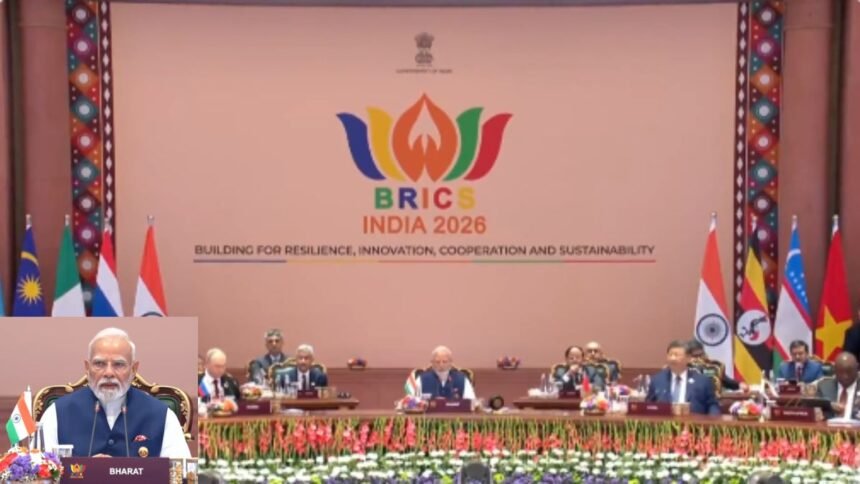
At the closing ceremony of the 18th BRICS summit in New Delhi, the Prime Minister of India, Narendra Modi, articulated India’s dream about a BRICS that will be able to work not only for itself but also for the entire Global South.

At the closing of the 18th BRICS summit, PM Modi highlighted India’s vision for BRICS to benefit the Global South, emphasizing resilience, innovation, cooperation, and sustainability. India introduced initiatives like an Early Warning System and Urban Mobility Hub, before handing over the chairmanship to China for the 2027 summit.
While addressing the gathering on Sunday, PM Modi said that there was growing confidence about BRICS from the developing nations since their concerns are getting attention in the group. He added that India had tried hard to make BRICS into an inclusive growth and innovation space.
As India’s term as the BRICS chairman ends, PM Modi will now transfer his leadership role to President of China, Xi Jinping, who will become the next BRICS chairman and will also host the 19th BRICS summit in 2027.
Sharing opening remarks during BRICS Session on ‘Resilience, Innovation, Cooperation and Sustainability: Shaping the Future for Inclusive Global Growth.’
https://t.co/xwKGoGfBjc— Narendra Modi (@narendramodi) September 13, 2026
Modi Calls for BRICS Solutions to Reach Global South
Modi said India’s approach during its presidency was aimed at ensuring that the benefits of BRICS initiatives do not remain restricted to member countries.
He stressed that solutions developed through BRICS should be made adaptable and accessible to the needs of countries across the Global South.
According to Modi, this wider approach has helped increase the confidence of developing countries in the grouping, as their concerns and priorities are receiving greater attention.
Four Pillars of India’s BRICS Presidency
According to Modi, the efforts made by India in its tenure as the president were centered on four key aspects, namely resilience, innovation, cooperation and sustainability.
These aspects, according to him, were translated into areas of cooperation through other member nations’ help.
The Prime Minister also cautioned about the rising use of technology and mineral resources as geopolitical weapons, which might impact the overall progress economically. It was important to ensure that technology is used inclusively.
BRICS Plans Early Warning System
One of the major areas highlighted by Modi was the effort to strengthen BRICS’ ability to respond to future crises.
He said the grouping has focused on building resilience against challenges such as pandemics, climate-related disasters and disruptions to global supply chains.
BRICS countries have agreed to work on an Integrated Early Warning System aimed at helping identify and respond to infectious disease threats at an early stage.
India also helped prepare Early Warning Data Integration Guidelines for disaster management, according to Modi.
The Prime Minister said the BRICS Logistics Supply Chain Cooperation Framework would further help make supply chains more reliable and resilient.
New Urban Mobility Platform for BRICS Cities
India also used its BRICS presidency to promote cooperation between cities.
Modi announced the establishment of a BRICS Urban Mobility Hub, which will allow cities in member countries to exchange experiences and share best practices in urban transport and mobility.
The initiative is aimed at helping cities learn from each other as they deal with growing populations, traffic congestion and the need for more efficient transport systems.
Focus on MSMEs, Skills and Women’s Workforce Participation
Modi said India also sought to ensure that BRICS cooperation extended beyond governments.
Through BRICS Connect, the grouping has promoted areas such as skills, employability, women’s participation in the workforce, social security and capacity building.
A BRICS MSME Cooperation Portal has also been launched to help small businesses connect with knowledge, financing opportunities and new markets.
The initiative is particularly significant for developing economies, where small and medium-sized enterprises play an important role in employment and economic activity.
BRICS Digital Centre of Excellence
Sustainability was another major focus of India’s BRICS presidency.
Modi said India had promoted initiatives that seek to balance economic and human development with environmental protection.
A BRICS Digital Centre of Excellence for Smart Grids and Energy Storage has been established to support more reliable and efficient clean-energy systems.
The Prime Minister also highlighted proposed Centres of Excellence focused on agro-ecology and regenerative agriculture. These initiatives seek to combine traditional knowledge with modern scientific methods.
India has also promoted principles for community-based climate adaptation, with an emphasis on using indigenous knowledge in climate action.
Modi-Xi Meeting Signals Effort to Rebuild Ties
The BRICS Summit also provided an important setting for a meeting between Modi and Chinese President Xi Jinping. The two leaders met on the sidelines of the summit as India and China seek to stabilise relations damaged by the 2020 military clash along the Himalayan border.
The meeting was particularly significant as Xi was visiting India for the first time in seven years.
Both sides discussed strengthening economic and transport links, while the border issue remained an important part of the broader relationship.
BRICS Declaration Raises West Asia Concerns
The summit also produced the New Delhi Declaration, which was adopted by BRICS leaders on Saturday.
The declaration expressed deep concern over the continuing escalation of tensions in West Asia and called for maximum restraint. Leaders also stressed the importance of dialogue, consultation and diplomacy in resolving international disputes.
The statement reflected the diverse positions within BRICS, which includes countries with different relationships with the major powers involved in global conflicts.
The grouping also raised concerns over unilateral tariff and non-tariff measures that can distort international trade.
India Hands BRICS Chair to China
With the conclusion of India’s BRICS presidency, China will take over the chairmanship and host the next summit in 2027.
India’s presidency focused heavily on expanding practical cooperation in areas such as health security, disaster preparedness, logistics, urban mobility, clean energy, agriculture and support for small businesses.
Modi’s closing remarks presented BRICS as a grouping that India wants to see play a wider role in supporting developing countries.
The transition to China’s chairmanship will now put the focus on how Beijing builds on these initiatives and shapes the BRICS agenda ahead of the 19th summit.