


India
oi-Madhuri Adnal

The Union Finance Ministry on Wednesday clarified that no foreign influence was behind the decision to introduce Merchant Discount Rate (MDR) on select UPI transactions, rejecting claims that the new charges were imposed under pressure from foreign payment companies or countries.
The clarification comes days before the new UPI MDR framework takes effect on October 15, under which a 0.4% charge will apply to specified Person-to-Merchant (P2M) transactions above ₹2,000. The ministry said the move is aimed at creating a self-sustaining UPI ecosystem and supporting investments in infrastructure, cybersecurity, innovation and merchant services.
The Union Finance Ministry clarified that the new Merchant Discount Rate (MDR) on specific UPI Person-to-Merchant (P2M) transactions over ₹2,000, effective October 15, aims to sustain the UPI ecosystem, not due to foreign influence. Person-to-Person transactions and payments under ₹2,000 remain free, with varied MDR structures for different sectors and merchants, affecting few consumers.

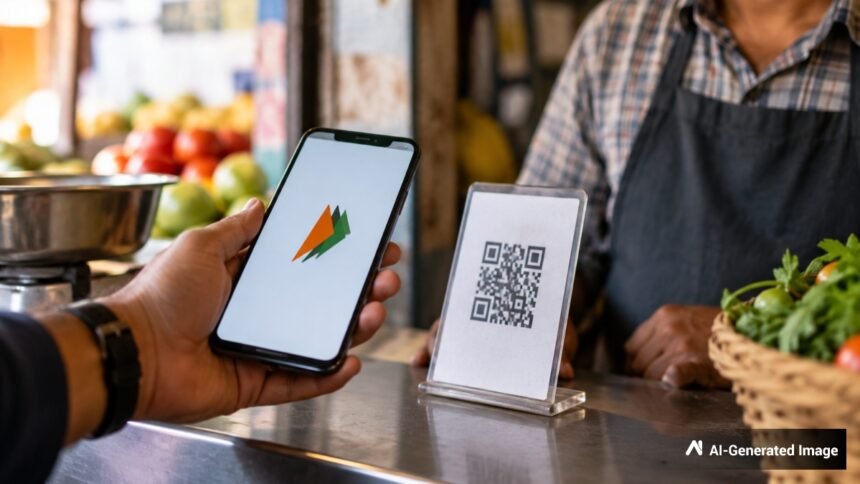
Importantly, the new MDR will not make UPI a paid service for ordinary consumers. Person-to-Person (P2P) transactions will remain free, while merchant payments up to ₹2,000 will continue without MDR.
The framework also does not impose the same rate across all merchants and transactions.
Small merchants covered under the P2PM category and receiving up to ₹1 lakh per month through UPI QR codes will continue to enjoy zero MDR. This means a payment above ₹2,000 does not automatically result in an MDR charge for every small vendor.
For specified sectors including railways, fuel, telecom, insurance and utility payments, a flat MDR of ₹5 will apply to transactions above ₹2,000. Capital market transactions, including mutual funds and securities, will attract a separate MDR of 0.02%, capped at ₹300.
🔰 UPI Remains Free for Consumers
UPI continues to be free for customers. Sending money to friends, paying at shops, or scanning a QR code — all remain without charges.
Key Facts:
✅ No charges on P2P: Person-to-Person transfers are always free, regardless of amount.
✅ Small… pic.twitter.com/PyQ7hotNMN— Ministry of Finance (@FinMinIndia) September 16, 2026
For other eligible P2M transactions, the MDR will be 0.4% above ₹2,000, with a maximum cap of ₹300 for transactions of ₹75,000 and above.
The ministry has also made clear that merchants cannot pass the MDR on to customers. UPI applications will not be permitted to impose a separate platform fee on consumers either.
The decision comes as UPI continues to operate at an unprecedented scale. UPI processed around 24.5 billion transactions worth nearly ₹30 lakh crore in August 2026 alone, highlighting the infrastructure and security requirements involved in running the payment network at such scale.
According to the framework, MDR revenue will be used within the UPI ecosystem to support infrastructure resilience, cybersecurity, fraud prevention, innovation and customer service. A dedicated fund is also proposed to support merchant onboarding and digital payment infrastructure in Tier III to Tier VI centres, including rural areas, the Northeast, Jammu and Kashmir and Ladakh.
The government has said the new commercial model is intended to reduce dependence on annual government incentives and create a more predictable funding mechanism for the payment ecosystem.
With more than 95% of merchant UPI transactions valued below ₹2,000, the government maintains that the vast majority of everyday digital payments will remain unaffected.
The new framework, therefore, does not introduce a blanket charge on UPI. Instead, it creates different MDR structures based on transaction value, merchant classification and sector, while keeping UPI payments free for consumers.